Fun stuff happens, even when you don't plan it, so be excited!
Author: Adventures of Dan and Lisa
When the boat broke down the nice lady from England exclaimed "oh goody, an adventure!" That changed the possible problem into a great story and improved attitudes. It has become the motto for our travels. We hope you enjoy the stories as much as we enjoyed the adventure.
We landed in Auckland and spent a few days gathering our wits, getting a car, and acclimating to the time changes. Immediately we were reminded how wonderful and charming the people here are. We stopped at the iSite (the tourist information center) to discuss our local rental car options. We both had the inkling we may have spoken to the woman helping us before. When Dan asked how long she’d been with the iSite because we had visited the old location on a previous trip, she replied “at the Sky Tower? Did I help you get a car rental there? It seems like I did.” We all agreed it was the case!
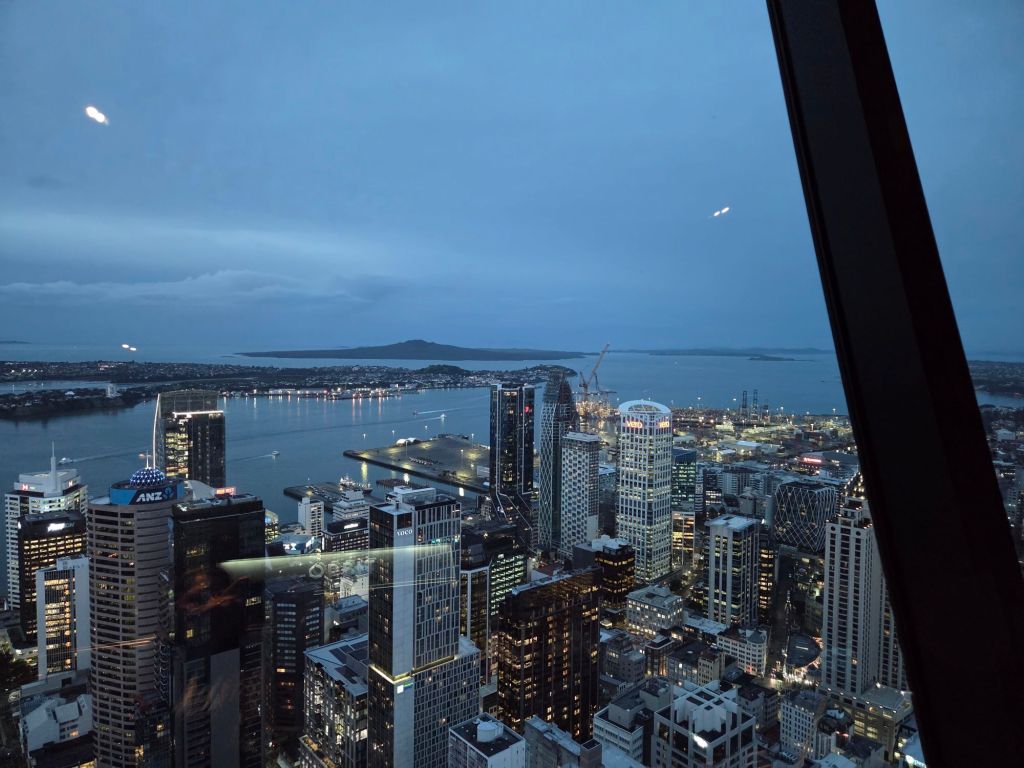
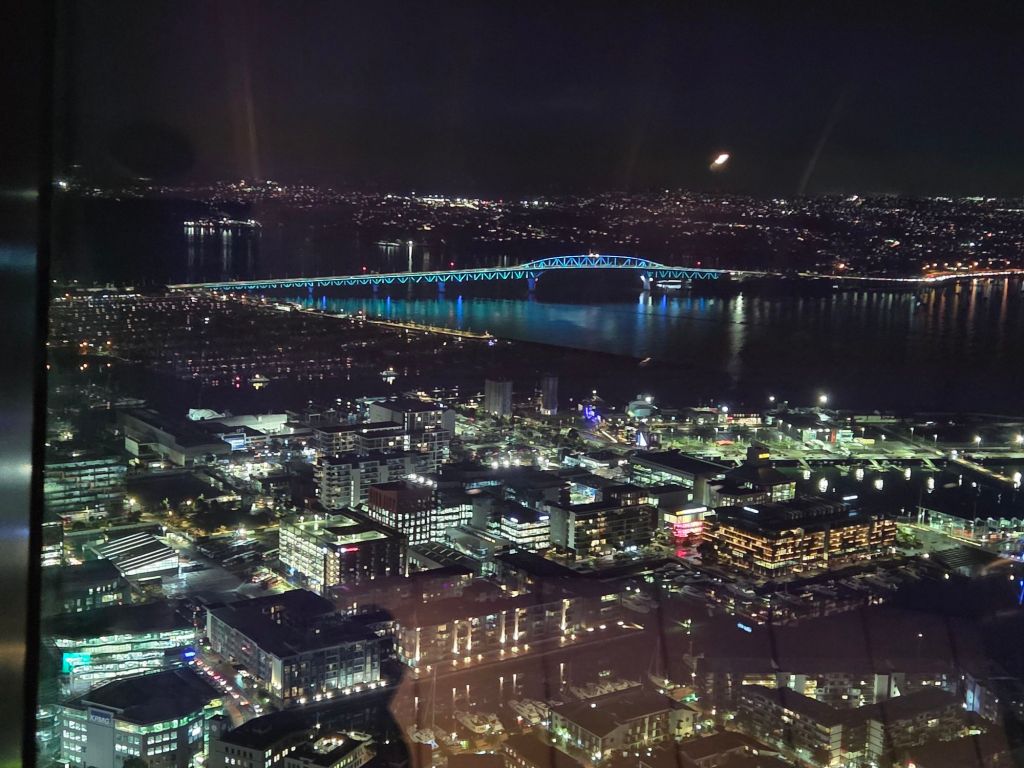
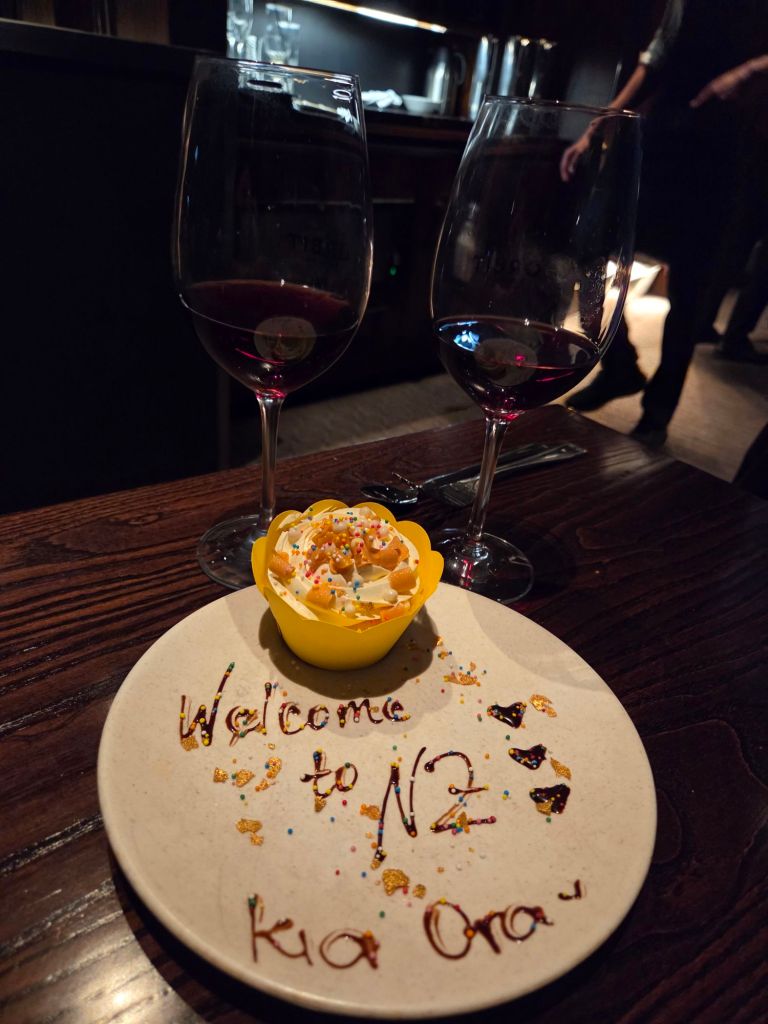
Speaking of the Sky Tower, we had reservations for the moving restaurant on our arrival. The views were well worth it!It gets dark early in winter. We were a bit surprised since the day before we’d been enjoying summer in the Northern Hemisphere. Here’s a view of the Harbour Bridge from Orbit 360.Speaking of charming, Dan forgot when he booked the dinner he invoked my Birthday Season. The server had subtly tried to get information for the “birthday” on the reservation. When we both responded with dumb looks, he did this with the special treat.
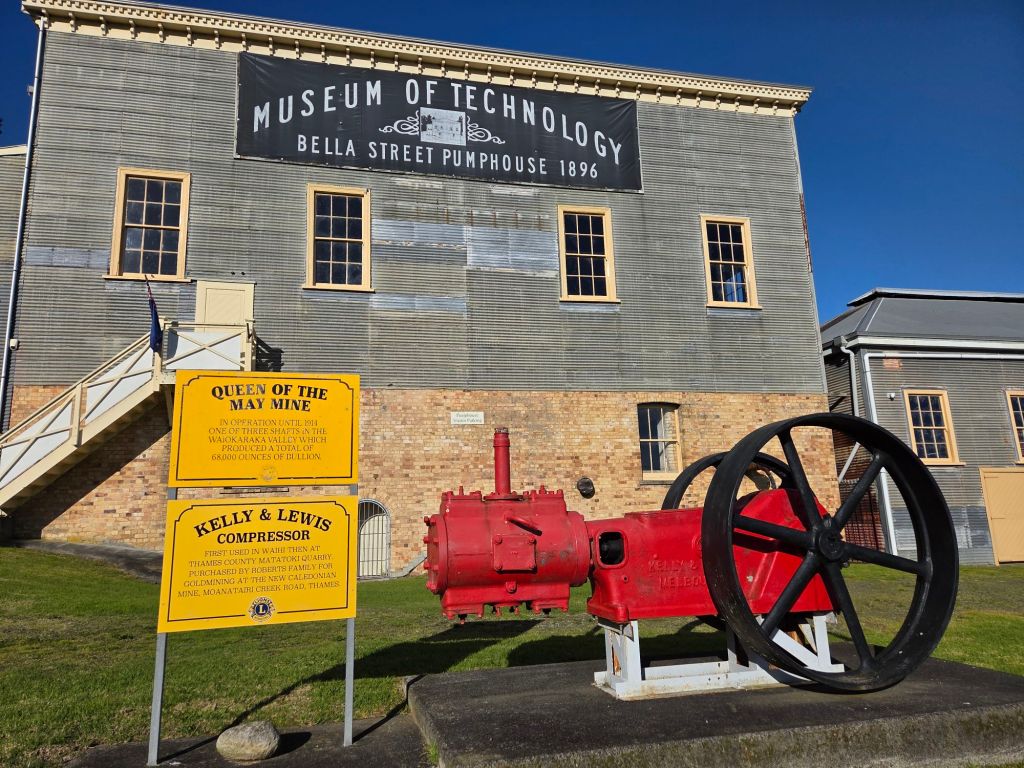
From Auckland, we had a leisurely drive east, and spent the night in the old mining town of Thames. We got in early afternoon and wandered through town toward the historic area. It was Sunday, so the museum was closed, but we looked up the road and saw that the Museum of Technology was open. So up we went!
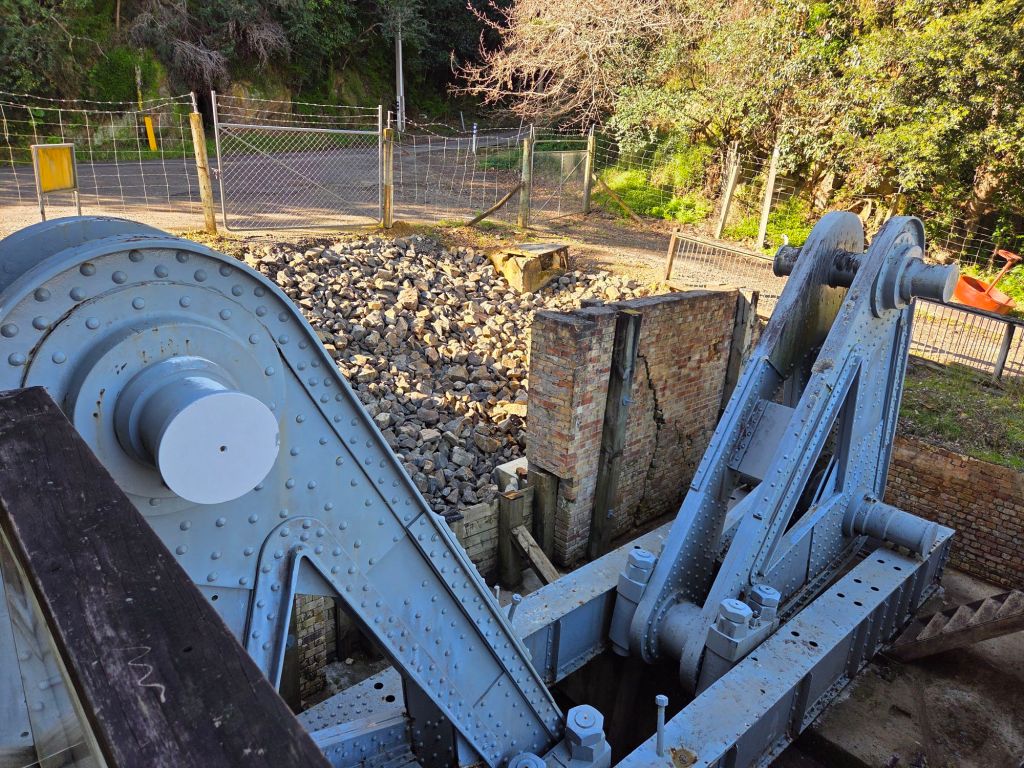
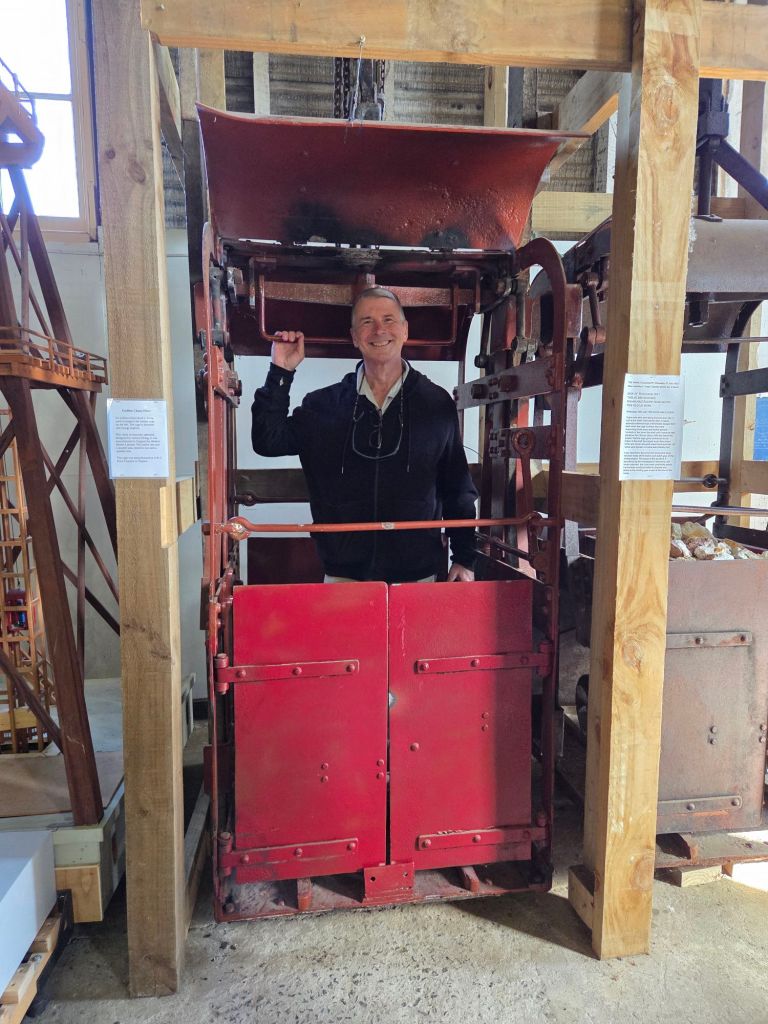
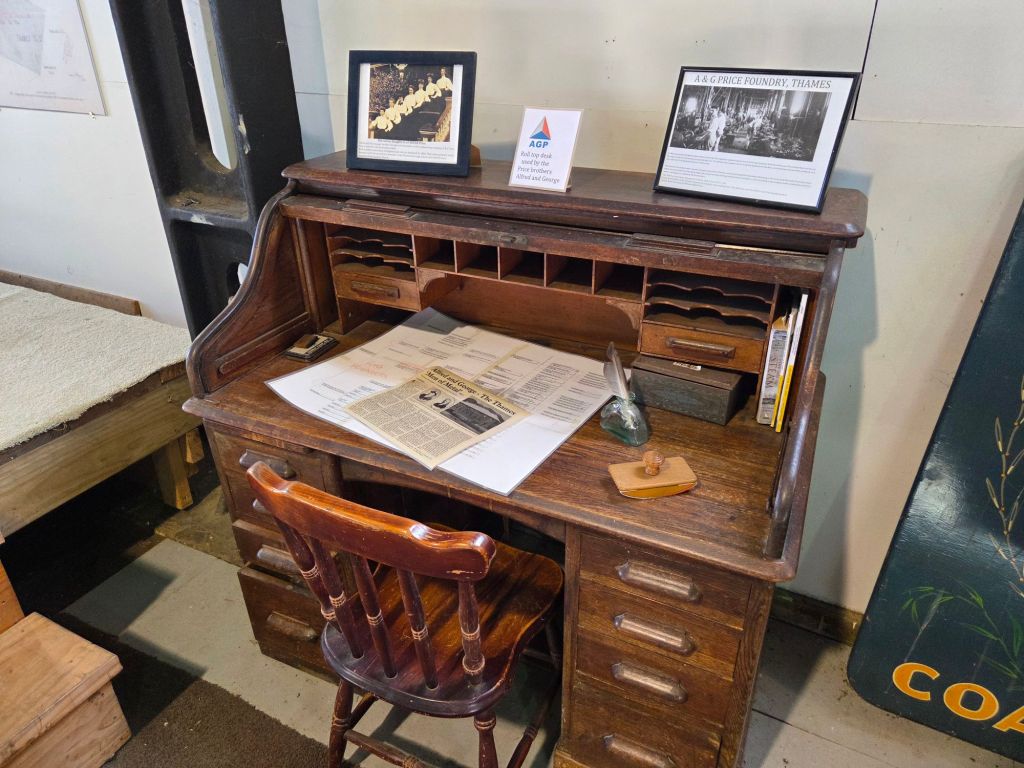
We entered the building and there were two gentlemen sitting by a desk. We inquired about visiting the museum, and after a little Laurel and Hardy banter with and between the two, we were able to purchase our entry. Then one said farewell, and carried on with his day. The other, apparently in charge of the museum for the day, proceeded to give us a very detailed tour of the place.It is a large building, mostly one room, that was originally built to house the mechanisms used to run an enormous water pump. A gold mine had been operating at great profit for some time, but at about 600 feet down, the gold ran out. They were certain, however, that if they went past the softer rock, closer to 1000 feet, they would find more gold. The problem with that was there was water, lots of water.The natural optimism of gold miners allowed them to convince investors that pumping the water out made sense. So, a massive engineering undertaking began, in England. And huge steam boilers, pistons, gear wheels, and other equipment was designed and made in England and shipped to New Zealand to be assembled and placed here. This all happened in the 1890’s. These pistons have the highest level of Heritage protection designation, because they are so unique.They had a working model of the pump, and the lifts for moving miners and and out of the mineshaft.They also had the actual lift cars! Dan included for scale. Our guide showed us the braking mechanisms, and explained how they must have marked the cables to know when to stop for people to access the shaft.Another model of the lift mechanisms. They were able to pump out the water, but there was no more gold to be found at the lower levels. The pump never really made money, and was closed down. Electricity was becoming common, and the location of thr pump house was close to some water runs, so the building was converted to be a generating station. But much of the original equipment, like the gears, had been removed for reuse elsewhere. Those gears are wooden models.This is a roll top desk used at a local foundry. The photo here is for Lisa’s dad. He loves a good roll top desk!These are surveyors chain. This museum, like so many we’ve explored in Australia and New Zealand, houses a wide array of items for the particular area.
We were the only visitors at the museum that Sunday afternoon, and we were treated to a charming, detailed, and anecdote filled guided tour by a local who clearly loved the history and lore of the area. And, just as it always is when this happens, it was a great time!
From Thames we carried on toward Tauranga, where we have friends. What comes next is a short story long about how we have friends in Tauranga. We have two sets of friends in Tauranga, one is a lovely couple we met in Melbourne on our first trip Down Under. We were having dinner in a tiny restaurant when the man at the next table leaned over and said “you aren’t from around here, where in America are you from?” And then proceeded to engage us in a delightful conversation. He, his wife, and adult daughter, were in Melbourne because it was a good halfway point to meet his son, who worked in Western Australia. Anyway, they were charming and insisted we contact them when on the North Island. We did, and have remained in contact ever since, and always meet up with them when here. The other set of friends Dan made through a travel to Portugal online group. He answered a question and they started a chat. When it came out that they were New Zealanders, and we were going to be in New Zealand, a meeting was arranged during our last visit. Of course, we schedule visits for this visit too!
Our friend from the Portugal travel website recommended we stop at a particular wine shop between Thames and Tauranga in Katikati. That was really all she said, but was a very strong recommendation. And, she mentioned the owner was an American, and she thought he was from Ohio. Now, Dan and I have had other instances here in New Zealand where “they are from Ohio” has been a thing. So far, we’ve met those folks and they were from Iowa, Minnesota, and Kansas. But each one was great!
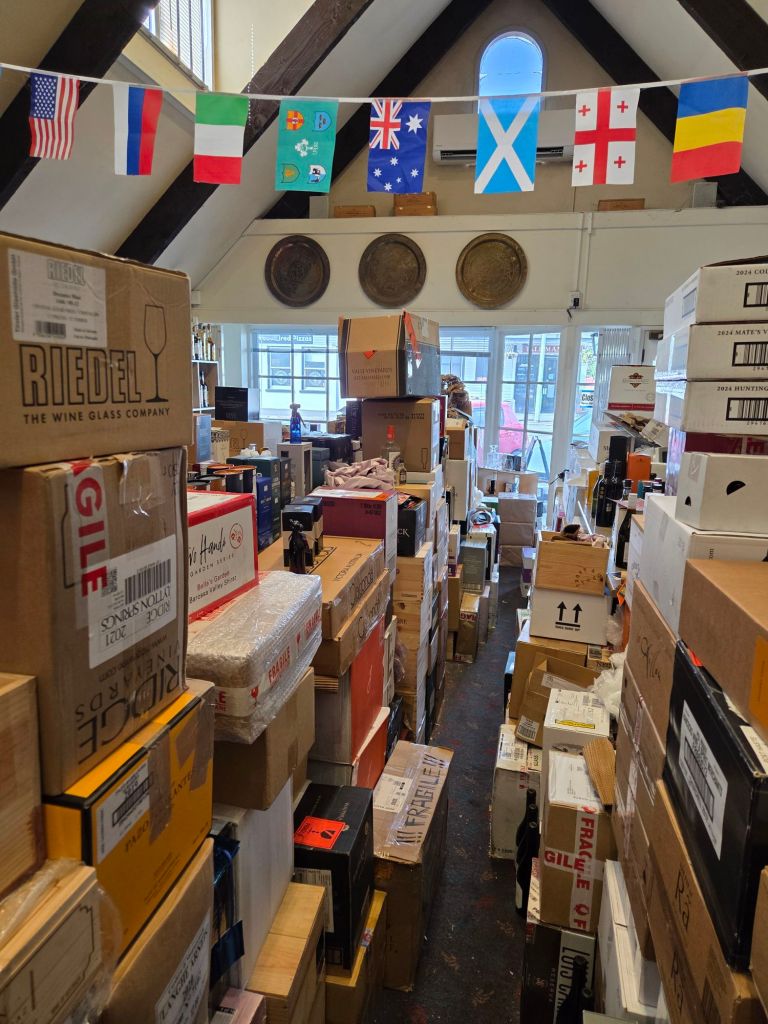
So, anyway, we get to Katikati, find the wine shop, park, grab a yummy lunch, and then walk over to pick out some wine. The store, Finer Wines – well worth the stop for good wine – looked open. There was an Open sign in the door, and a sandwich board on the sidewalk with some specials. But, looking in the doorway were stacks and stacks of boxes. Dan opened the door, but it didn’t really seem like there was a path. Lisa peeked in the window and saw two people in the back of the store. Maybe the real entrance is toward the back? So we wandered around back, nope. On our return Dan spotted someone come out of the shop with a bag clearly containing a bottle of wine. So, we took a chance and entered the store.
There was a path! And we were greeted by the owner with “it always looks like this! I am too busy selling wine to get it organized!” Then we got to chatting about what we were after. There isn’t really any browsing at this shop, you just tell the owner what type of wine you’re after, or what you like, and your price range. He then makes recommendations. Miraculously, or maybe because he has a system, he is able to produce the wine you agreed on!Notice the Kansas Jayhawk on the wall!So many choices! Added bonus, you get to stand around and chat about a variety of topics. This expat moved to New Zealand 20 some years ago and has been running the shop for most of those years.
Over three visits to Tauranga, because we have to come back each time to check in with our friends, we have become a bit familiar with the city. We have a favorite restaurant near the hotel where we always stay, and as we’re joking with the server we both realized we’ve played this game before. Yep, she worked there a few years ago and likely served us back then too. The next day, at a florist shop where we picked up flowers to take to lunch, we told the ladies there that we were enjoying the familiarity of the town. Then, one said, wait, did you buy flowers here a few years ago? I waited on an American couple then. Yes, yes we had bought flowers there last visit. Finding these connections is one of the things we enjoy when returning places.
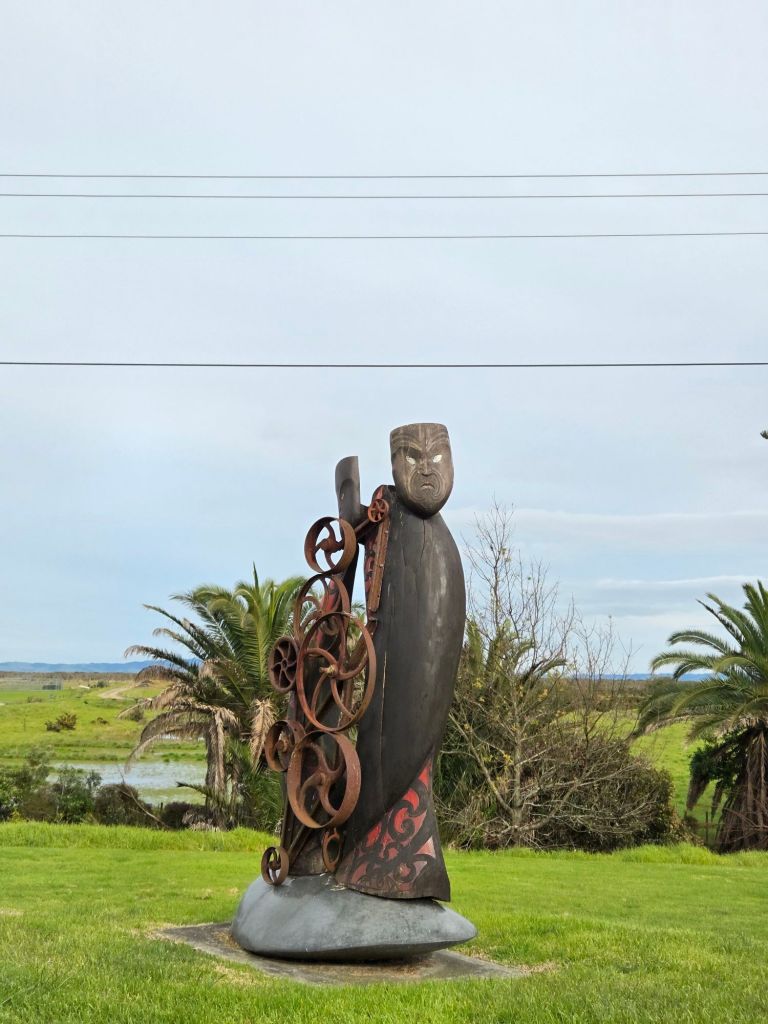
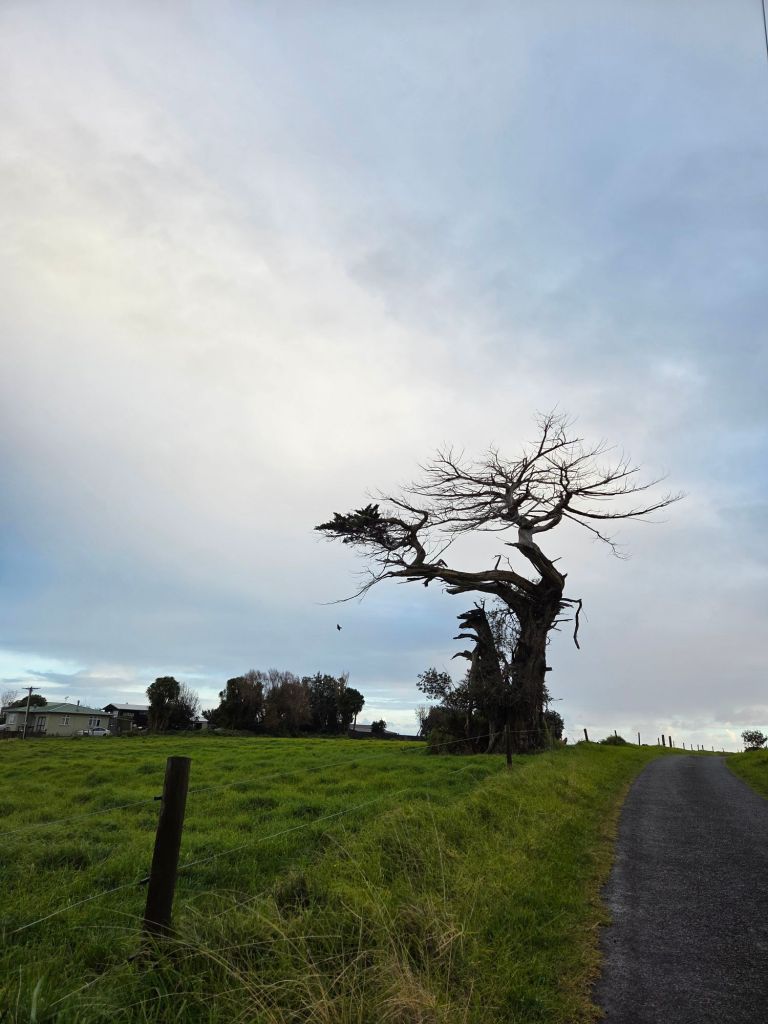
A cool sculpture on the walking path.Not really sure what this tree has been through, but it is unique.Flowers.Another tree that has been through some stuff.
We had a tight connection. The airline offered an itinerary with a 30 minute connection at a major hub. We could have taken an itinerary with a longer layover, but it required leaving Minneapolis at 6 am, instead of 8:23 am. Dan has an intense dislike for very early flights (the 8:23 flight even caused grumbling) as they are disruptive of his sleep. I am usually inclined to take them as I think it is a small price to pay for a flight that is less likely to be delayed, and longer layovers are always better than shorter layovers.
That said, I love Dan more than I care about airport stress, which means I love him A Lot. So, I believed the airline, despite a previous experience with a similar layover at the same airport on a flight to the same destination that required a mad dash through two terminals to be the last passengers to board the plane.
Well, a storm just West of MSP required a flight path that took us due North toward Canada before we headed west to Salt Lake City, which added just enough time to our flight that we landed and exited the plane as our flight to Montana was headed to the runway, without us.
The airline already rebooked us on the later flight, so it wasn’t tragic. But that later flight got us in way past our toddler like bed time, and we would still need to make a 3 hour drive to our destination. Faced with 11 hours of hanging out at the airport, and the need to wait until tomorrow to drive the last bit anyway, we made the call to take the next morning’s flight and spend the night in a city Dan had never visited, and Lisa hadn’t been to in 25ish years. Plus, spending the night gave Dan the chance to check Utah off on the list of states visited (based on the family rule “you have to stay the night, airports and drive throughs don’t count”). The airline people who helped with the rebooking and baggage retrieval were super nice. And, the volunteers at the Salt Lake City Airport Information booth were delightful!
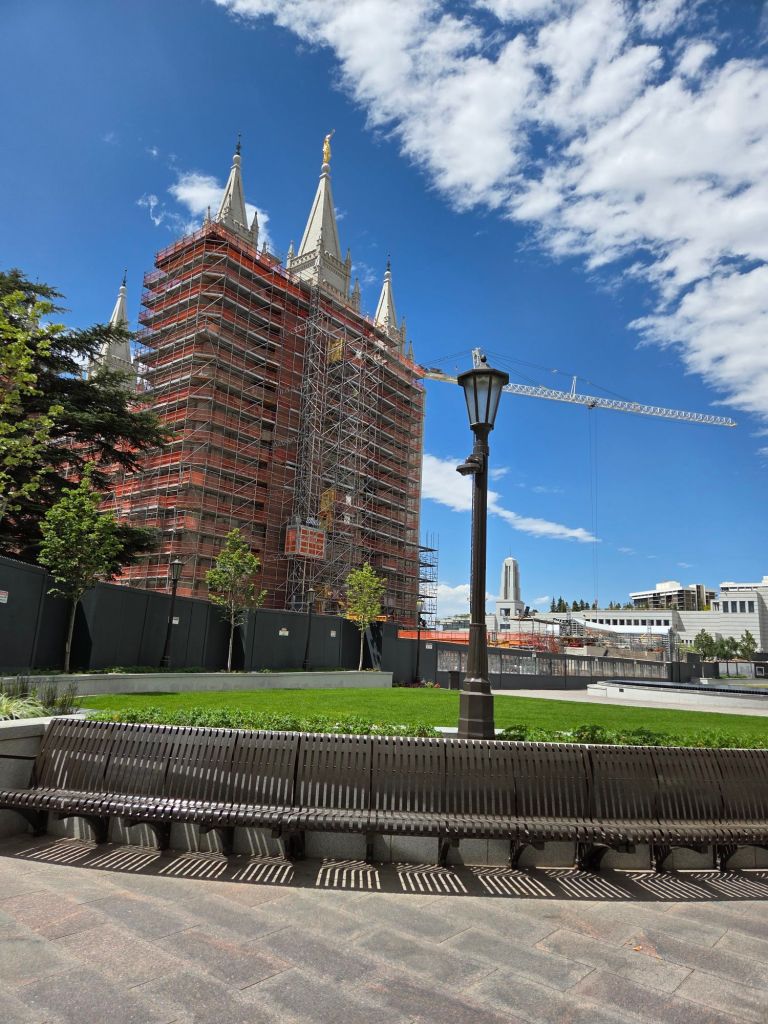
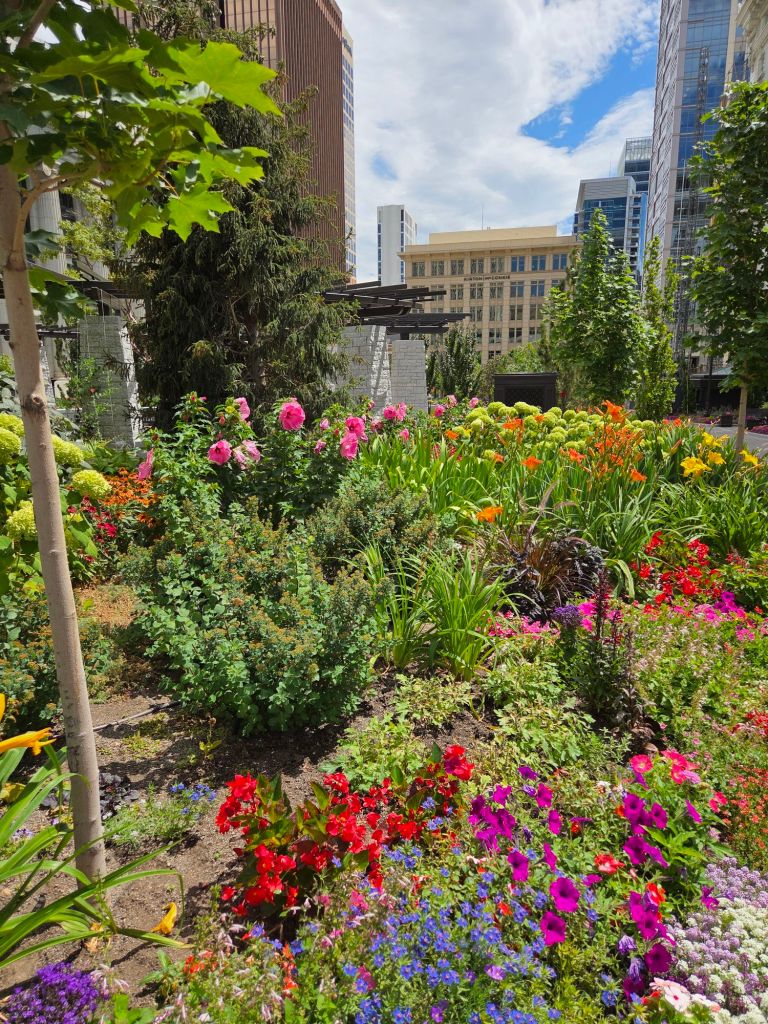
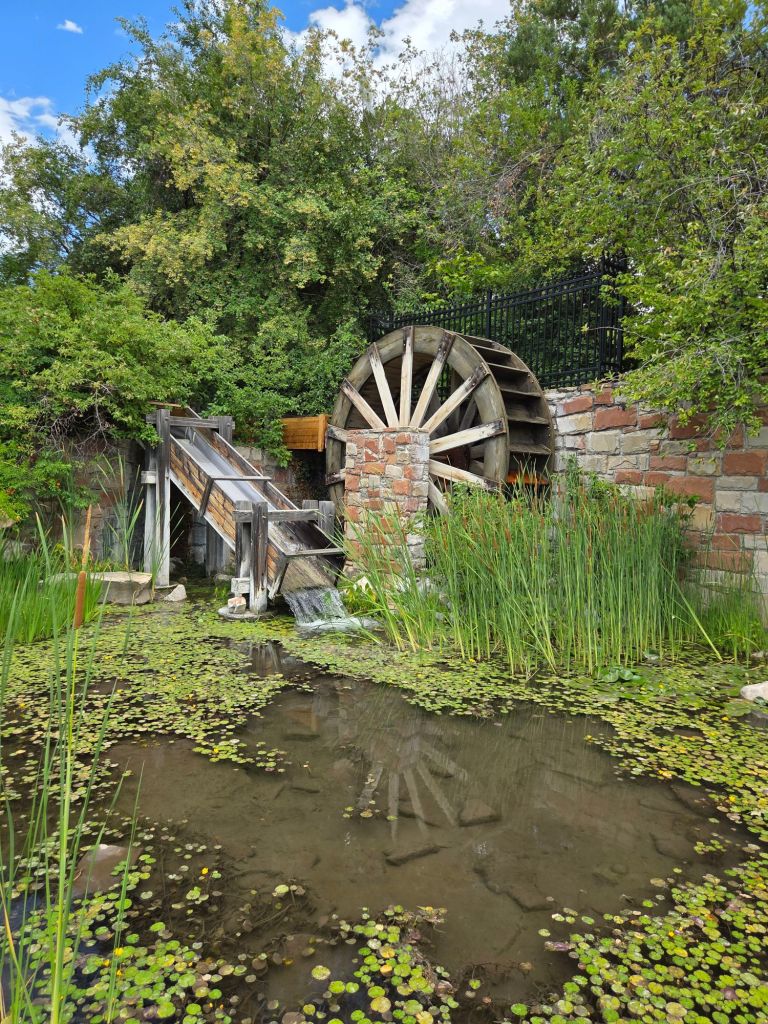
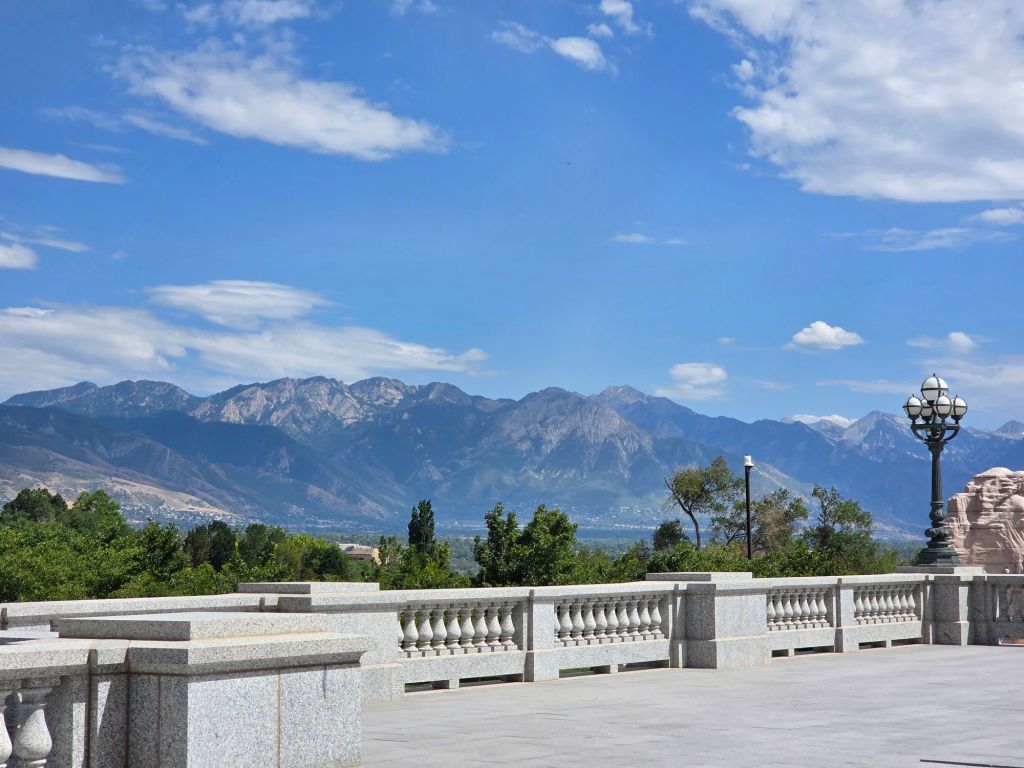
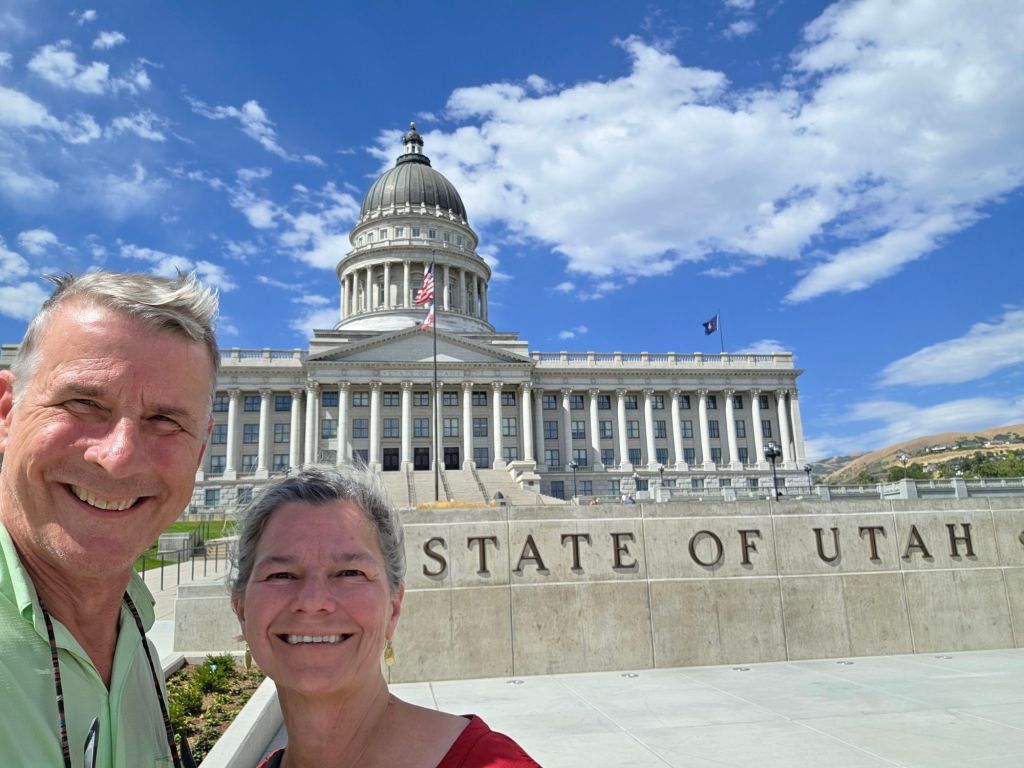
A view from the very efficient and convenient City Train that whisks you from the airport to the city center in less than 30 minutes!The view from our downtown hotel. SLC seems a bit more dense than I remember from my visit last century.They are doing a massive renovation on many of the building is on Temple Square.The gardens were open, and blooming. Based on the enthusiasm one of the Information Desk volunteers had as she shared this information, we think they only recently reopened that part of Temple Square.Across from the Square was a park that used to be part of Brigham Young’s complex, complete with water wheel, like the one that would have been used for the on-site Mill. With multiple wives, lots of children, and other pioneers encouraged to come west, there was labor to support these endeavors.At another park in town they had a number of stones to help folks learn the tracks of some animals. I don’t think this would be an inaccurate travel moniker for me to use, but it might cause some folks to question how delightful I am.Here’s another, Dan just offered me a long suffering look when he heard my plan to maybe reference each of us with these options on this blog post.As we exited the second park, we realized we were half way up the hill toward the Capitol Building. I had already promised Dan I wouldn’t drag him on a tour because I had done one when I was here back in the 1900’s. But we were mostly there, so there we headed. It was a warm day, but breezy and gorgeous.The Church of Latter Day Saints and the founders of the State liked the industry of bees and there are many representations in the Capitol Building. Don’t ask for any more detail on that, the tour I took was over 25 years and many other Capitol tours ago.One thing about SLC is that it sits in a massive valley, with lots of mountain views. Here is a particularly nice one from the Capitol.And, since this was a new state and Capitol for Dan, we got a selfie!More blooming flowers. These surrounded a marker for the Kimble Family, a founding family. Near as I could tell from the listing of family members, the senior Kimble had at least 9 wives, and a lot of kids.
If you’ve hung in this far, you get a glimpse into our marital and travel dynamics. When I realized it was highly likely we would miss our connection, I spent a few minutes working through how to respond to the issue. Not just the logistics and rescheduling, but the “we should have given ourselves a longer layover” response. At that point I decided, while I was disappointed to miss a day with family, we still had a good number of days to spend with them, and this really wasn’t worth drama. And I reminded myself that our travel motto is “Oh Goody! An Adventure!” for a reason. So, I just turned to Dan and said, “we’re not making that second flight.” And when he responded “the airline will help us figure it out, and it will work out.” And you know what? It did, and I was much happier not being a stressed out fussball, and Dan was much happier not having to manage said stressed out fussball. So, we enjoyed a nice day in Salt Lake City and are looking forward to a nice visit starting tomorrow.
When Dan found out that this year was an especiallly active year for the solar activity that results in the Northern Lights, he was determined to go see them. So, he did some internet sleuthing and found a cruise up along the coast of Norway all the way to the Northern Cape, above the Arctic Circle. Normally, we agree on where we want to go, Dan looks up “things to do” and Lisa finds the way to get there, and how to get around. But, when presented with a “I want to take this particular trip” it made that bit of planning so much easier.
So, without much further acknowledgment of the fact that we would be spending early January in the Arctic, we booked the trip!
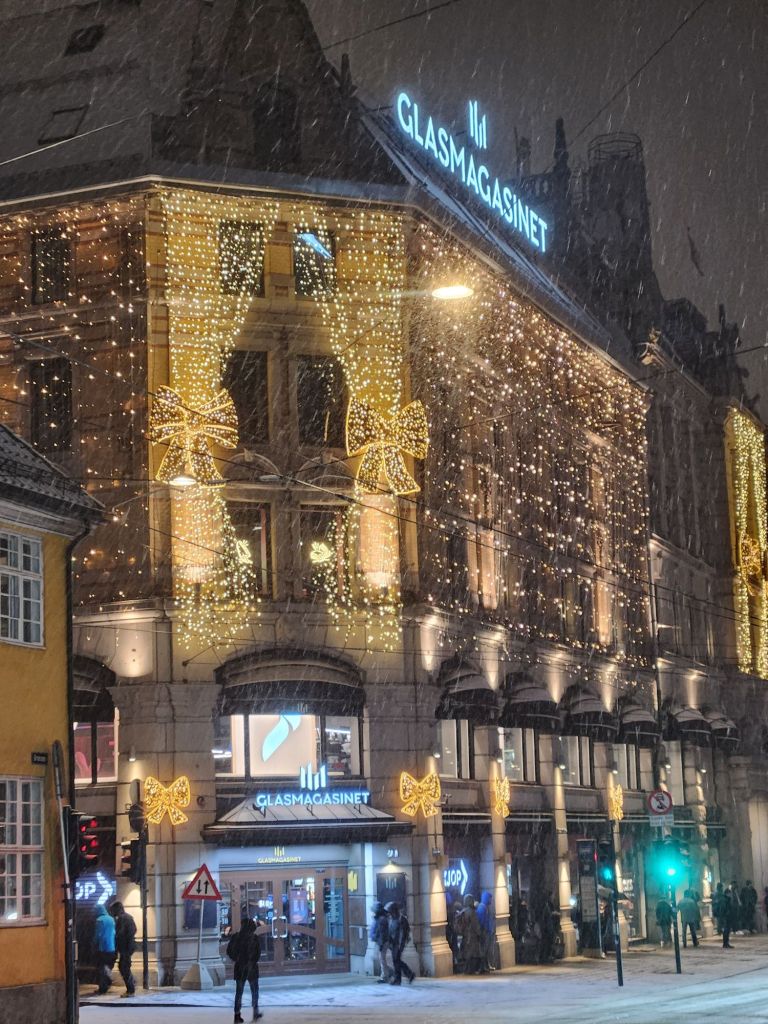
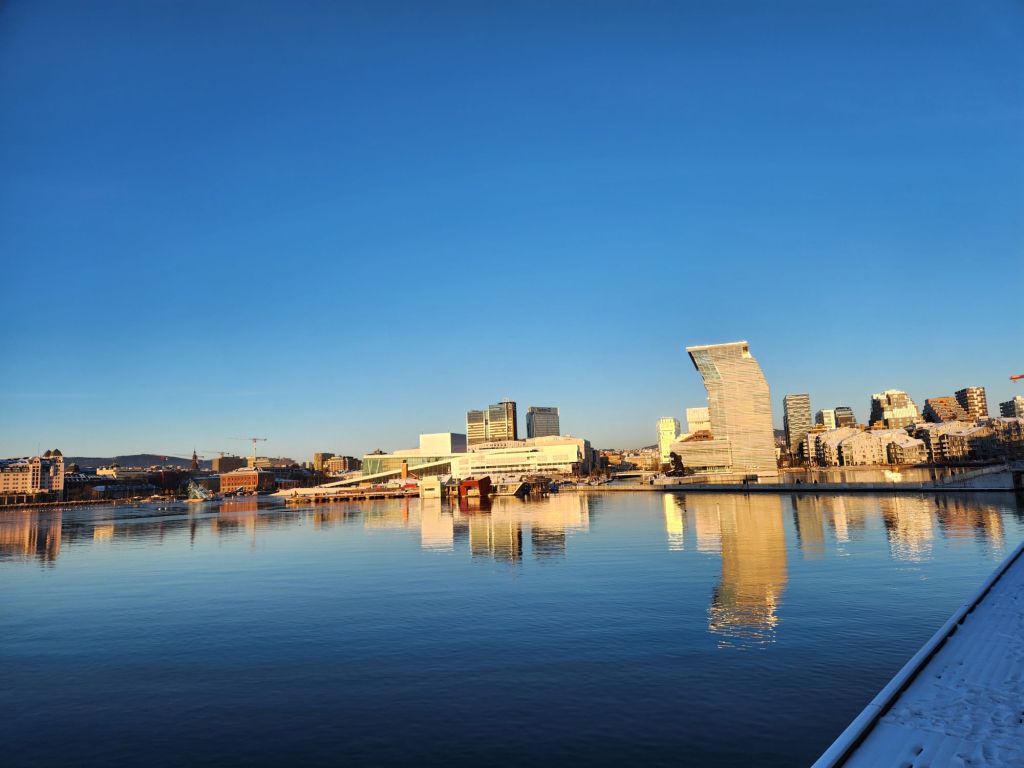
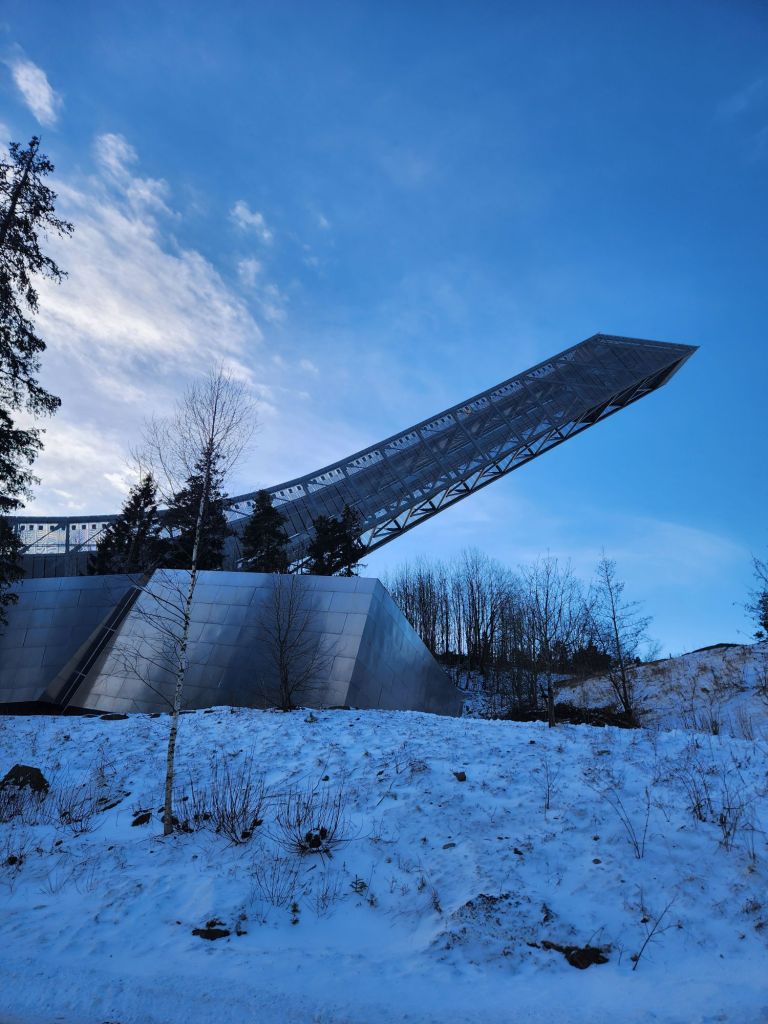
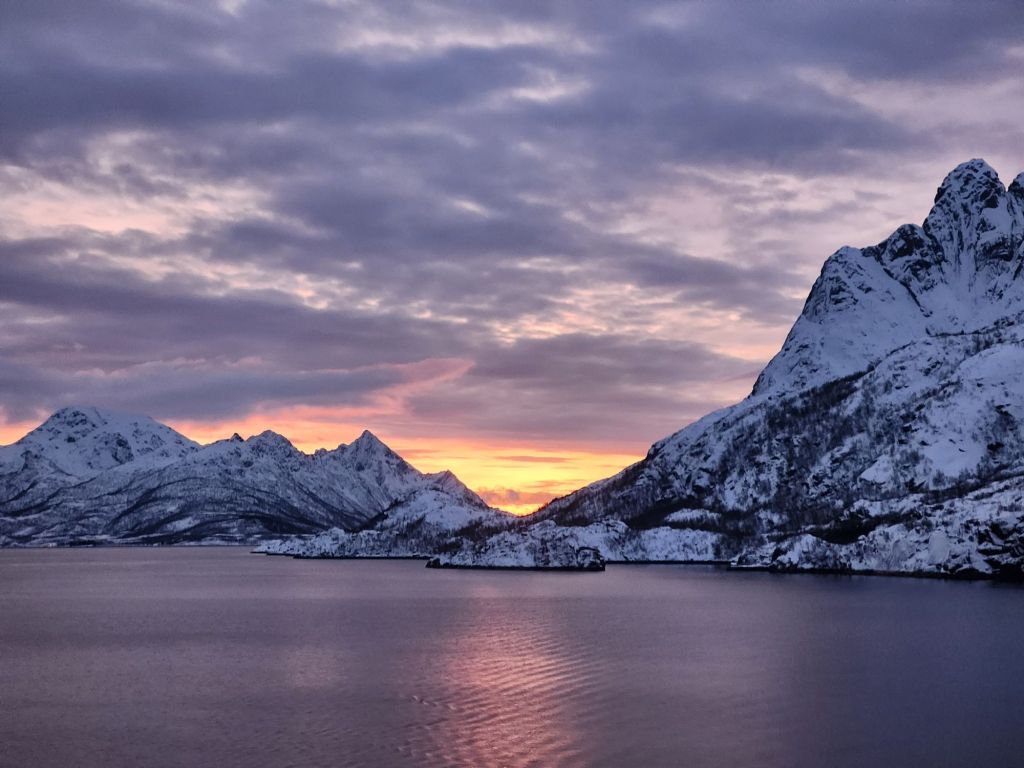
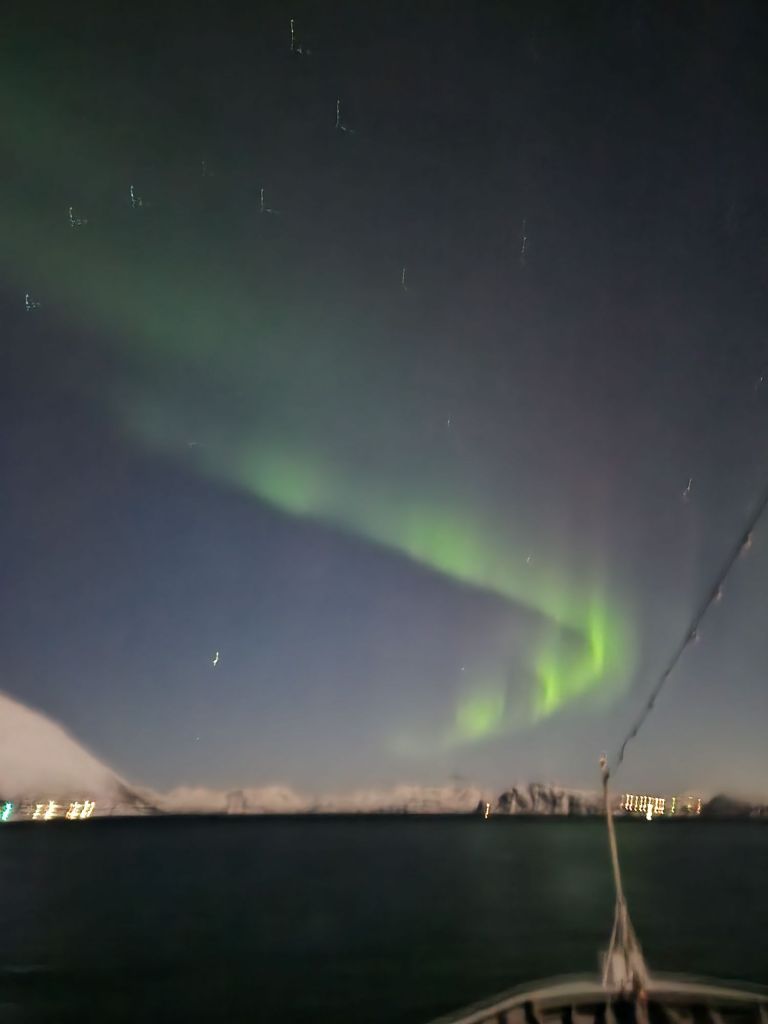
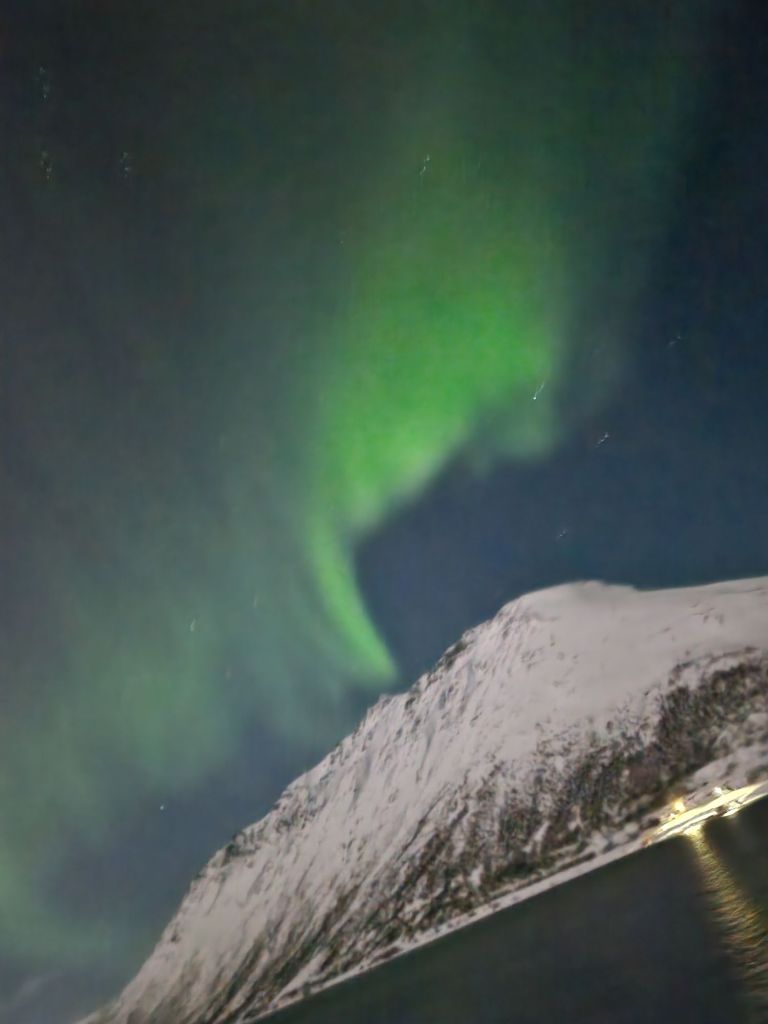
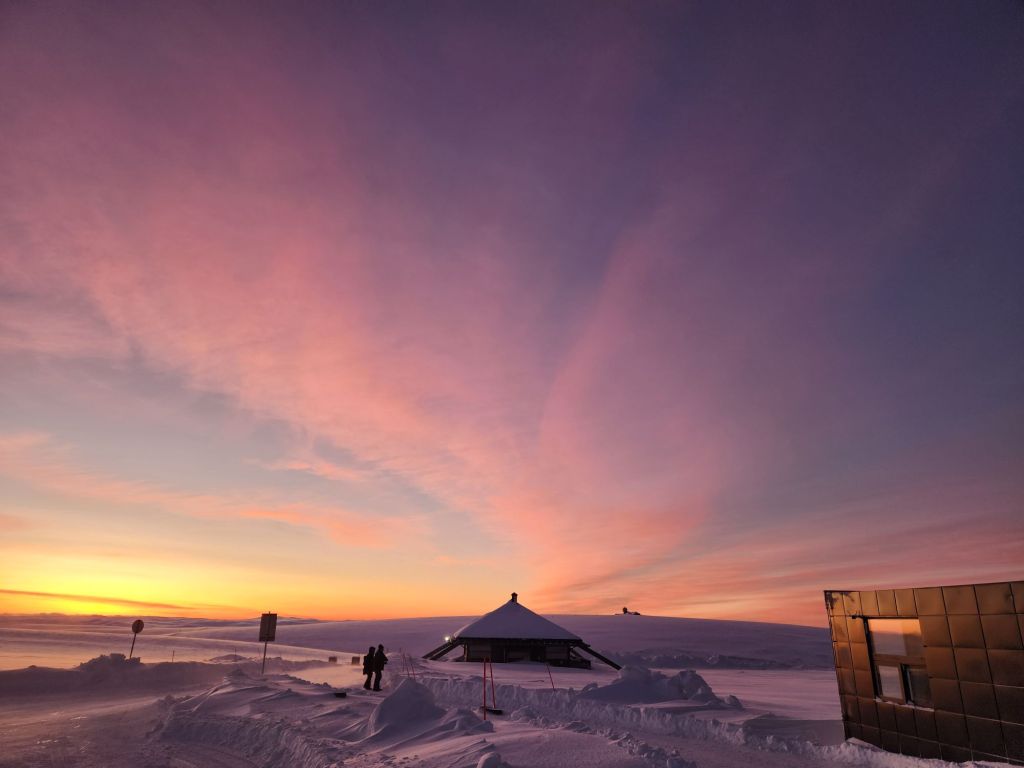
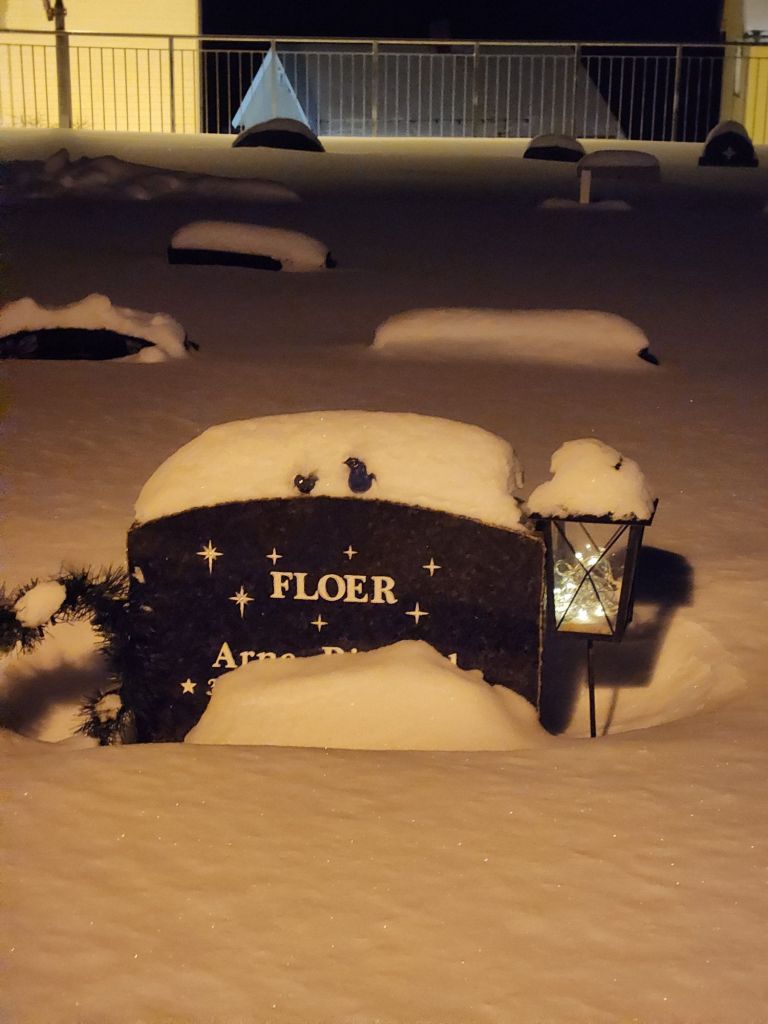
A Guard at the Castle. We weren’t actually headed there, but wandered through a Christmas market and found ourselves on the grounds. Oslo is a lovely city, and was bustling with activity leading up to New Year’s Eve.The Holiday Lights were still shining, especially with the early sunsets.The Oslo Skyline.A Norwegian Sculptor wanted to create a park to display his ambitious plans for a series of sculptures he had planned. The country didn’t have much money coming out of World War Two, but land was set aside and he began his project. The Vigeland Park remains a popular place in the city all year round. The many sculptures depicting birth, growth, childhood, parenthood, aging, and death are spread around the lovely grounds.The iconic Olympic Ski Jump. It sits high on a hill overlooking the city, surrounded by ski trails and even a biathalon training center. There were some folks taking shots at the targets. It was also very windy and was good preparation for what was to come!We were on a Hurtigruten ship, this one was recently refurbished and is more of a cruise ship than the passenger ferry model some may know about the line. Although it still has an area for cars.The mail delivery vehicle, with an unexpected postal carrier!As we progressed up the coast, snowy weather greeted us.This is a bad photo of the lighted globe that marks the boundry of the Arctic Circle! It was a bit windy on the deck, but we all rushed out there to get our proof!The entrance of Trollfjord, the namesake of our ship. In winter, there is sufficient concern about avalanches that you cannot venture too far in. In the summer, ships are lined up to take folks in.The sun doesn’t officially rise above the Arctic Circle, but it does paint the horizon and light things up for several hours in the day.One of the bridges over the water along the shore. We hadn’t yet seen any Aurora, and I may have made a few jokes about this being our best option.Then, the next night, we had Northern Lights! Again, it was windy and cold on deck, but we all ran out for photos. These were the level where you get a much better sense seeing the lights through your camera lens. To the naked eye they were more gray and whispy. We will likely use that as an excuse to chase them in the future.But, we got some nice motion! The camera adds a fair amount of light, but between the snow, the aurora, and the moon, arctic nights are remarkably bright.Another view of the light you get, even without a sunrise. This is at the North Cape, the northern most point (on a road) of the European Continent, at about 11 am.In the North Cape Visitor’s Center, they have several dioramas of early visitors. Before the road was completed, you had to take a boat and climb up the cliffs. She looks much happier about having to hike up in that crazy get up than I would have!This is as far North as Lisa has made it, Dan has been to the Northernmost city in Alaska, which is a few tenths of a degree higher. Yes, he looked up the coordinates so that could be included here.Walking around at one of our stops, we went came across a cemetary. Some of the paths were cleared, so we took a look. The gravestones in this area were about the same height as the 24 or so inches of snow.This family, however, choose a higher stone. A number of the plots did have lights and lanterns. The church and cemetary were across from a school that was letting out and kids were sledding down a hill as they waited to be picked up. So, we had hoots of laughter and joy to accompany our visit.Another picture that does not come anywhere near doing justice to the sight. This is a nacreous cloud, which occurs sometimes in polar regions where the cloud cover is just right to reflect the sunlight coming over the horizon. Several members of the crew commented that is is more rare than the Aurora. We had the effect all day, and many attempts at photos were made. I hope the ship’s photographer had the right equipment with his camera. He seemed pretty excited to spend the day photographing the sky.Another attempt. If you squint, you can see there is pink, blue, and green up there! We did hit some rough seas one day, this is the library the next morning.Our lovely bartender set up a quick Aquavit tasting after we admitted we had never tried that Nordic apertif. Lisa chose to have a full serving of one made by a distillery founded and run by women. Delicious.
Our trip up the Norwegian coast was a real treat. We found the scenery, the food, the people, and even the weather to be delightful. We both agreed that having 20 days of snowy, cold winter was about perfect!
We are off on a 7-ish month adventure that will take us from the mid-west to Europe, to the Arctic Circle, down to the southern Cape of Africa, and back to Europe, before we journey home.
We spent two days in Queens as we began our journey eastward. Why Queens? Well, it’s near the airport, but more importantly, our hotel was within waking distance of Spaceships that were featured in Men in Black. So, why not!
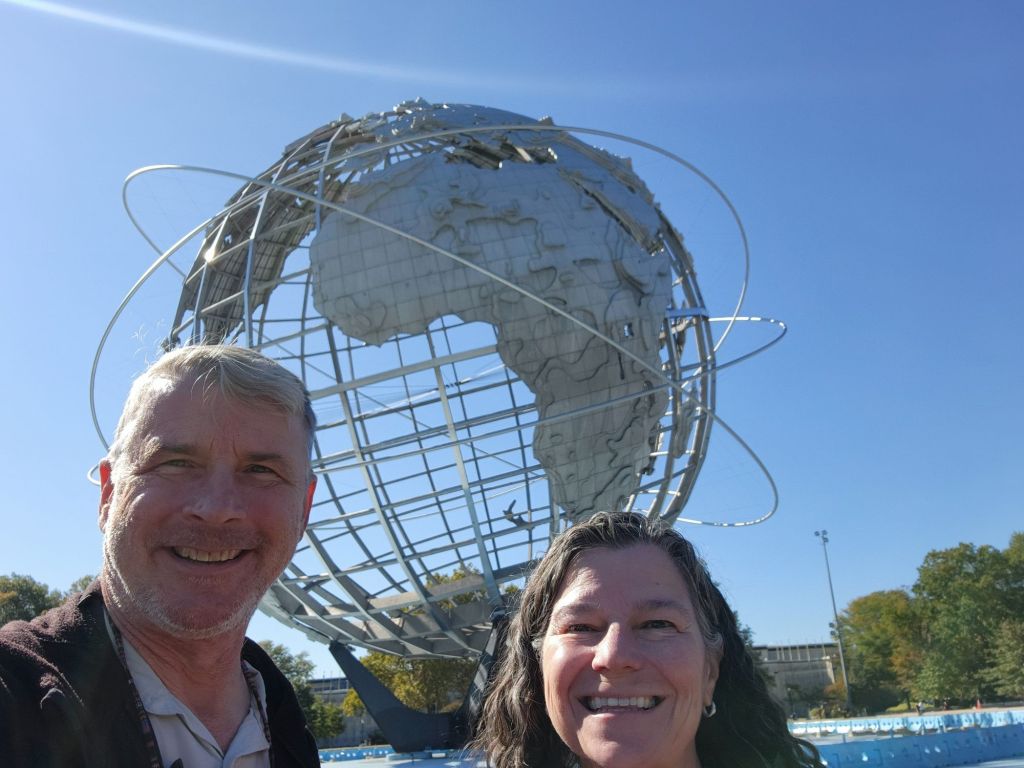
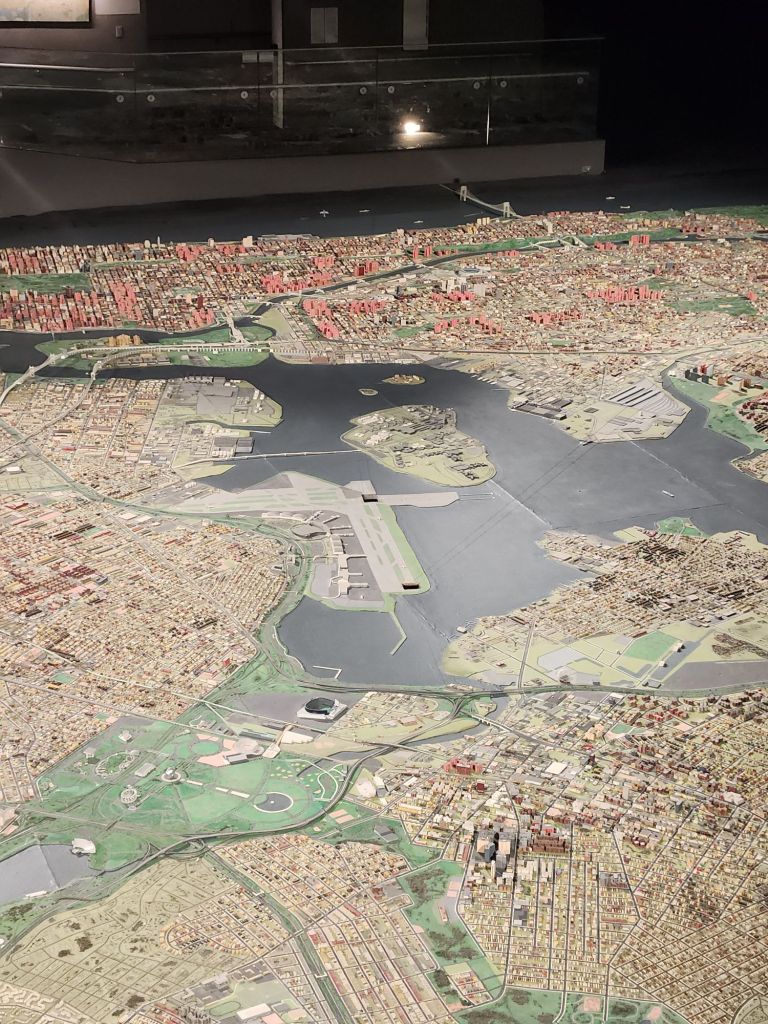
There they are! Still under repair from the damages caused by the bug, and the fly ball!Of course, we had to visit the Unisphere! Since we’ll be taking a ship up the west coast of Africa, I thought this perspective was perfect for a selfie! Dan did a little research and decided a visit to the Queen’s Museum was in order. It is in one of the buildings built for the 1965 World’s Fair. It had art, and lots of items from both World’s Fairs. One of them was a “well, that wasn’t at all what I expected and it was amazing!” scale model of NYC. It even had planes suspended on wires, and rotating in and out of LaGuardia airport. It was updated in the 1990s, so it is a remarkable view of the city. There weren’t too many informational placards, but what were there were pretty interesting.A slightly zoomed in view to show some of the detail. They also cycled the lights in the room for a 24 hour cycle, the map had areas that glowed, like parks and other green spaces.
The walk there took us by the USTA center, which brought to mind many Labor Day weekend afternoons, sitting in the TV room with my Grandma watching tennis. She liked to sneak away from the rest of the family to watch it and let me join here. It was a great way to have her all to myself in the midst of a bigger family visit. And, since we both enjoyed playing tennis, we had opinions. She was a much better tennis player than I was.
We love traveling by ship! And this adventure began in NYC when we boarded the NCL Sky for a 14 day Transatlantic crossing. We pulled out of the port as the sun was setting and were treated to a pretty iconic view of the Statue of Liberty!
This is the third time we have cruised in or out of NYC, and it is always a treat to see this sight. Early morning, dusk, or after sunset.
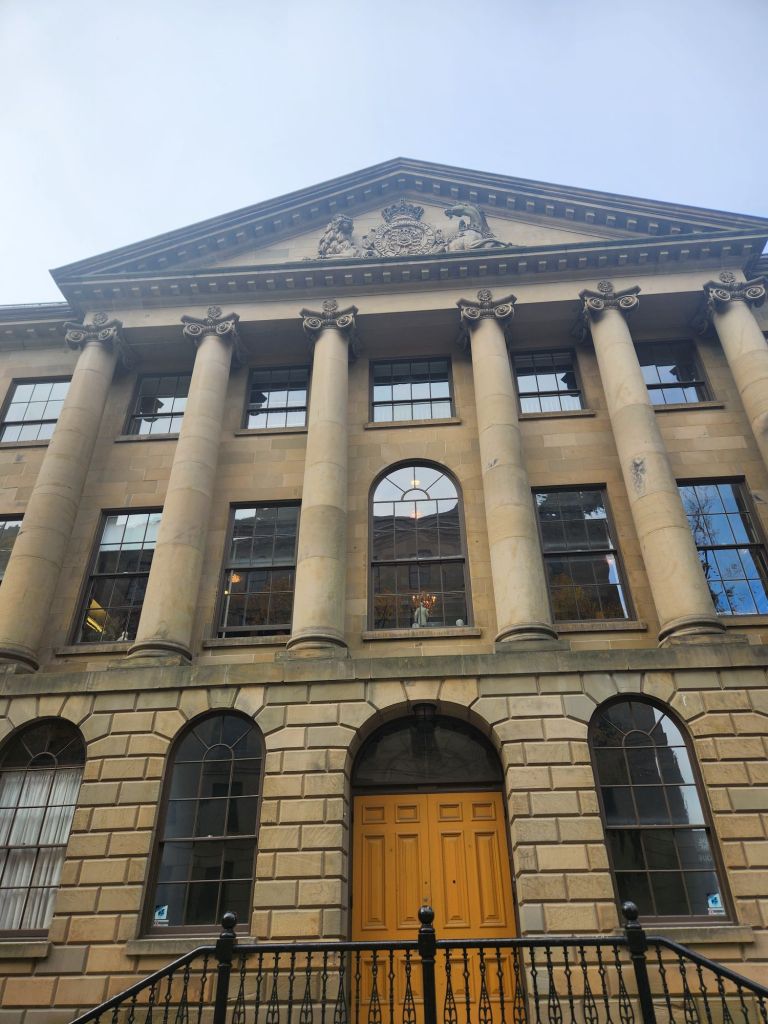
Our crossing, I can’t remember if this is technically a “repositioning cruise” or if it is a Transatlantic cruise, not sure it matters, and for that matter, I don’t know the criteria anyway, so I will just call it a “crossing.” Anyway, the plan was to stop in Halifax, Nova Scotia, and St. John’s New Foundland before we headed out to sea. Alas, weather had other plans. We were able to stop in Halifax, but missed St. John’s. So, instead of visiting two Canadian Provinical Parliment buildings, we only got to see one. It was a gem, though, lovely 1810 ish architecture, gracious rooms, and chatty and helpful Security guards. Then we proceeded up the hill to the old fort and wandered around for several hours.
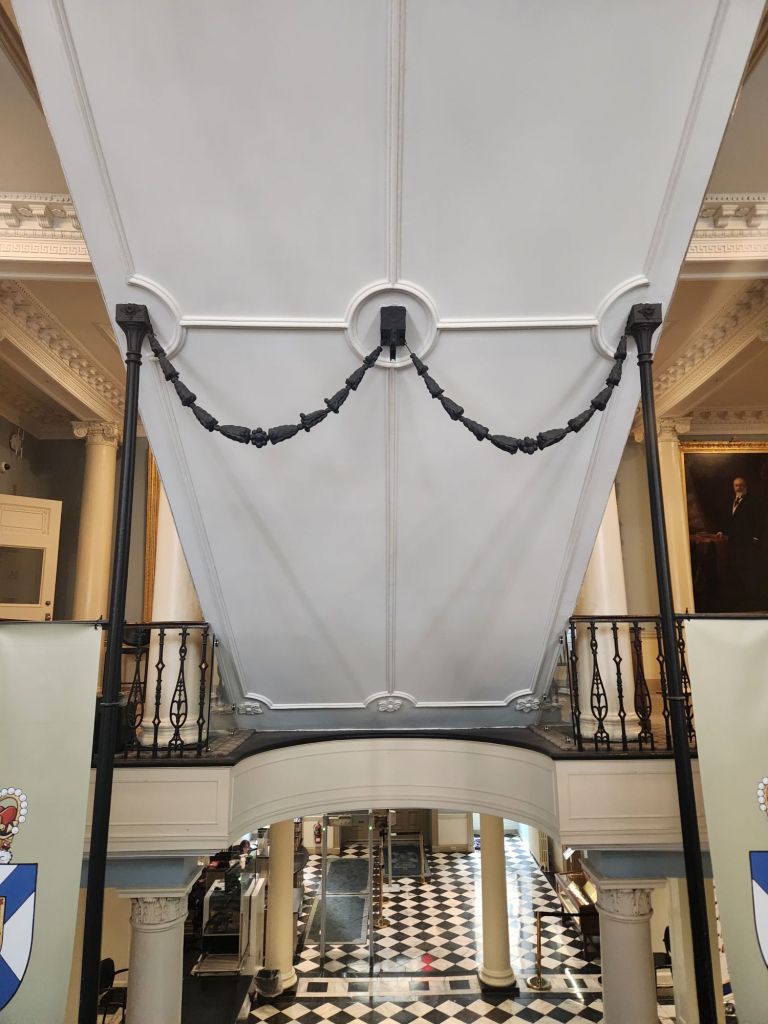
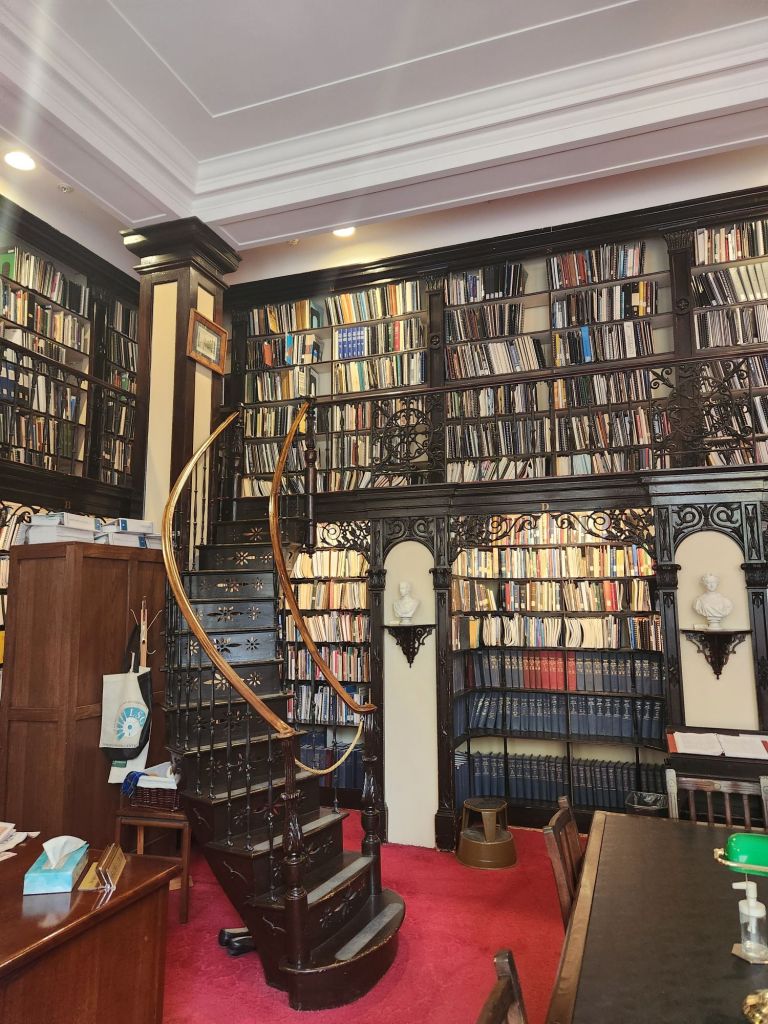
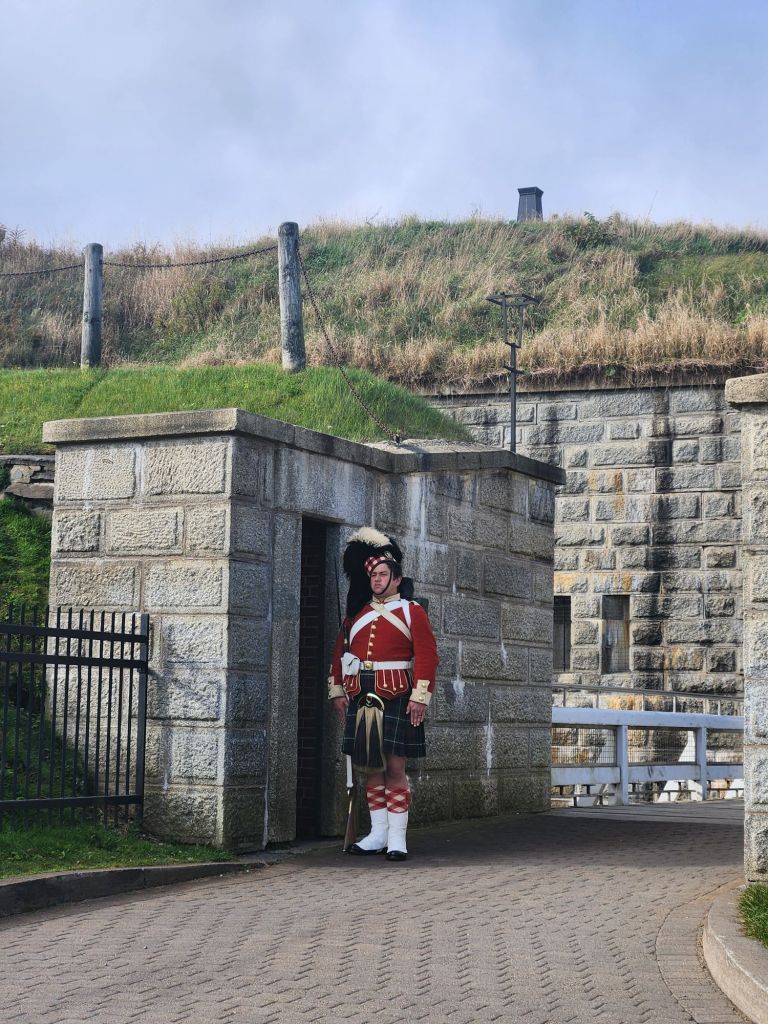
There is no rotunda, as it was not a design element of the time, but some lovely supports on the stairs.The chambers.The Library. It used to be the courtroom. While we were looking around a young woman who was interning there said there is still a jail cell in the basement. Alas, that was not on the tour.The front of the building. You can’t see them, but the door nobs all have a maritime theme, given Halifax’s location, and the main doors have fish tails.Looking up at the clock tower between the city and the citadel.Guarding the gate. They had interpretive guides around the fort in period dress, they fired some cannons and demonstrated the muzzle loading rifles used to defend the area.There were lots of cannons, several galleries with nicely done exhibits about the city, the history of the region, and Halifax and Canadian involvement in various wars.
From the Canadian coast, we headed east toward the Azores Islands, a vocanic archpelego located at the triple junction of the North American, Eurasian, and African continental plates! I won’t yammer on about the geology, but I do enjoy learning bits each time we visit. Dan and I had a brief stay in Punta Delgada on the island of Sao Miguel, in 2021 and enjoyed our stay. This time, with just a day trip, we decided to wander the city instead of doing an excursion. We found the local gardens, enjoyed wandering some neighborhoods we missed on the last visit, and reaquainted ourselves with Portugese beer.
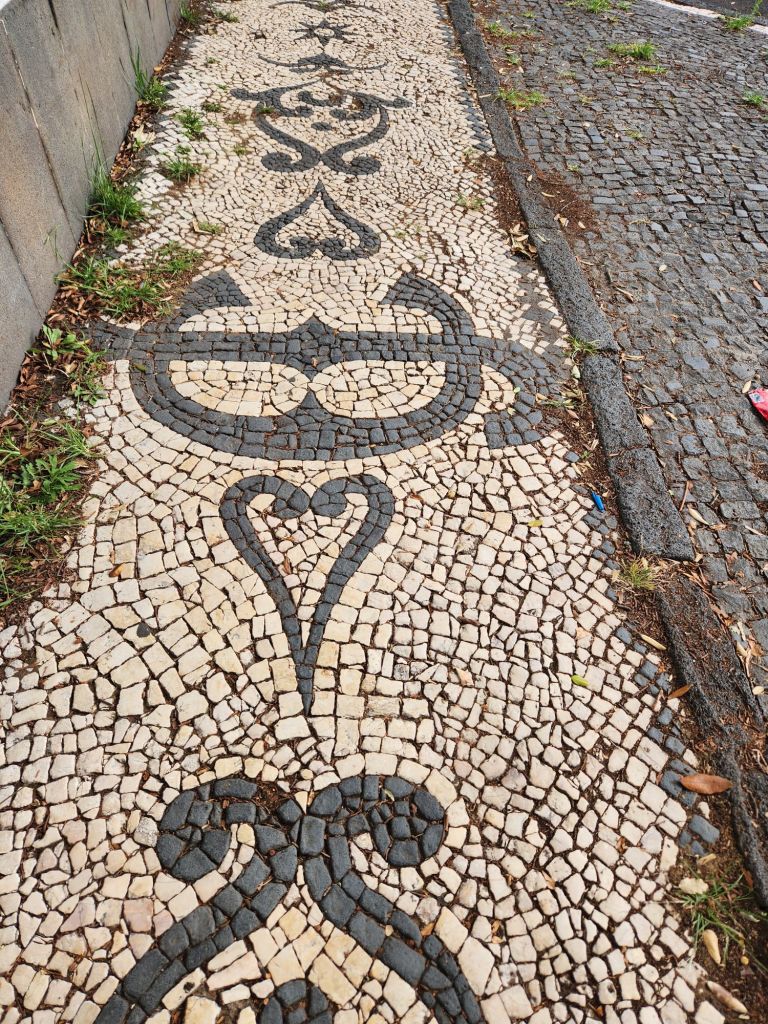
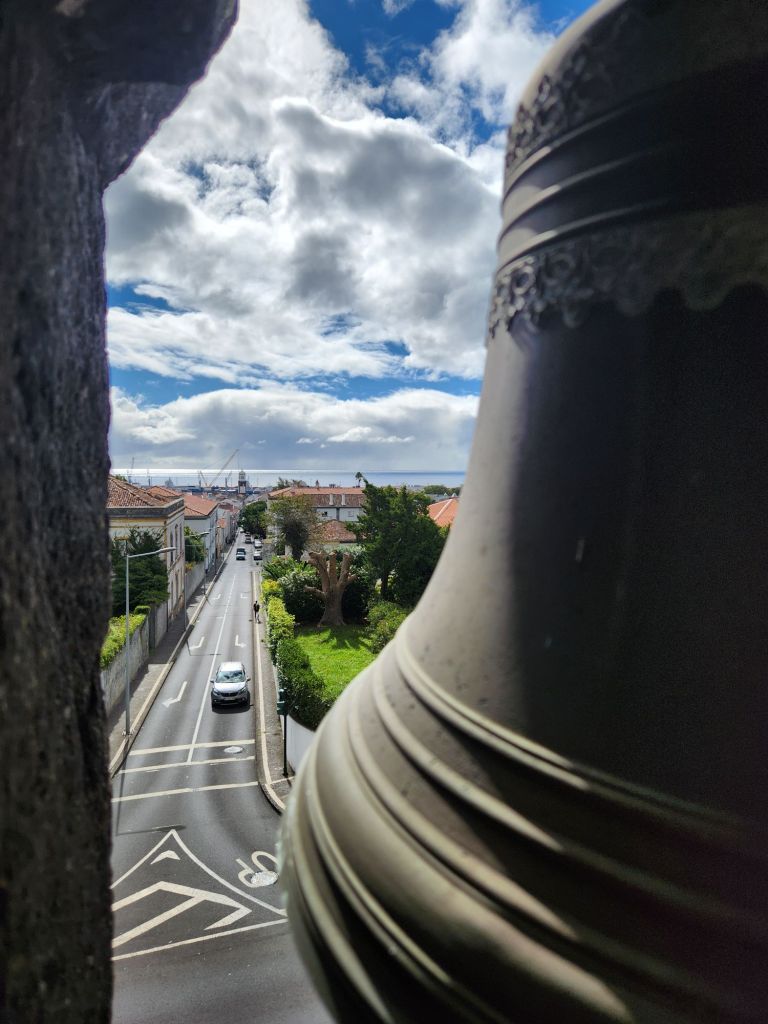
Some of the lovely calcadas – Portugese mosaic sidewalks – that are all over the place in the city. These are outside a government complex. The armed guard at the gate didn’t look like he was letting random “I like to tour government buildings” tourists mosey in, so we carried on.A local citizen who was interested in botony collected a wide array of samples of the flora that would grow well in the region. His estate is now a lovely park with nice views of the city.A church is also attached to the gardens, which I would name, but the map and brochure I was sure I hung onto is nowhere to be found.You can climb up to the bell tower, here is the view back down to the port.One of many lovely churches in Punta Delgada. This one is now a museum. The Portugese came across the islands in the 1400s and have had a presence here ever since.
From Punta Delgada we had a few sea days before going through the Straits of Gibralter (at night, so no photos this time) and on to Spain’s Mediterranean coast. We were scheduled for three stops in Spain before we landed in Barcelona, on the southern coast in Motril, and on the Balearic Islands of Ibiza and Majorca. A planned strike impacting the Port of Barcelona had us missing the stop in Majorca, but we did hit the other two lovely towns.
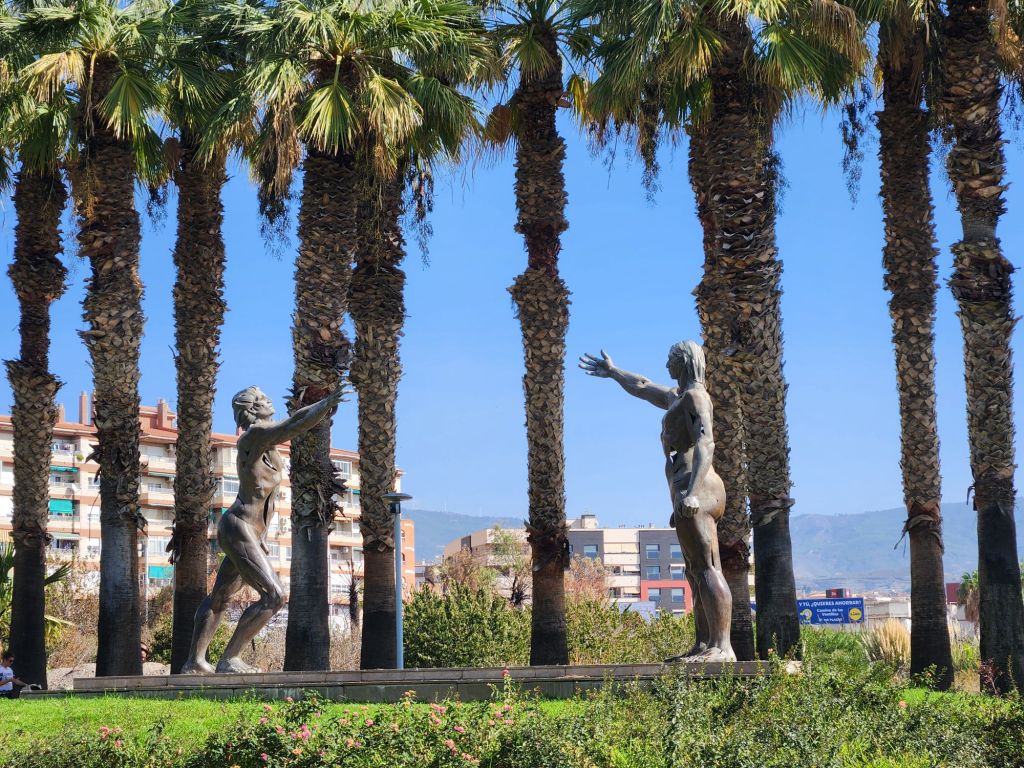
Motril is a stop where most folks go to Grenada, but we just took the shuttle to town and checked things out. It was a bit quiet due to the All Saints Day Holiday, but the town was lovely, and the Pre-industrial Sugar Factory Museum was open!
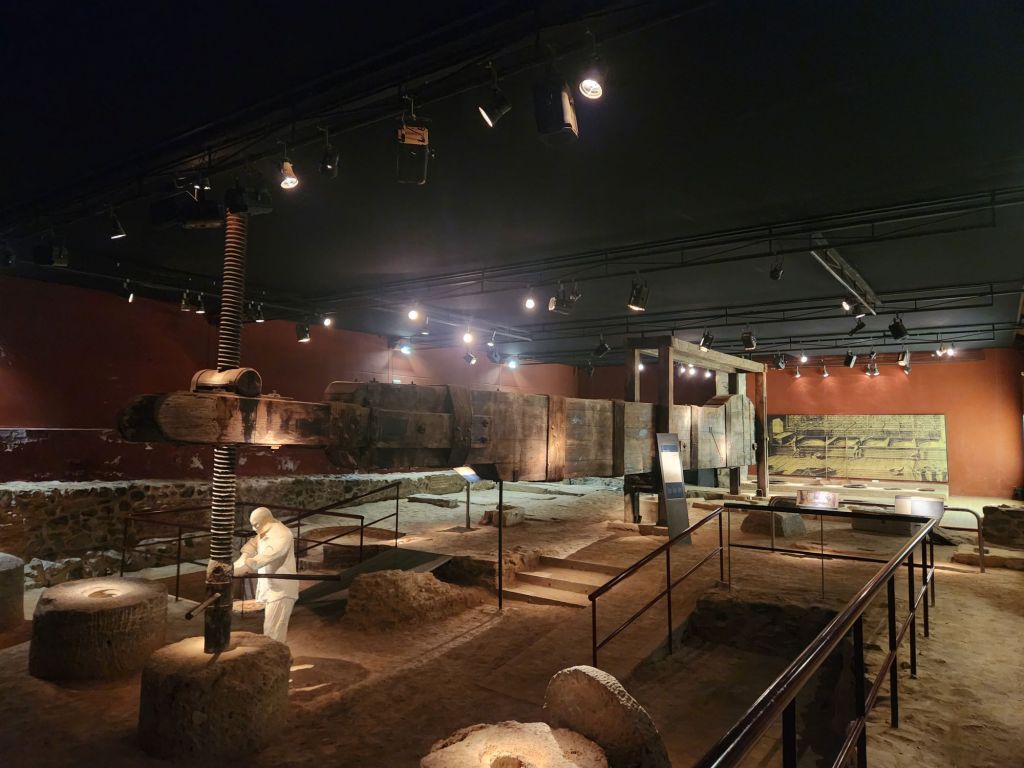
Motril is now a major agricultural area, primarily fruits and cherry tomatoes. But, back in the day, it was a major source of sugar traded in the Mediterranean and up to Great Britain. This caused its own set of problems as deforestation and the monoculture of sugar cane caused flooding, and other problems. The museum is the only one in the Mediterranean, and the site is one of only 5 known former sugar mills of their era. The process for making the sugar was brought to the region by North Africans, and the trade routes were related to the commercial power of Genoa.
The mill, this was a major advance prior to industrialization and allowed for more sugar to be processed, the cane was fed through this mill to squeeze out the juice.The lighting makes this photo a little hard to interpret, but it is a 15 meters long, and there is a double fulcrum process (please don’t expect me to explain it, suffice it to say, the guide did an excellent job) that takes the already milled cane and gets even more juice out of them. The second process is very similar to the processes used to get olive oil.The levers are above these stones with channels. The juice they squeezed out would flow through these channels to a collection point for the boiling of the juice to get the sugar.After boiling for hours, the concentrated sugar cane was put in these clay pots. The pot on top has a hole in the bottom for the molasses syrup to drain, leaving the sugar loaf.Two examples of sugar loaf. The larger one is what would have been produced here. The size was standard and was how the sugar was taxed. Apparently, the regional government, in Granada, levied very high taxes on the sugar, and that, combined with deforestation (loss of fuel to run the fires), and piracy, made the economics challenging and led to the industry pretty much closing up for many years. It made a comeback in the 1800s when mechanization made the boiling of the sugar cane juice more economical.The city also had a lovely park which was full of people on this holiday.
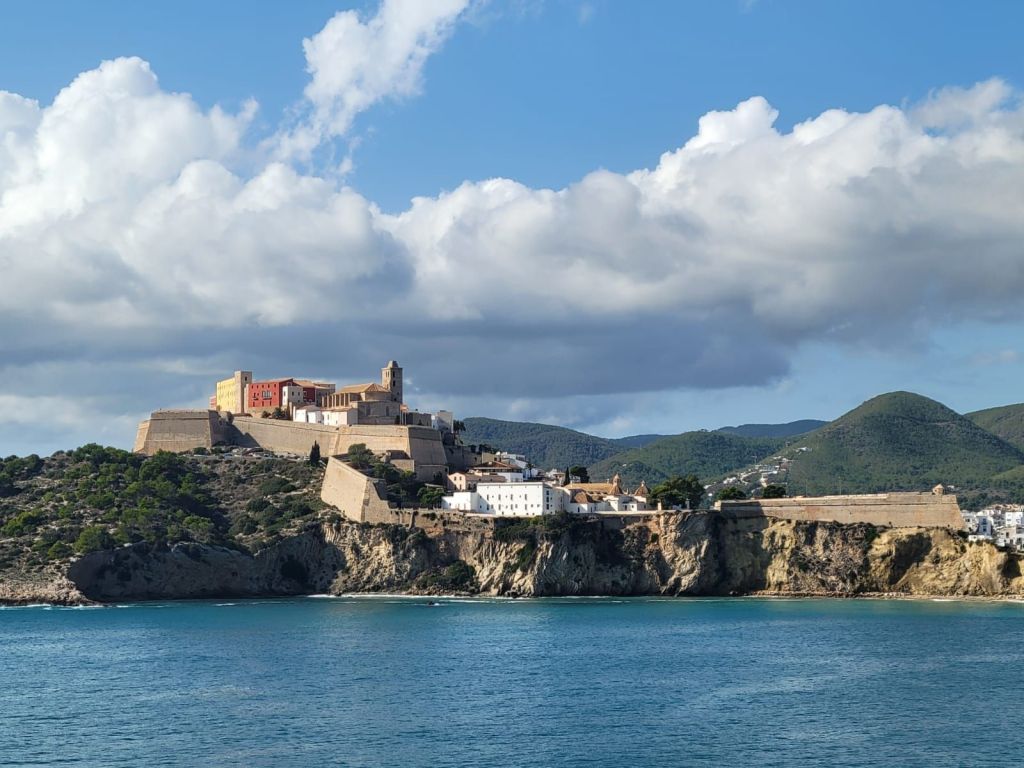
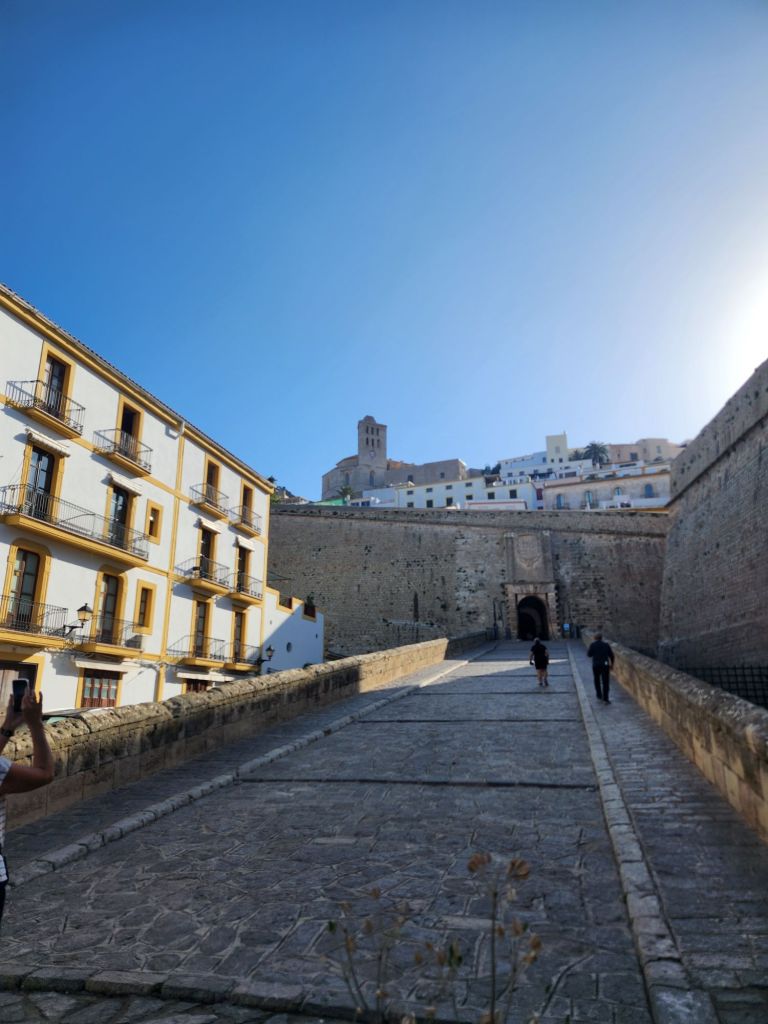
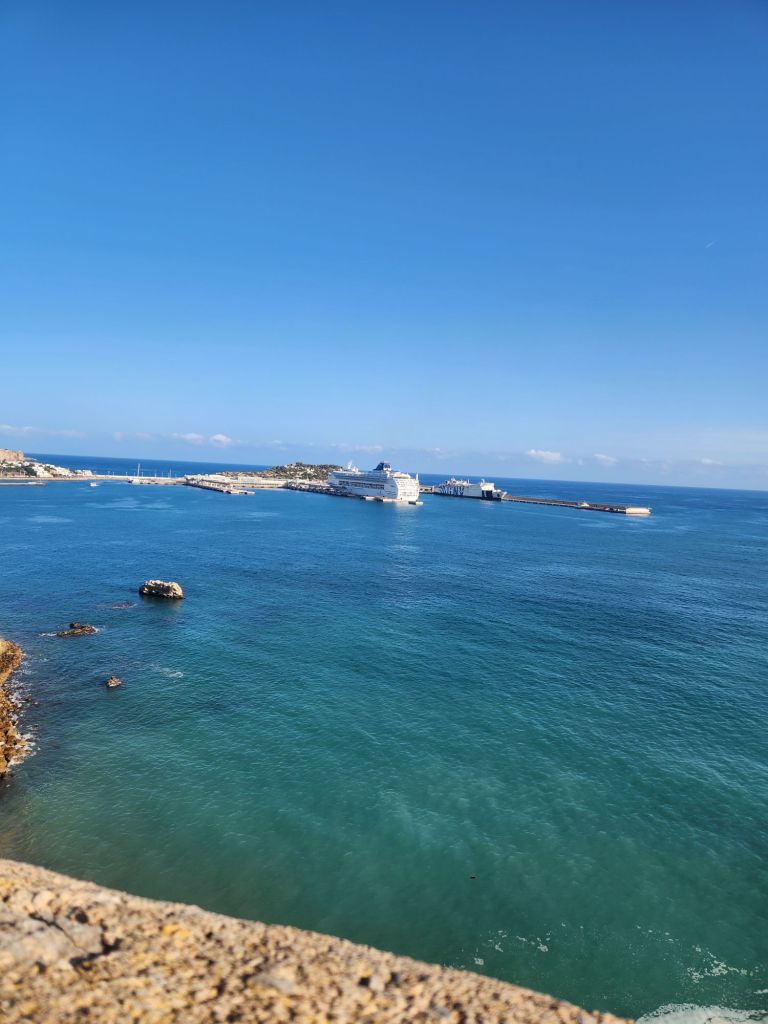
From Motril, we haded to the Ibiza, a popular vacation and party spot! Again, we chose to depart the ship and explore on our own. It was a beautiful day, and we hopped the water taxi from the port to the center of the city. Of course, there was a fortification on the top of the hill. Loyal readers will recognize the theme – yes, we hauled ourselves up there, the forts and castles always have the best views.
A view of the fort from the ship – with a bit of zoom.The gates into the walled part of the city.Some statuary around the gate.Along the way, we met up with someone else who appreciates a good sun hat!One of the many cannons guarding the city. This was a very long and elaborate citadel built over several hundred years. They had really nice signage explaining when and why various fortifications were built. They also detailed how the firing lines worked. It made a lot of forts make more sense!Looking back at the ship from the fort, with the same amount of zoom.The fort after sunset.
Our time on the ship for our crossing was coming to an end. At this point, we learned of the need to skip the last port of call and that we would be docked in Barcelona in the morning. So, I declare the tale of the Great Atlantic Crossing of 24 to be at an end. Our adventures in Spain begin!
Today was a blustery, rainy day in the North Coast of Portugal. So, we decided to tour the canning factory down the street from our favorite hotel in the Porto area. We’ve walked by a bunch of times, but there hasn’t been a compelling reason to figure out what goes on behind the doors of the Pinhais Cannery & Co. Building. Well, a quick Google search later, and I’m buying tickets for a factory tour, sardine, and wine tasting included!
We put on our rain gear and made the 10 minute walk through the neighborhood for our tour. As we checked in, Madalena said she had checked out our blog. I am such a bad blogger, but now I have a challenge to my bloggerdom! So, here we go:
The Pinhais cannery has been run by the <singular version of Pinhaus> family since 1920. Three generations, all of them – grandfather, son, grandson – sharing the same name, first and last, and building. Our tour started in the 104 year old entry lobby of the factory.
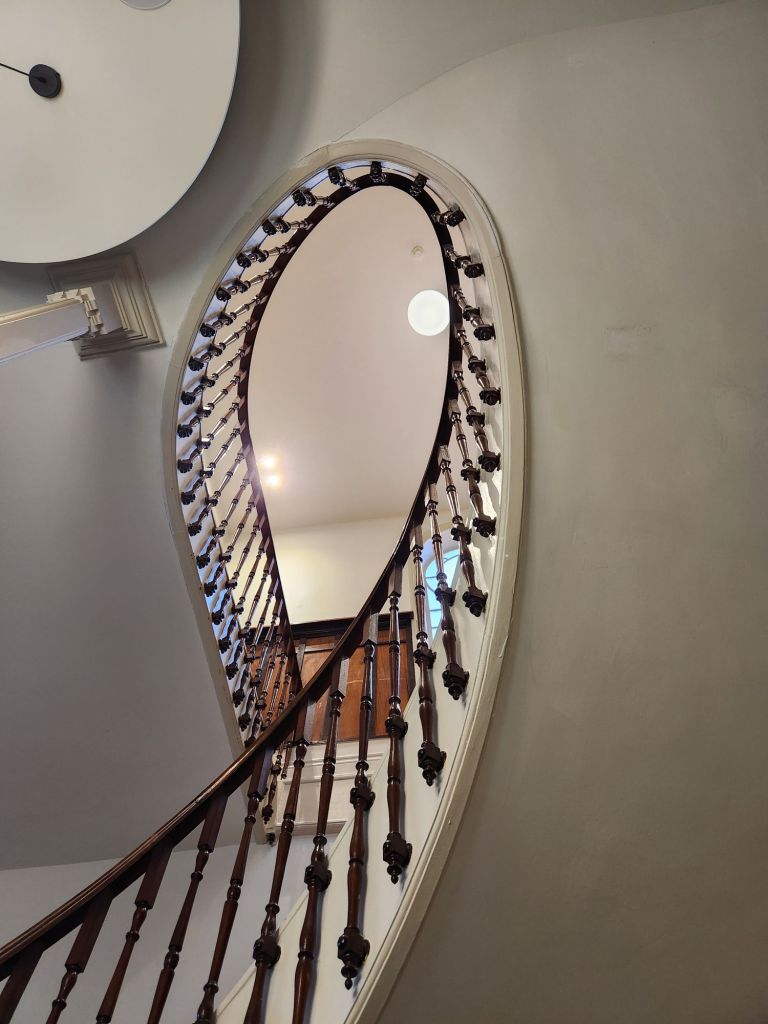
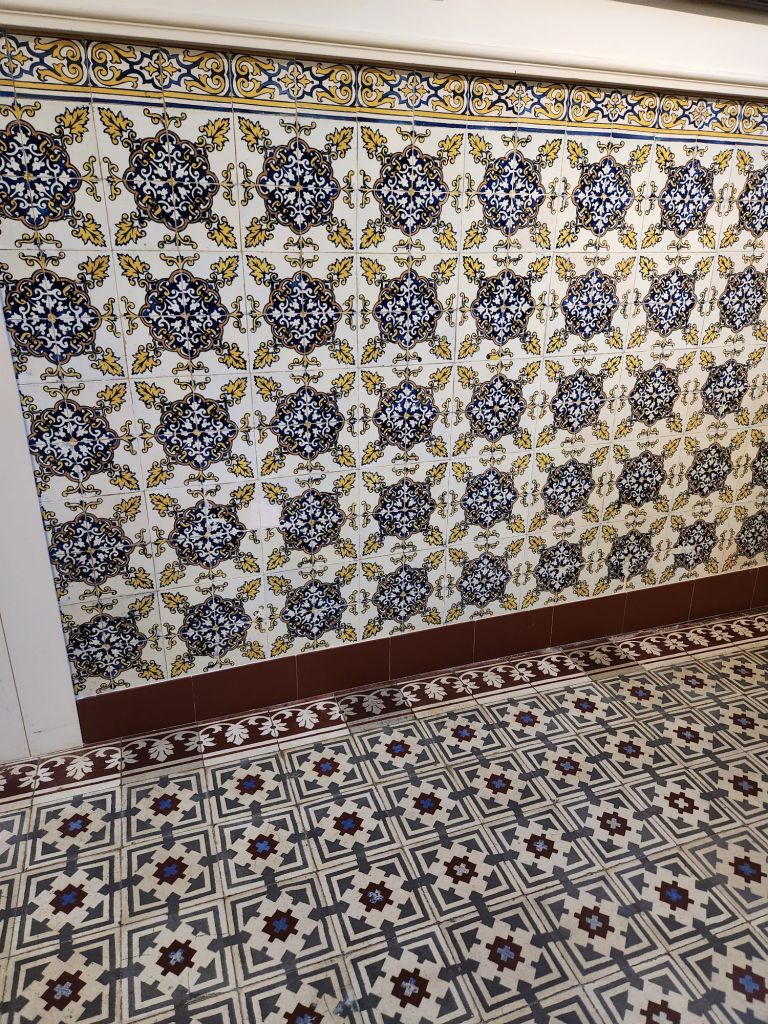
The sign above the door.A pretty fancy staircase to the executive offices.If you squint a bit, you see the staircase looks like a sardine with the light for an eye.I love all the fancy tile in Portugal.
Our guide gave us a bunch of information about fishing and canning in Potugal. They consume more fish here, per capita, than anywhere else in Europe. There used to be over 50 canneries in Matosinhos, but now only 4 remain. Pinhais is a high end cannery that exports 95% of its product. Apparently, since so many Portugese live near the coast, fresh fish is by far the preferred choice.
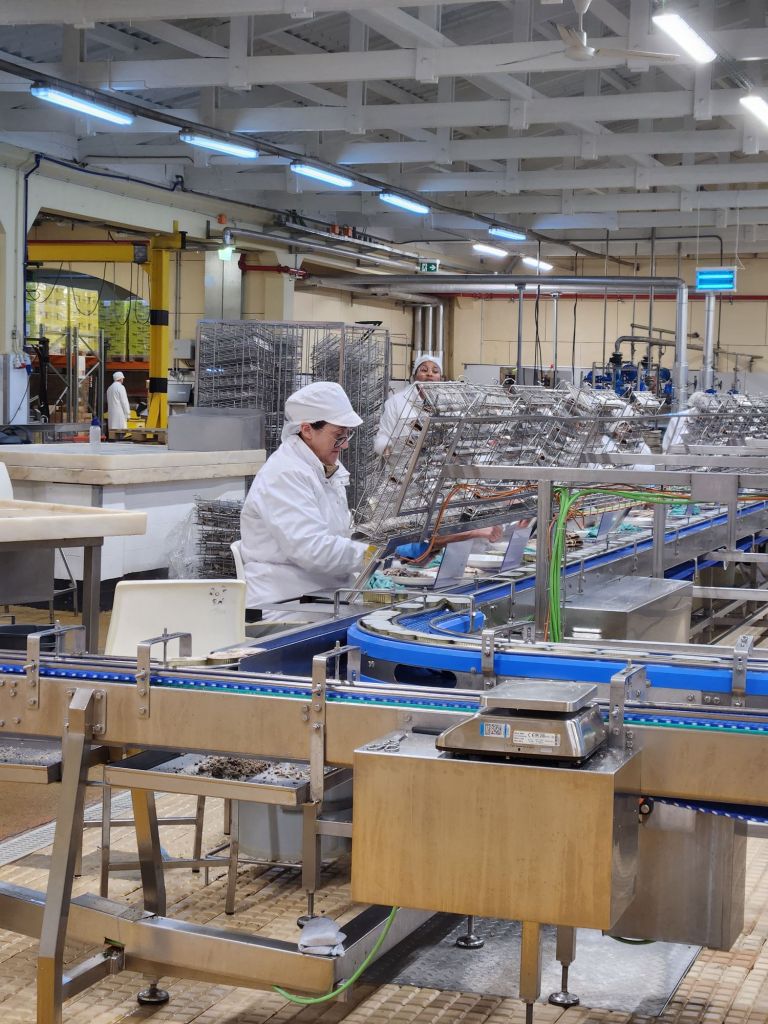
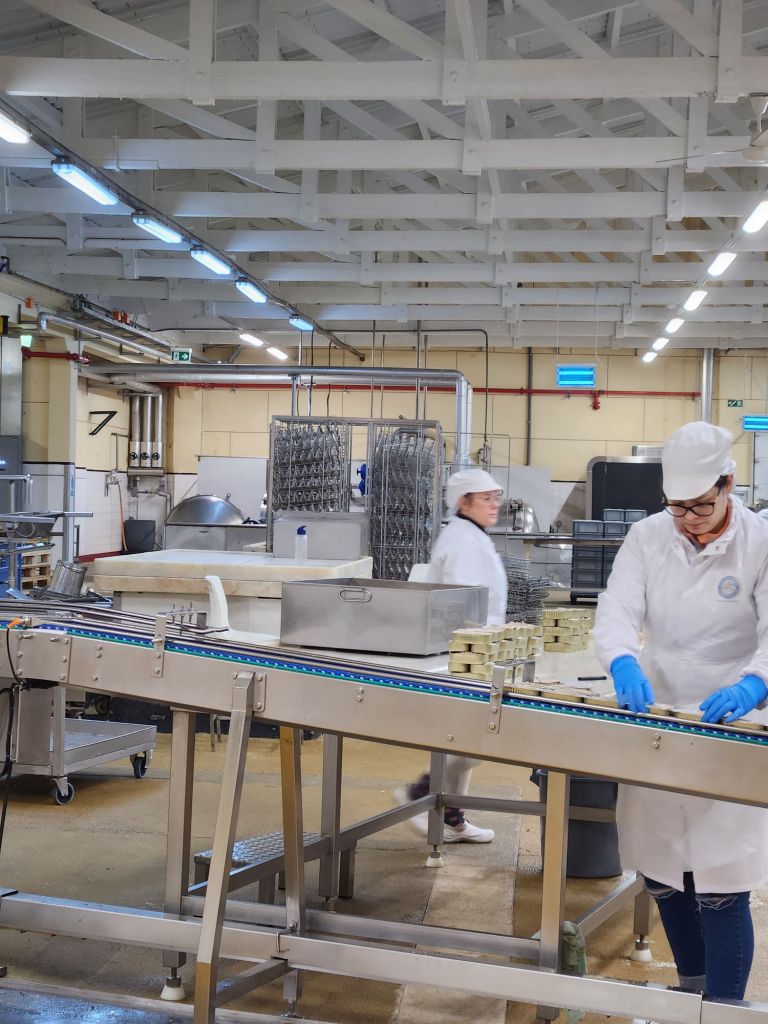
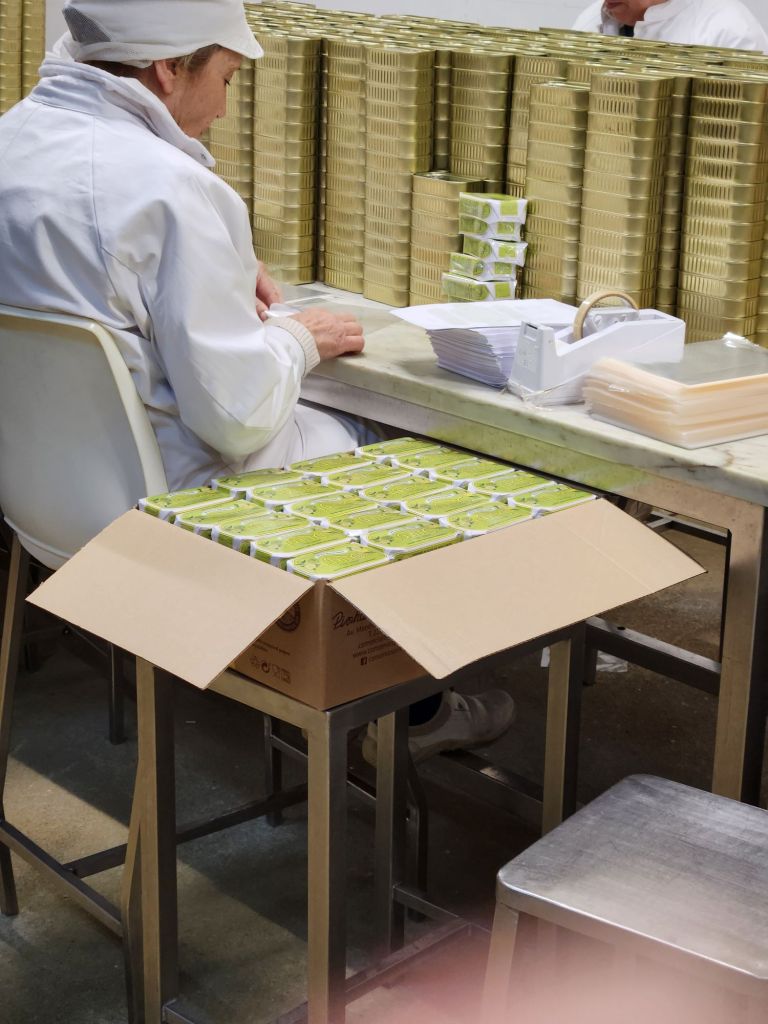
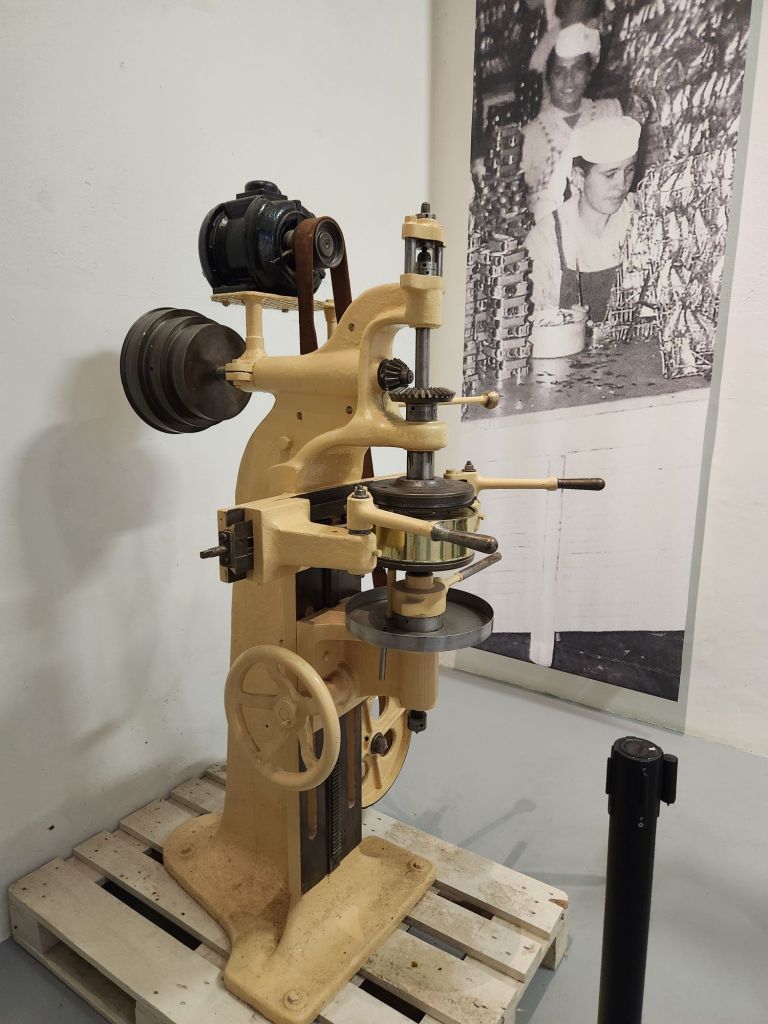
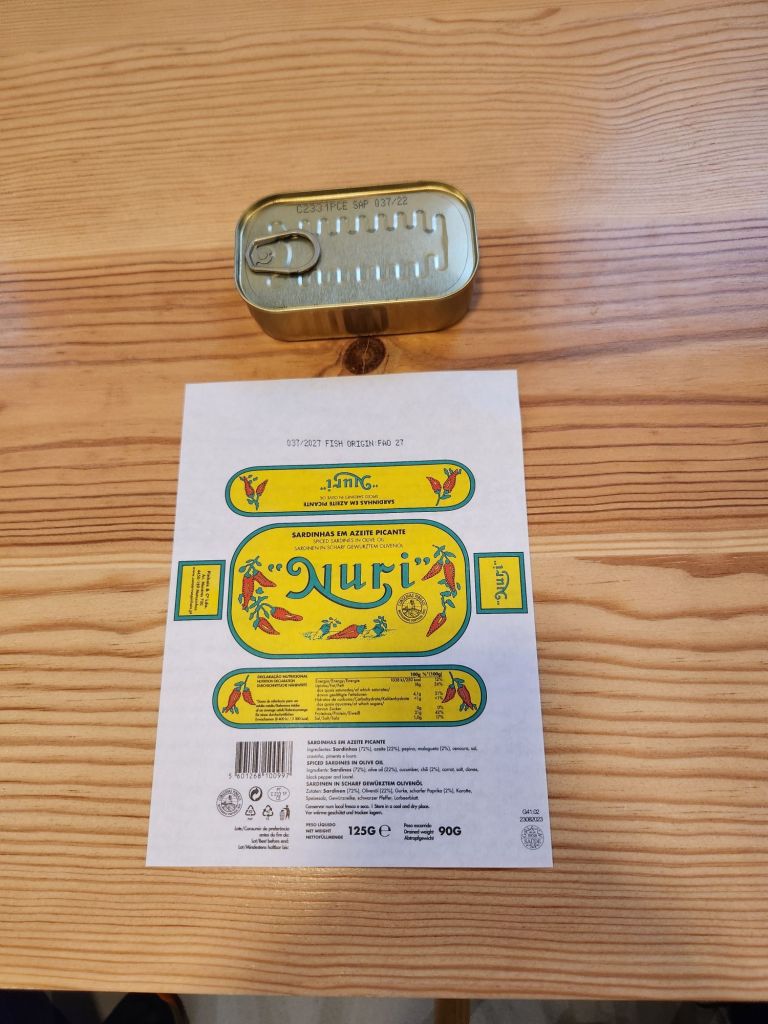
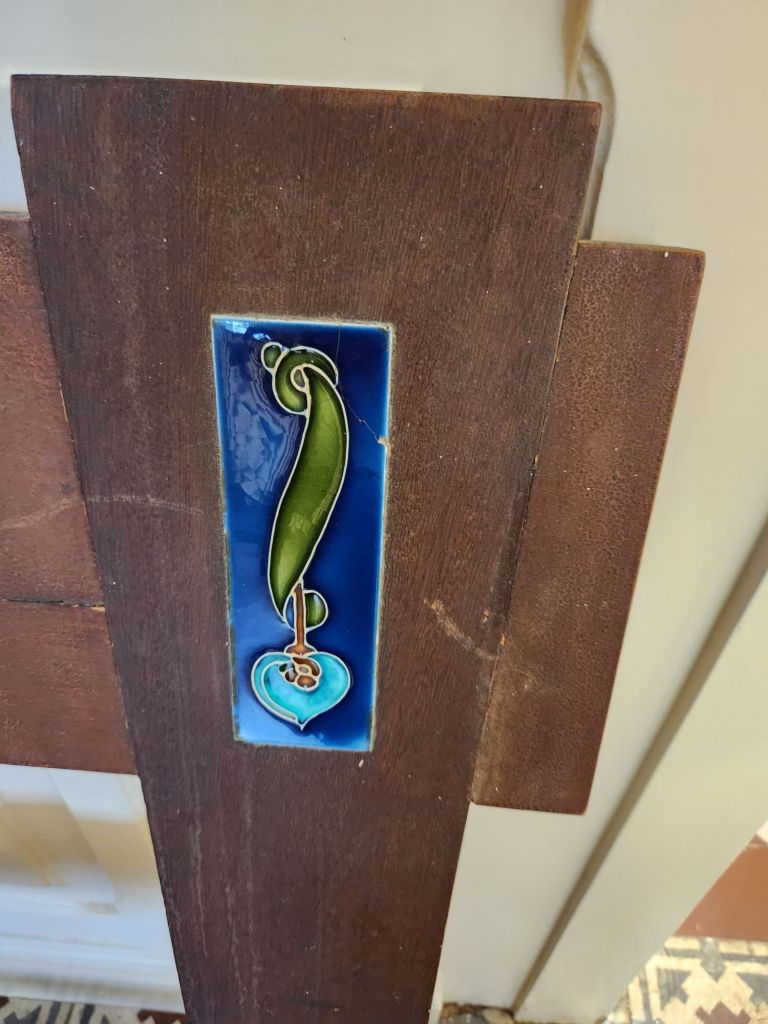
We had to get suited up to hit the production area!Quality control. There are about 120 people working in the factory, and there are 110 women and 10 men on the team. They can produce up to 20,000 to 25,000 cans of sardines a day, which is 5 to 7 tons. This usually happens during the summer season and depends on what’s available at the market. They buy fish daily from the auction at the fish port a few blocks away. The secret ingredient to their success is the tomato sauce, which is made by 2 long-term employees, mentioned by name, in the back room. Apparently, quality control knows the recipe too, but no one is telling!Pinhais is a specialty cannery, and the product is canned almost entirely by hand. They brine the fish, and then they remove the head and guts. When done by hand, this can be done in a single cut. Fortunately, we were there for the afternoon tour, and that process was not happening as we walked through the area. From there, the steam cook the fish, trim them, add the seasonings, and fill the cans. The fish are canned, with olive oil and seasoning – some spicy – and then it “seasons” in the can for at least 90 days before it is hand wrapped with the label. There are 8 women who specialize in wrapping the labels full time. They can wrap 1 can per 9 seconds, about 1400 per day. This doesn’t keep up with the days of maximum canning, but things ebb and flow. For instance, off season, there are days they don’t buy any fish, and everyone wraps. The whole process relies on everyone being able to pitch in. When the fish arrive after they have been purchased, everyone cleans, then they can!A canning machine from back in the day when they also made their own cans.The original desk from the shop, and our wonderful guide Miguel.A can of sardines and a label. Our assignment, wrap the can!Success! They then gave us the opportunity to buy the cans we wrapped. Of course we did!The benches near the entrance had these beautiful tile accents.Our spicy sardine tasting, with wine. Yum!
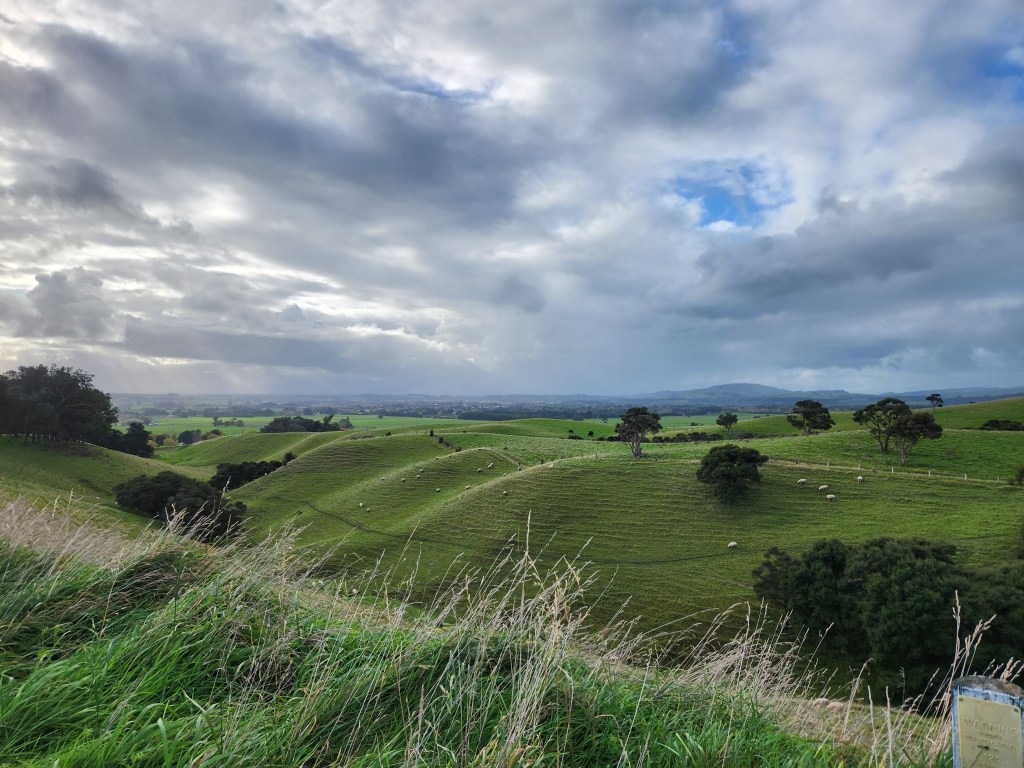
We did some wine tasting in the Martinborough region over the last few days. This is a tiny winemaking region, in size, in production, and in many cases in the size of the wineries. New Zealand produces about one percent of the world’s wine. Martinborough produces one percent of New Zealand’s wine, and it does it with about five percent of the countries wineries. So, when you go out to taste wine here, you are very likely going to meet the folks who do all of the work, from planting and caring for the vines, to harvesting, to the magic that makes the wines. The tasting experience can be very intimate, and, so informative. The winemakers we met all took great pride in their processes and their products. Also, as several of them told us, “when you make such small batches, you make the wine you like.”
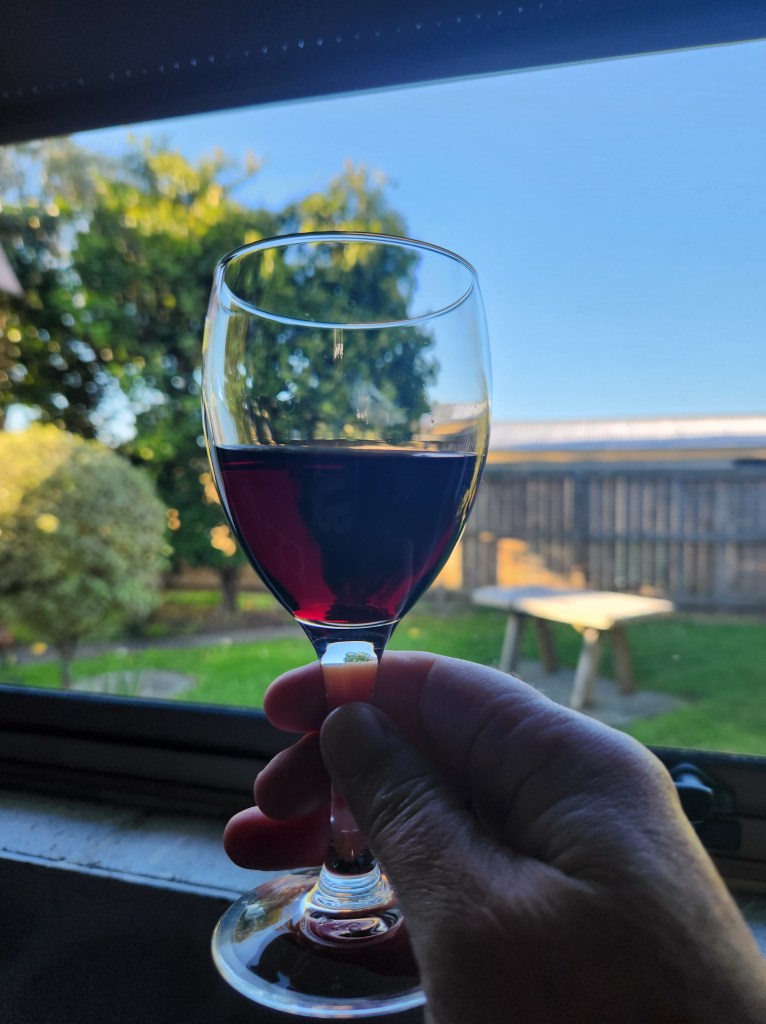
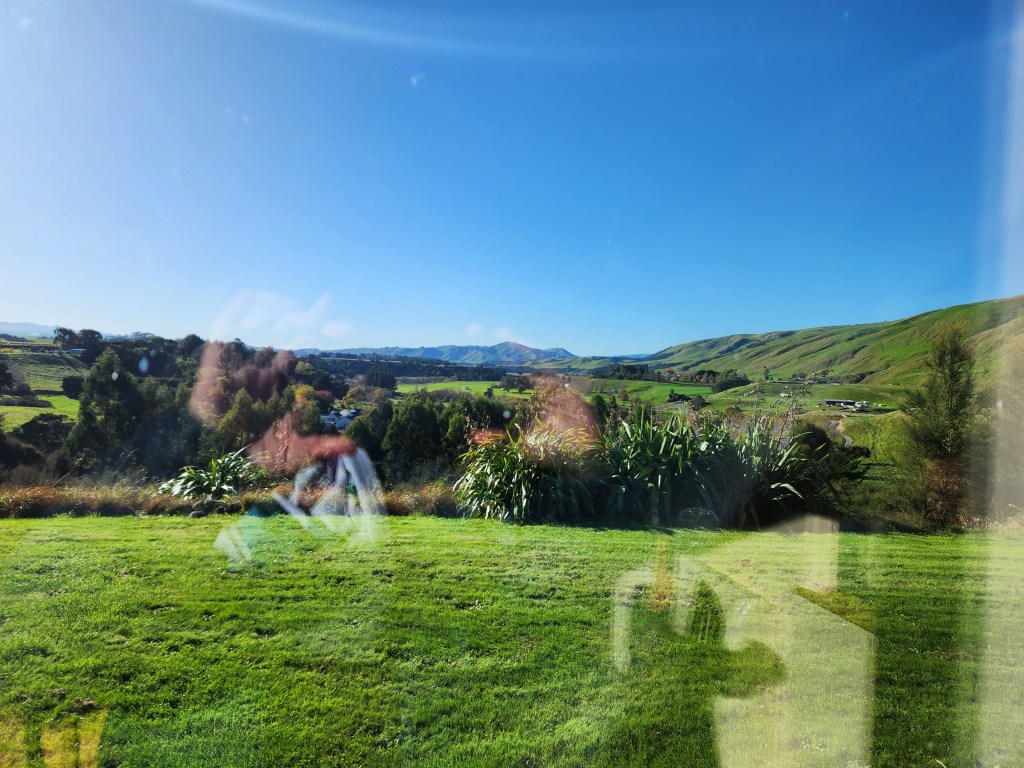
The region specializes in Pinot Noir, and it is such a lovely color. It is also a really nice wine.The region has had agricultural roots since the 1800s, and has rivers and lakes flowing around the hills and mountains.The view from the “tasting room” which is also the winemakers’ kitchen at The Elder. Needless to say, we were very impressed they are able to produce delicious wine and some pretty amazing olive oil when they could just sit here and enjoy the view.Another great view from the area around Martinborough.One day we took the Martinborough Wine Tour, and had a fun group as we traveled around. Lee, our guide, and some New Zealand natives made for a fun afternoon. On the tour, we found out about some of the different methods and varieties for making wine from the grapes grown here – mostly Pinot Noir, Pinot Gris, and Sauvingon Blanc, but also some Merlot.
Martinborough was mostly a quiet agricultural region until the 1970s, when they had some agricultural scientists from the government come out to help them determine how to “revitalise” an area that was losing population. When the scientists looked around, they determined that much of the “river terrace” in the area was similar to the soil in Burgandy, France, and combined with the weather, grapes might be a good crop. There had been some vineyards in the area in the past, but they had not been optimized for the region or well cared for, so the government offered incentives to pull out the old vines. A few brave souls – including one of the soil scientists – planted some vines and started a small wine industry. In the 1980s, a local Pinot Noir won a big prize and put the area on the map. Because the areas with the right soil are somewhat limited, the wine industry here is both robust and small. There are so many small producers that there is a lovely variety of wine tastes and styles. Plus, the town in charming and the scenery is great.
Prior to coming to Martinborough, we spent a few days in the central part of the North Island in Taupo. While we were waiting for the floodgates to open on the dam for one of the daily “tourist releases” that fills the channel and is worth hanging around to watch, we started chatting with another couple from the area. When they found out we were from Ohio and headed to Martinborough, they said, “You have to look up this winery – an American from Ohio started it!” Well, Mike is actually from Blue Earth, Minnesota, but he and Margaret have a lovely wine and olive oil business. It took a little bit of time on the Google Machine to track down their winery, but an email request later, and we had an appointment for wine and olive oil tasing!
Margaret and Mike in one of the groves of olive trees. They grow four different types of olives and press them in combination to create three different styles of olive oil. We learned about harvesting olives, both by hand and with a harvester – they do both based on the type of olive. We also learned about pruning olive trees. Apparently, the fruit grows on “last year’s growth” so the pruning takes off big sections of the tree to generate new growth. If you prune too much, you get a huge yield one year and almost nothing the next. Their vines, they grow both Pinot Noir and Pinot Gris. When they bought the property, they really weren’t looking to do all of this, they just wanted about five acres, alas, they found this piece of paradise that had just been used to graze sheep, and it was closer to 30. They planted the olive trees, and a year or so later, a friend from town told them they should be using the land for grapes. He talked them into letting him plant the vines, and he was to manage them with minimal help from the landowners. Unfortunately, he passed away after a few years, leaving them with the vines. So, they went into the wine business. The wine is good, and Margaret was one of the folks who admitted to making the wine she likes, so their Pinot Gris is nice and dry and very complex.
We are not really oeniphiles (a new word we learned recently), but we have come to appreciate wine, and really enjoy going to wineries and learning about the wine process. It is one of those things where the more you know about the stuff, the more you get interested in it. It doesn’t hurt that most wine is grown in areas that are incredibly scenic!
No, we don’t know the rules, and we don’t understand the strategy, but we always say we want local experiences. So, when the high level league has a game in the town we’re visiting, we buy tickets and check it out!
The Avis Magic are the home team for this game in Hamilton, New Zealand. They also stayed at the same hotel we did!Introducing the teams, with the mascot. The team in black is the Magic, the team in Yellow is Te Wananga o Raukawa Pulse.
The Pulse raced out to a quick lead. We did understand the scoring, if nothing else. Our seats were pretty high up, alright, they were row Z. No one was sitting right next to us to ask, so we just tried to figure out the game on our own. We enjoyed the action; lots of passing, no dribbling or running with the ball. Players are restricted to zones, and we’re still not sure what prompted a lot of the whistles or actions after the whistles, but it was fun, and we’d go again.
Getting the ball into scoring position.Taking the shot – she made it.
The Magic clawed their way to a small lead in the 4th quarter, and there was an exciting see saw of baskets. The final score wasn’t what the local crowd hoped for.
Where to start? We spent a lot of December and January with Lisbon as our base of operations. This gave us plenty of time to explore the city at our leisure. Which was a very good thing, because there is a lot to do in Lisbon, and it can get pretty overwhelming, especially when it is crowded. Having a base of operation was a nice way to balance how much you can do with some down time.
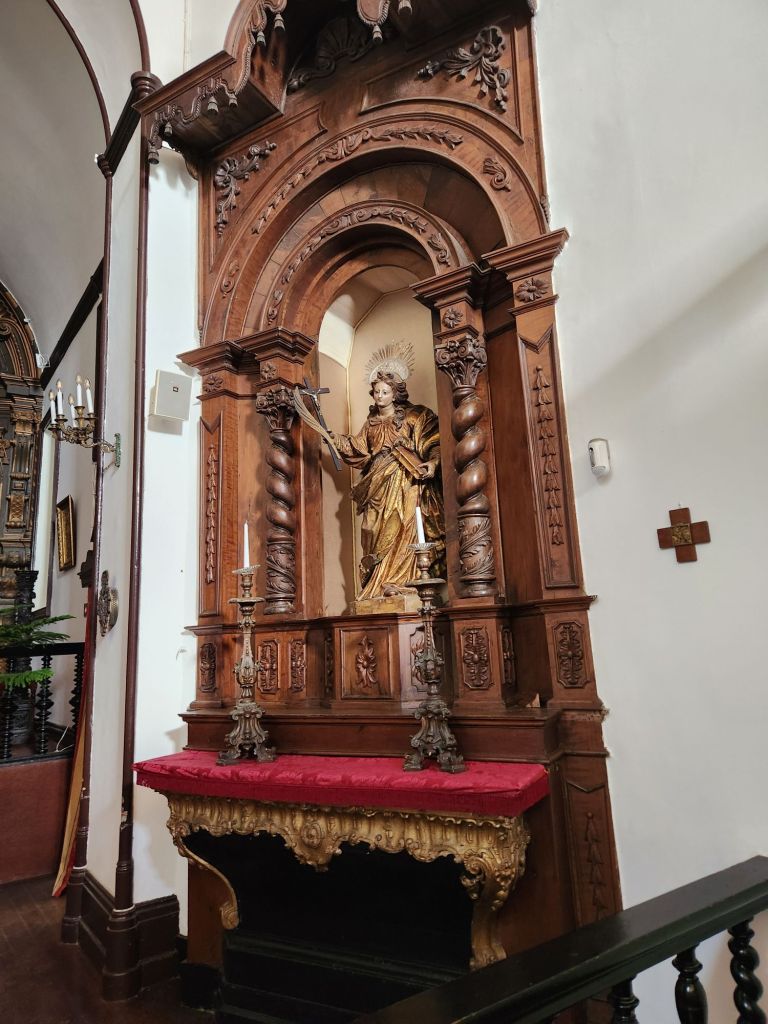
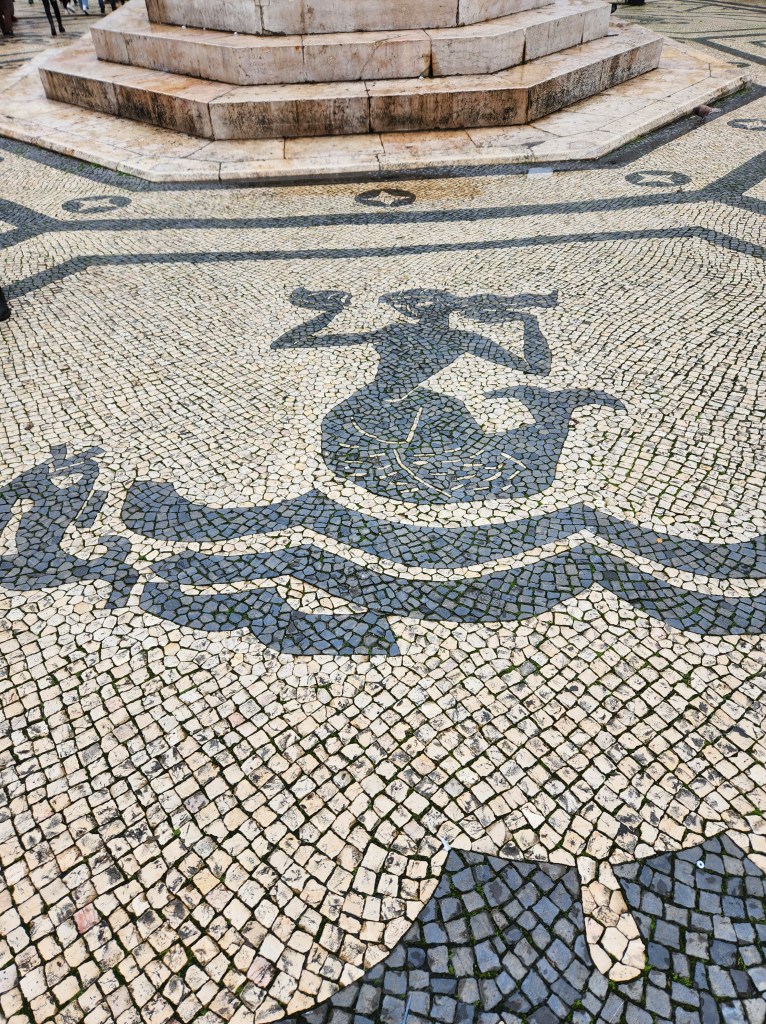
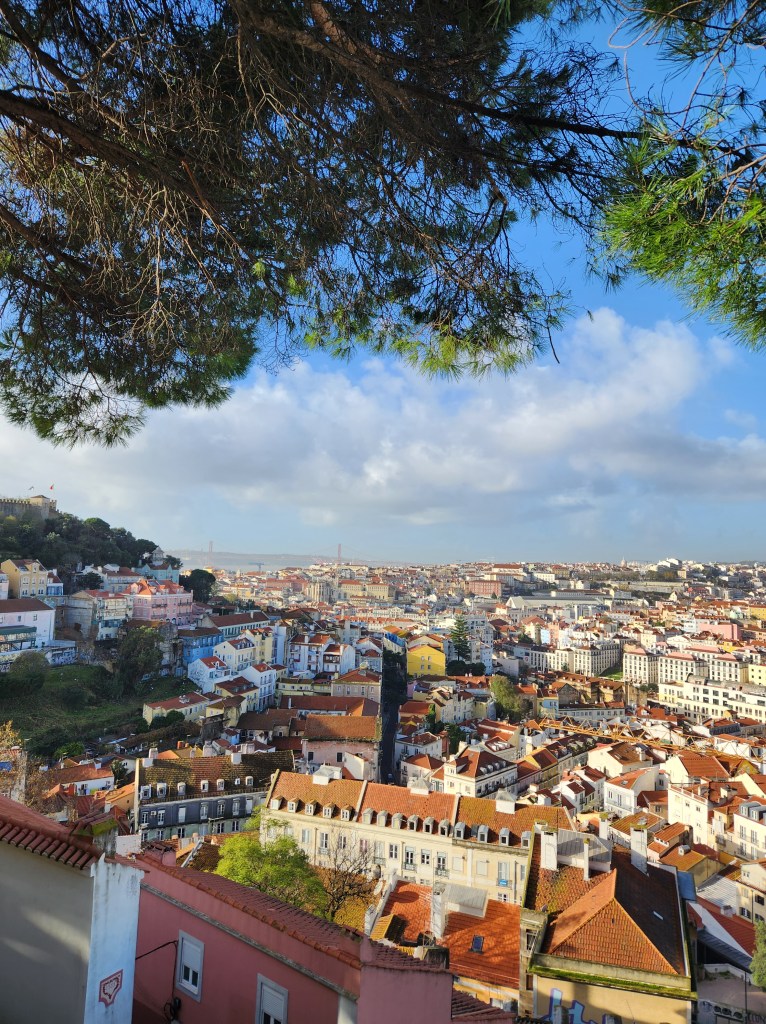
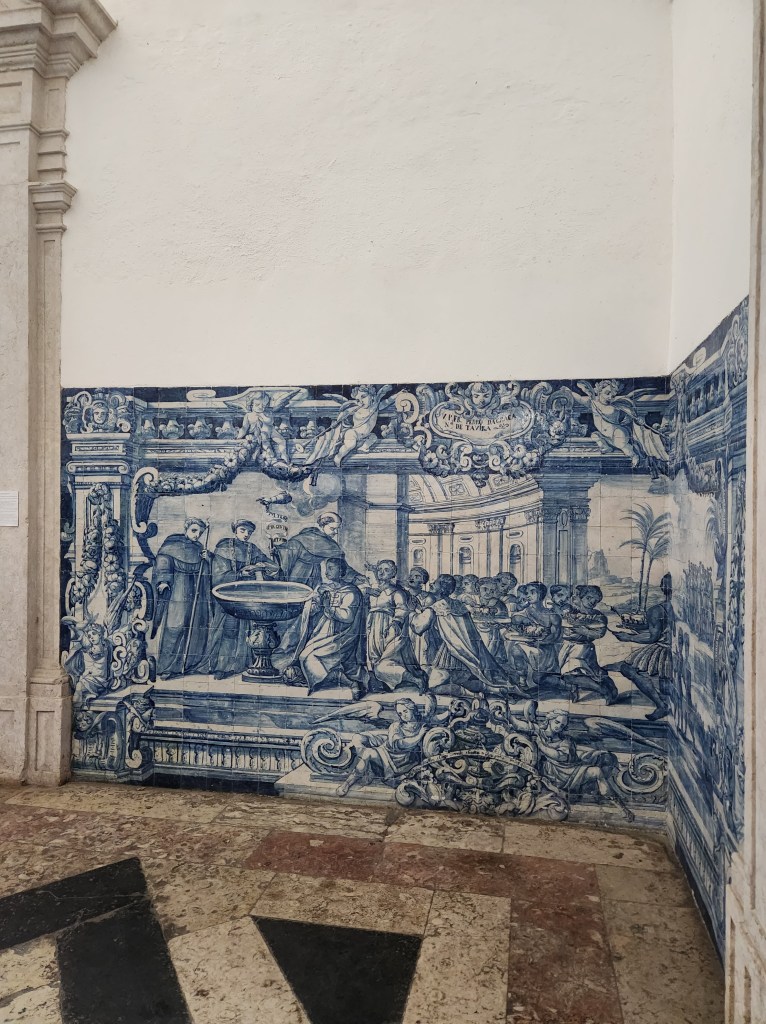
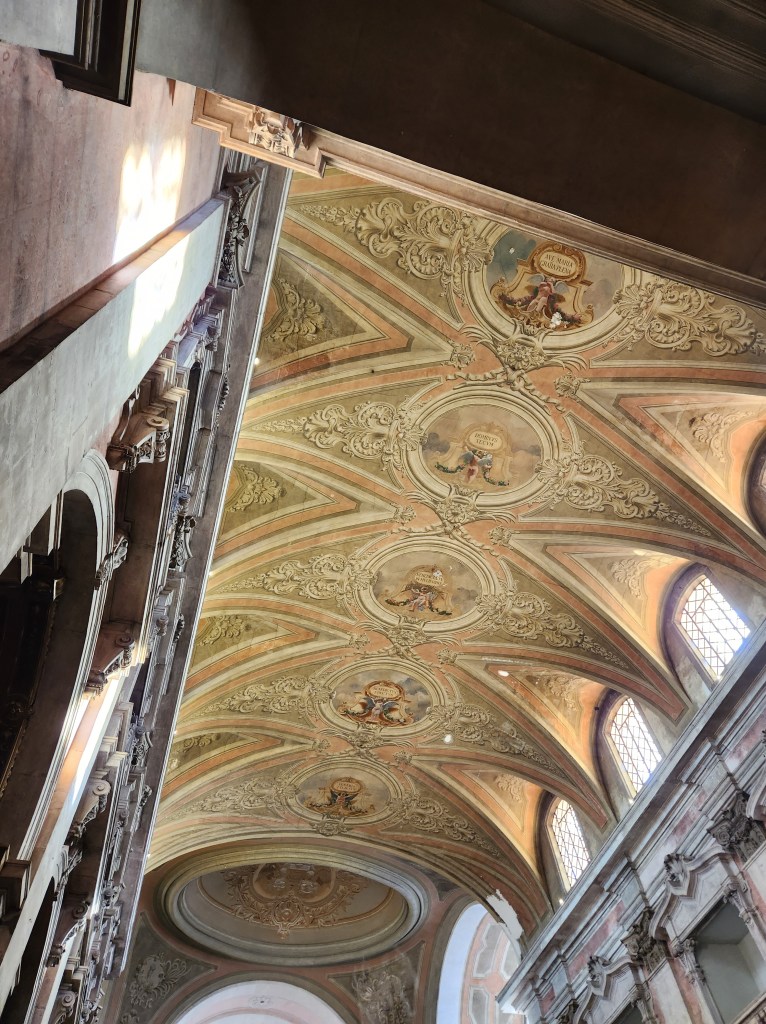
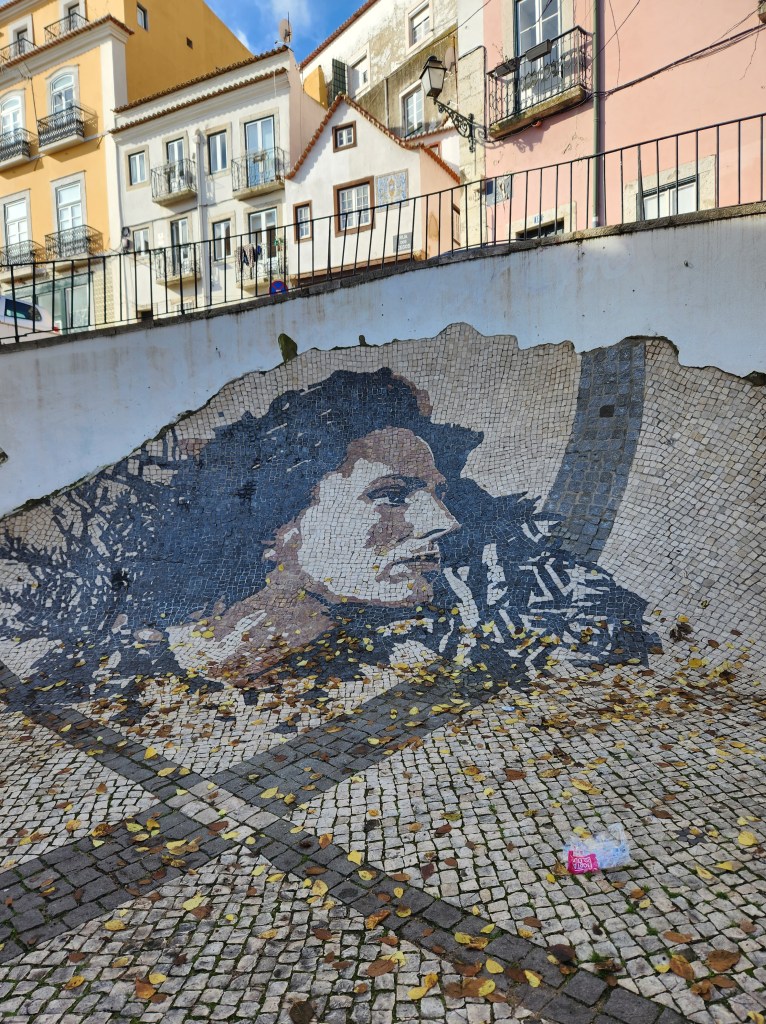
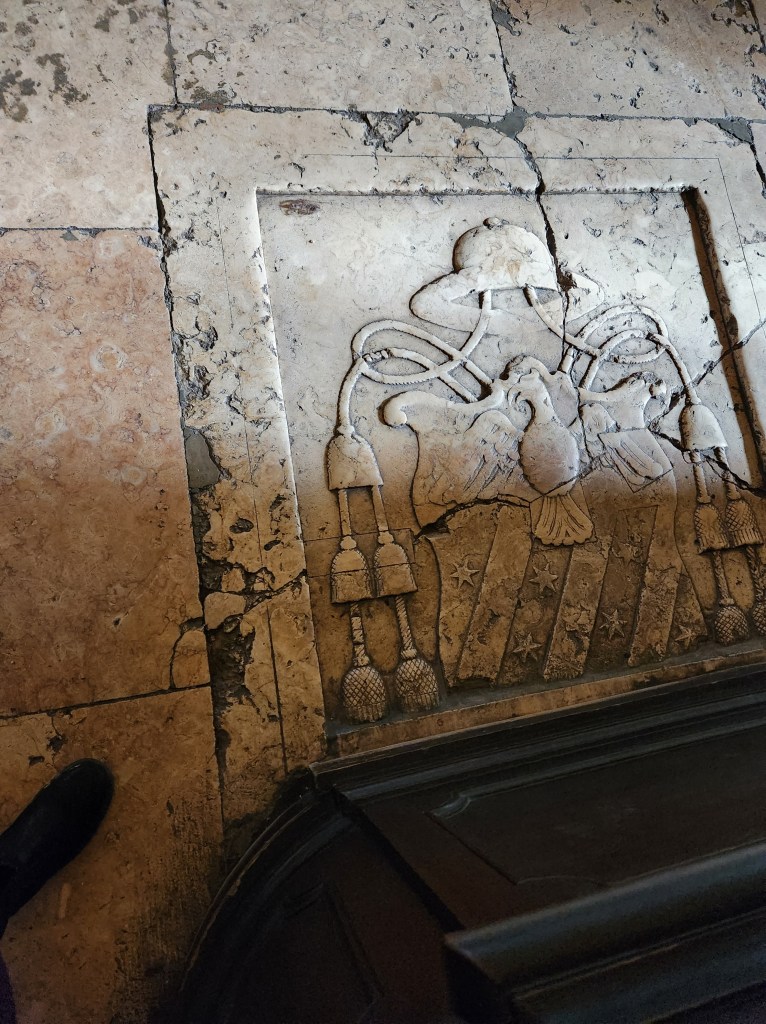
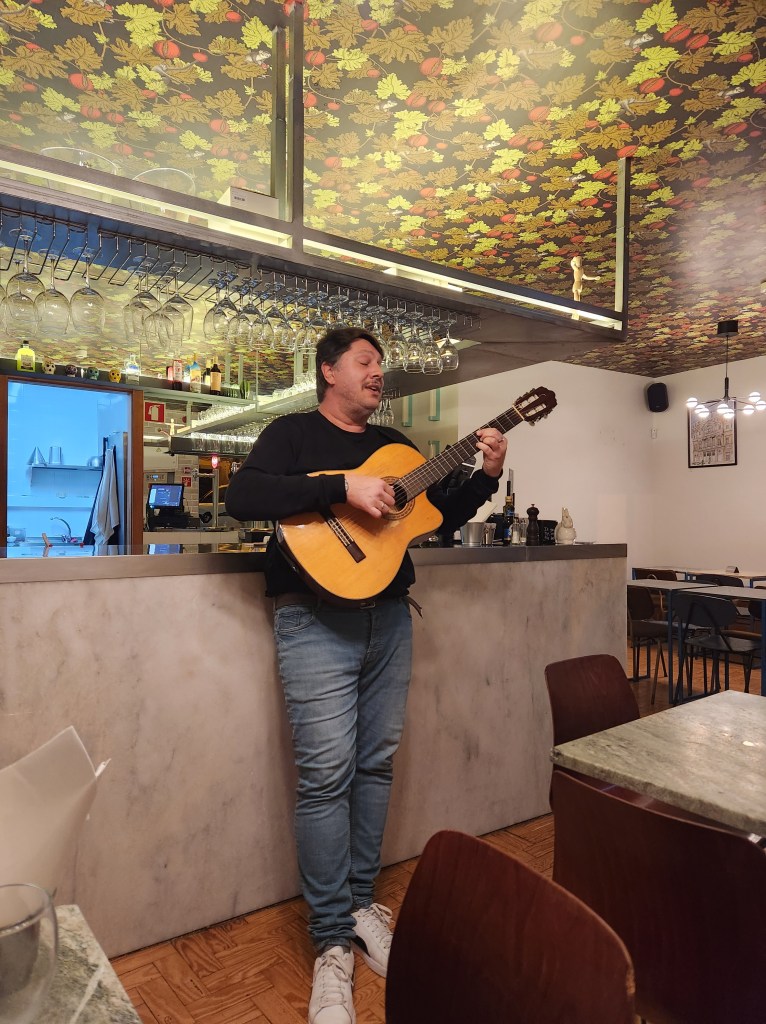
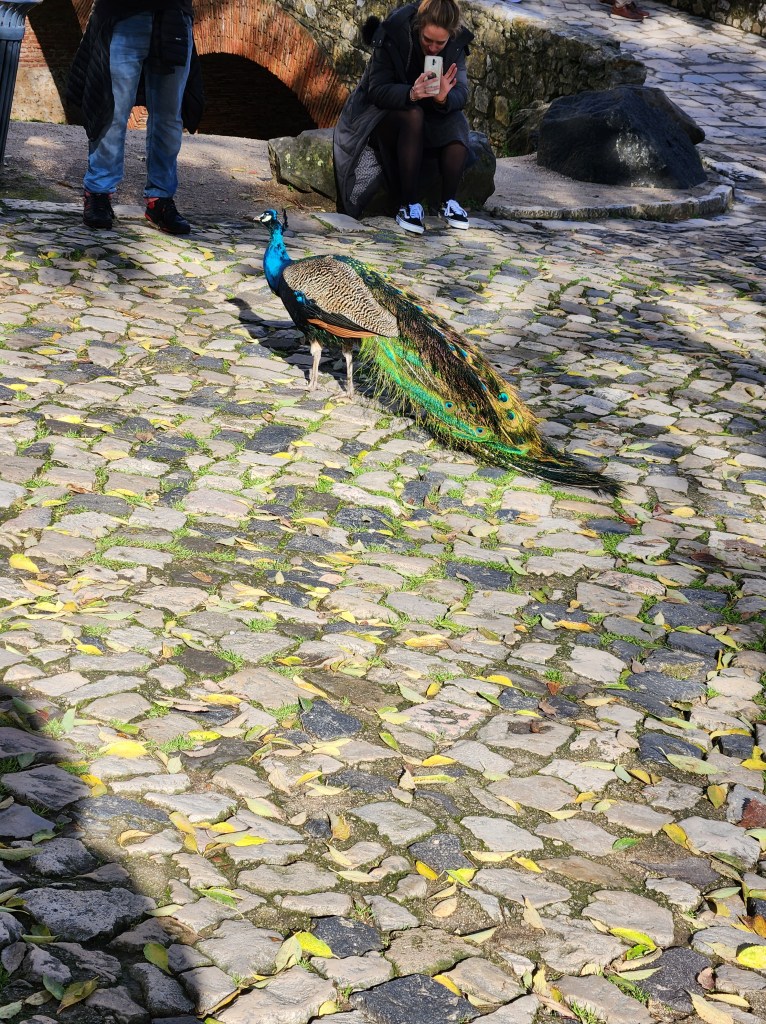
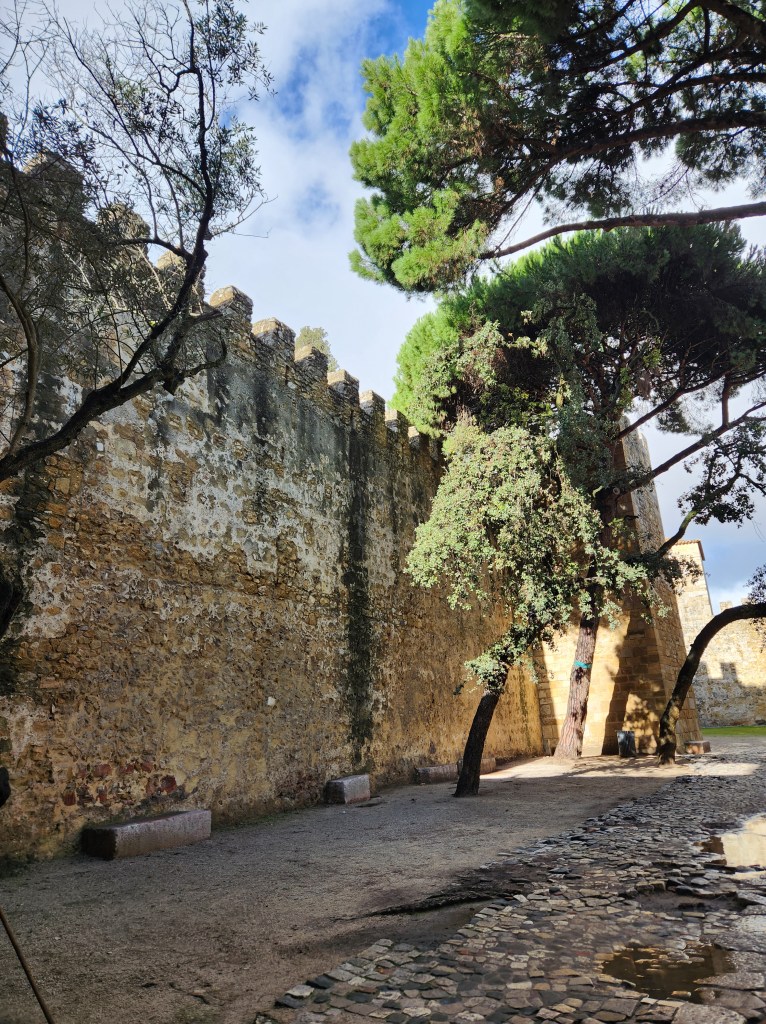
Most of the roads, sidewalks, and squares are paved with stones. This started after the earthquake that devastated the city in the 1700s. In order to reduce mud and make getting around cleaner and easier, the rubble was used around the city. Today? The paving is known as Calçada, and very often includes beautiful and whimsical patterns. This merperson is located in a park near the river.Our stay was over the Holidays. There were lots of lights and decorations around town. We walked past this tree daily as our lodgings were near by. We dubbed it the “cat proof tree.”The city, as seen from one of several miradouros on a hill. Miradouros are viewpoints, often with a park and cafe. Lisbon is a city on Seven hills, so lots of veiwpoints!At the Church in the Graca neighborhood. It began as a Monastery and the dining hall was ringed with these tile murals telling the history of the order. This tile memorialized the conversion of some African Leaders.Inside the chapel. We got some advice early on to always look up. So, here is a shot of the ceiling.One of the enclaves in the church. This one shows some of the black saints, which you don’t see very often.Fado is the music of Portugal, and this is a calçada mural of one of the most famous Fado singers of the 20th century. The mural was done by an artist know for public art around the city and elsewhere. No, I did not have the chance to record the name, but we did see many examples of the art he has done around the city.More street art in the old sector of the city. We saw a piece by the same artist in Coimbra, and there were several more around Lisbon. No, I didn’t get his name either.We were told to look up, but don’t forget to take a quick look at the floors too!Around the corner from our lodgings we found the Bistro Carioca, a recently opened restaurant run by a wonderful couple from Brazil. Both were musicians, and Rafael will bring out his guitar and serenade customers whenever there is a chance. The food was amazing too! Since we were there at Christmas, we got to take advantage of their “take and heat” Holiday Dinner. It was a traditional Portugese cod dish with rice and Brazilian Farofa – ground casava root – made with grandpa’s recipe. Delicious!A wonky lock in our accommodations meant a service call. The very nice man spent a good amount of time trying to fix the electronic lock before he had to just put in a physical key lock. Fortunately, he had the right tools! We sent him off to his dinner with a beer for thanks.At Castelo de São Jorge there are peacocks and peahens roaming the grounds.Very pretty Peacocks.The walls of the castle.
We took a walking tour, one of three we took with the same guide, and were advised to check out the Lisbon Geographic Society to see the collection. We took that advice and enjoyed an informative time looking at the building and many treasures from Portugal’s 19th Century explorations. They had items from India, China, and Africa. Brazil was already independent when the Society was formed, so it was not represented in the collection. The building is worth the visit, and the displays were very interesting.
This is a stone marker left on the southwest coast of Africa several hundred years ago as Portugese explorers expanded trade routes.The Portugal Room. There are display cabinets with artifacts circling the main meeting room for the society.They have a smaller meeting room that also holds a map with the routes around the world blazed by the Portugese.
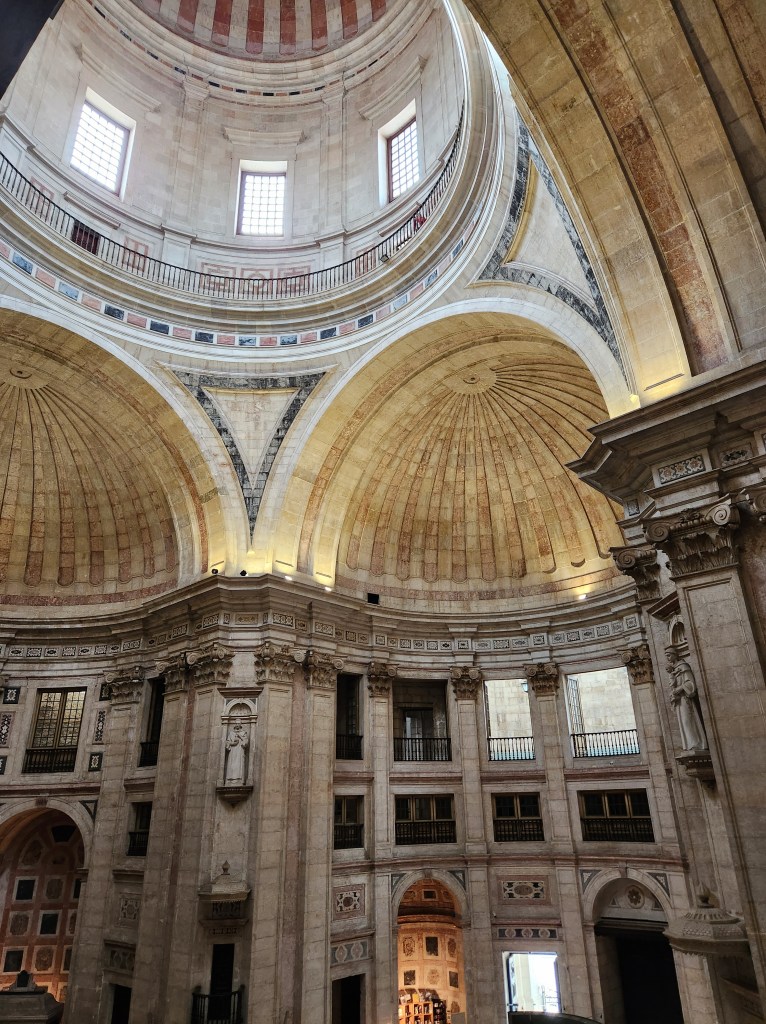
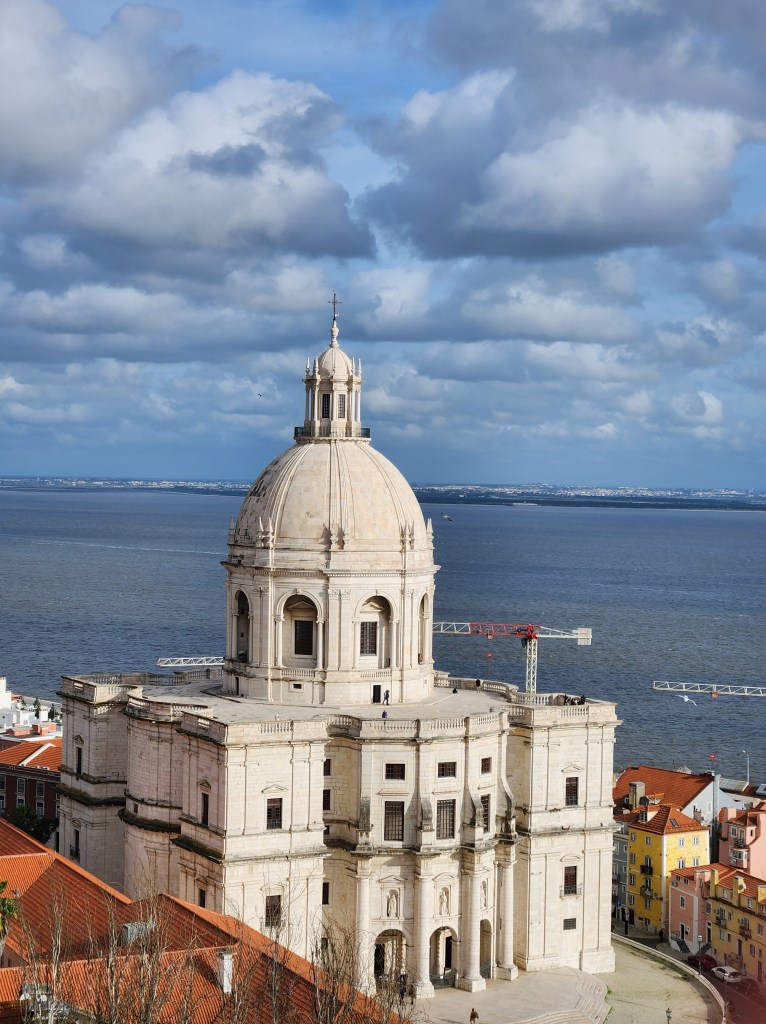
Our guide for the walking tour, Peter, also recommended we go to the Pantheon and the Monestary nearby. Both buildings were well worth the visit. Many notable Portugese are entombed in the Pantheon, politicians, poets, sports figures, and explorers are all there.
The impressive Rotunda of the Pantheon.
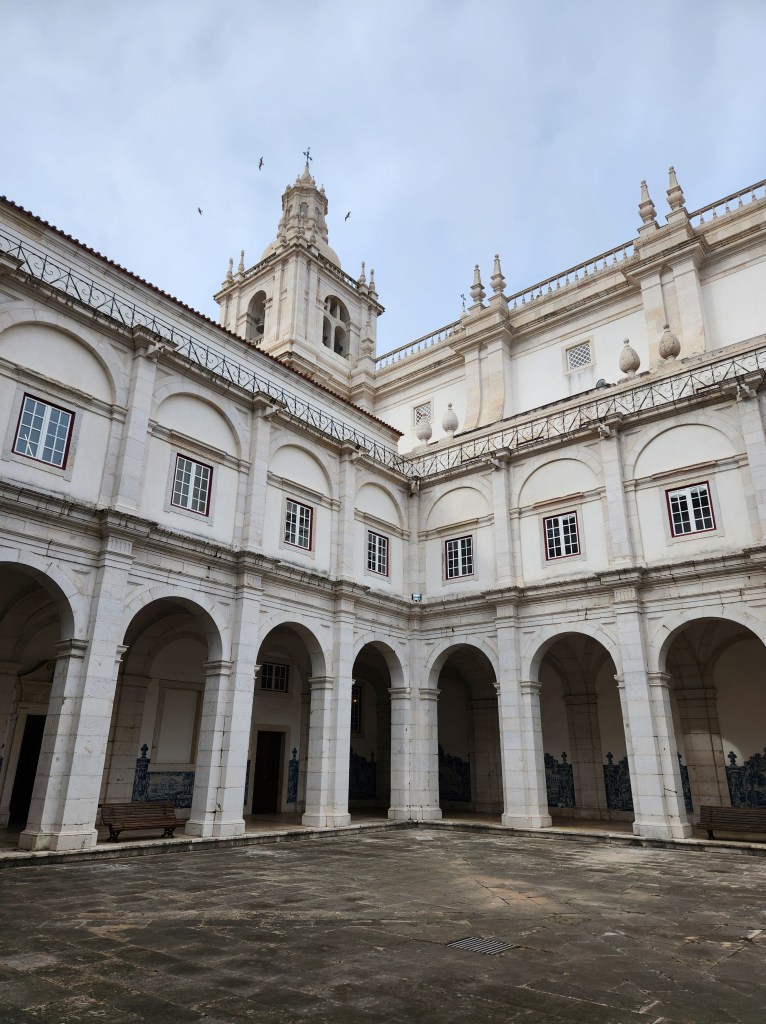
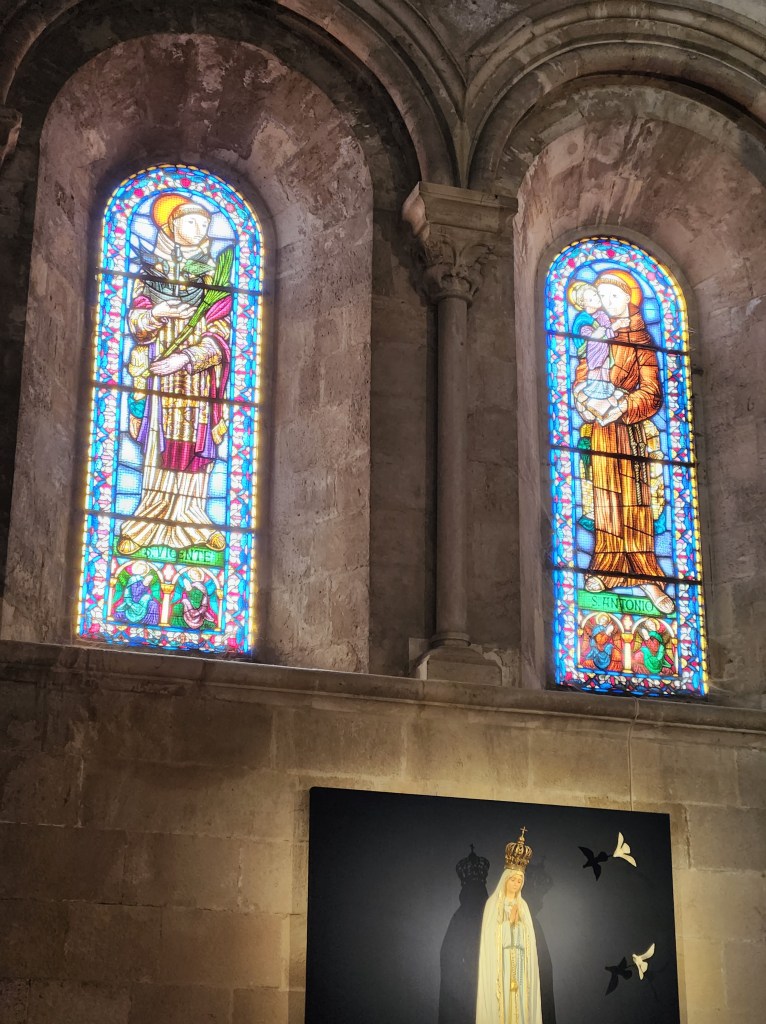
From the Pantheon, it is a short walk, and only slightly uphill, to the Mosteiro de Sao Vincente de Fora. The monestary is well worth the visit for both the building and the exhibits.
Some of the tile work in the receiving room of the Monestary.The floor and railings in the receiving room of the Monestary. It makes for an impressive introduction.The courtyard of the Monestary.A bench in the Monestary with some lovely tilework.The ceiling. Always look up when roaming around buildings, you are going to see some lovely stuff!And look down. Often, there are these markers on the floors of chapels noting burial sites.A view of the river from the roof of the Monestary. This may be the best reason to visit – you can wander on the roof and get many great views of the city.One of the views from the roof of the Monestary is the roof of the Pantheon – which you can also access and look over to the Monestary.The roof – yes, we enjoyed the perspective up here.
We happily recommend the walking tour we took, it was very informative and served as a “sampler platter” of the area because Peter, our guide, recommended various places that were worth a more in-depth visit. One of those places was the 11th Century Se, or Cathedral. Harking back to the rule of Portugals’ first king and rebuilt after the earthquake, it holds a wealth of history and artifacts. And, across the street in the small square, the public toilets are built above some Roman ruins. They are visible from the steps before you need to pay to use the toilets, so you can visit even if you don’t need a pit stop.
Another roof view point, this from the Se (Cathedral) in Lisbon. Another stop well worth the visit. Parts of the 11th century building survived the earthquake, and it has been in use for a long time. That square is where the Roman ruins can be viewed.A view into the Catherdral from the Choir loft.A stained glass window in the Catherdral.More beautiful stained glass.The organ in the Se.
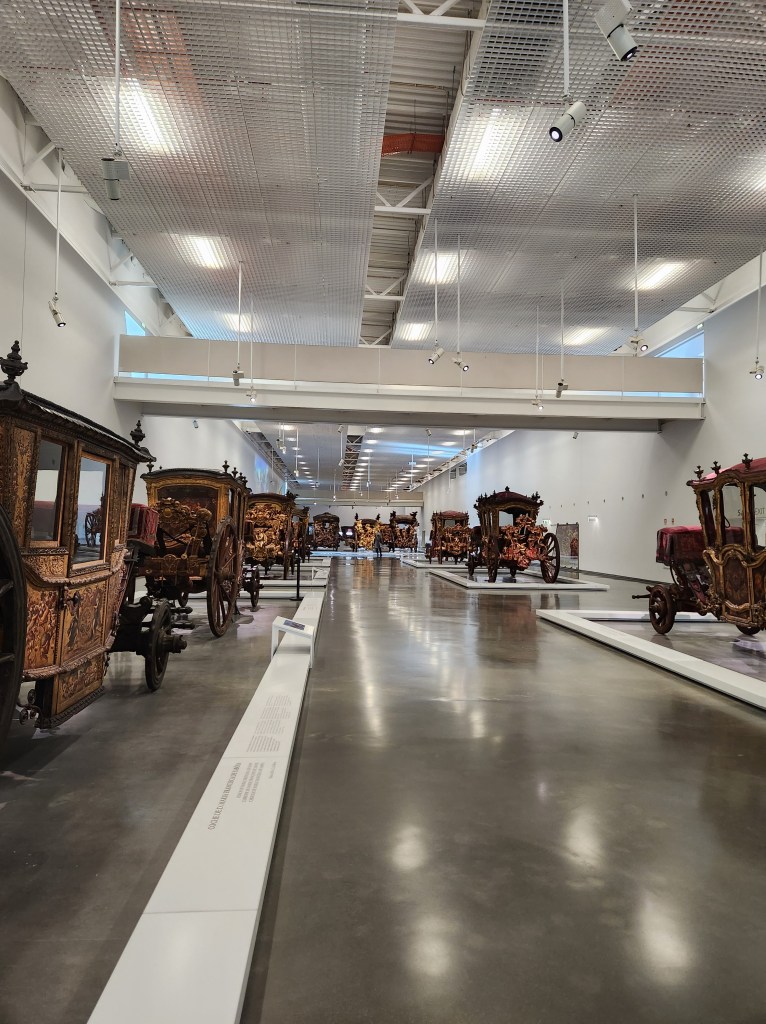
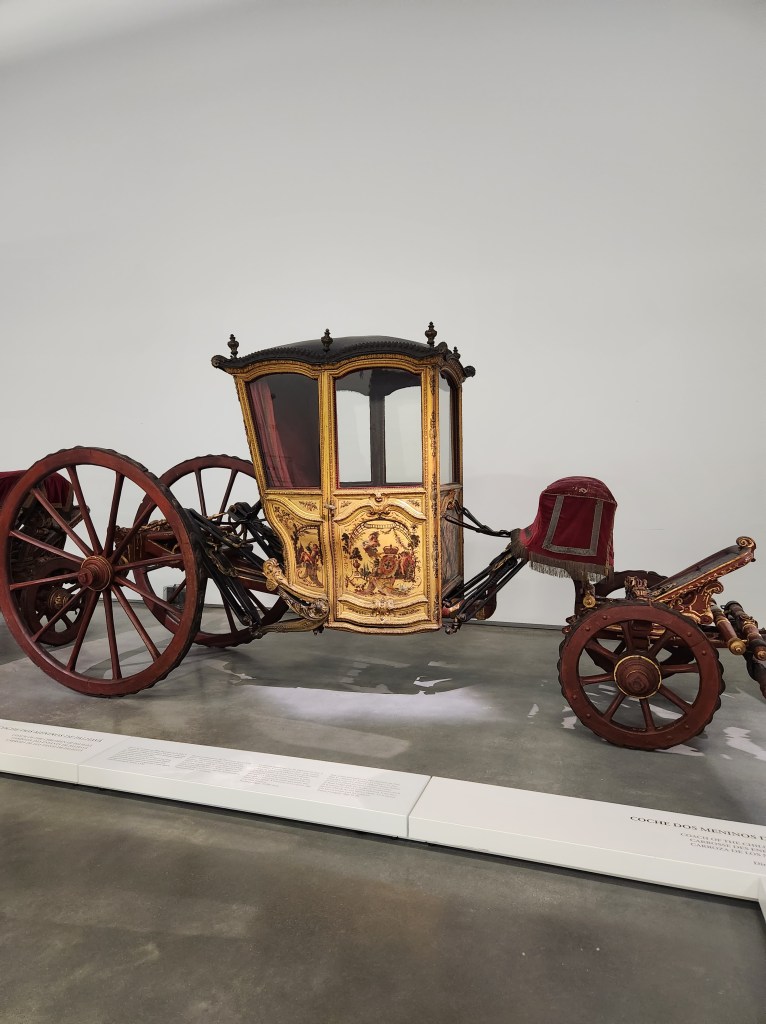
The municipal trains around Lisbon will take you to many notable sights, some are historic, some are beaches, and all are easily accessible and affordable. We took the train out to the west of the city center and enjoyed a lovely day walking along the river and looking at the lines of people to visit some of the iconic sites of Lisbon. As we waited for our return train, we noticed the Coaches Museum across the way from the train station. As it was late in the day and we were a bit punchy, the speculation included “sports museum” and “train engine barn.” When some expats living in the city said ‘it’s well worth the visit,’ but didn’t tell us why, we added it to the plans. It is an amazing museum. There are royal coaches – you know the horse-drawn carriages, like the one that took Cinderella to the ball – dating back to the 1600s on display. They are in great shape, and, even better, the displays have really good interpretive signs detailing the provenance, engineering, and other significant information about the coaches.
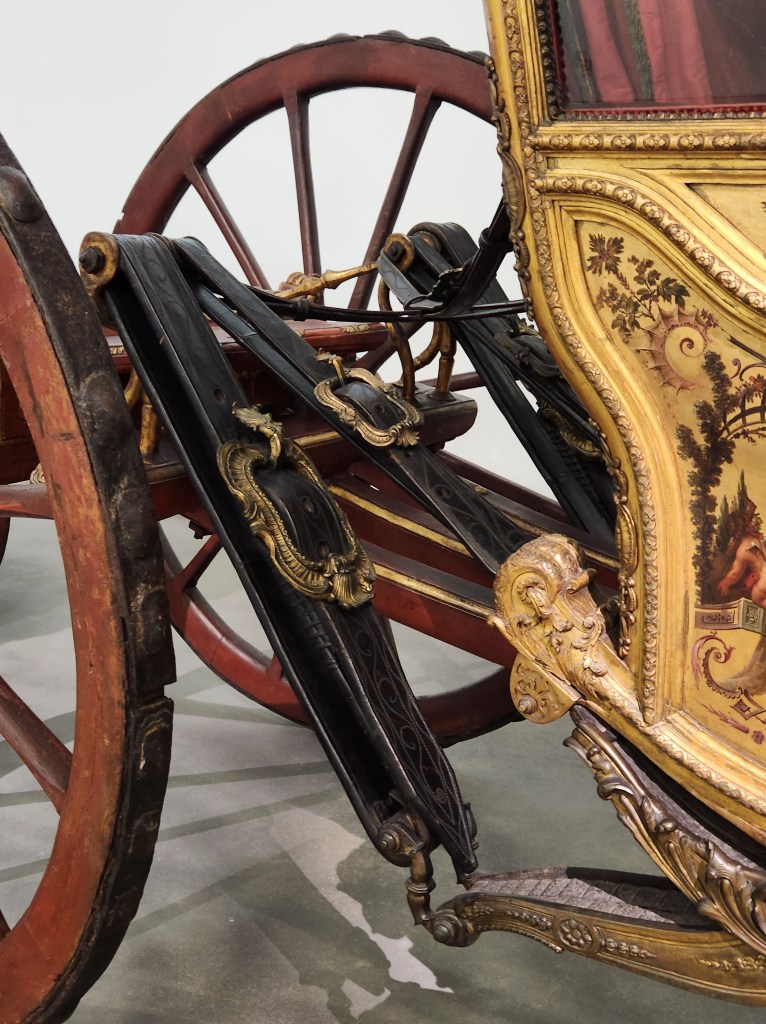
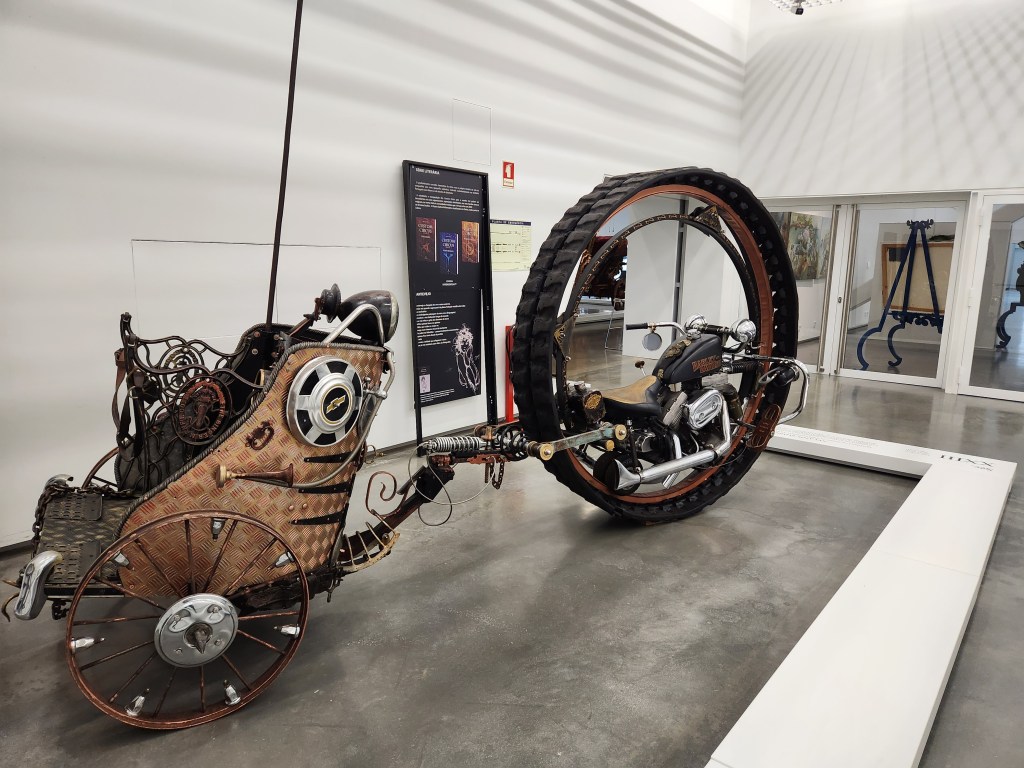
The building is modern, and the coaches are laid out in an orderly and chronological fashion. And there are a lot of them.And they are elaborate. The signs expain who built them, and why. We aren’t huge museum people, but we both agreed that these explanations made the exhibit more interesting and fun.The signage explained that this coach was an early user of a suspension system from Berlin that used the thick leather straps to smooth the ride.A concept vehicle. Not a royal coach like everything else in the place, but totally deserving of its parking spot!Another coach – just go to the museum when in Lisbon. In fact, if you’re on the fence about a visit to Portugal, this place is a reason to go.
With so much time in Lisbon, we indulged in many random activities, including weekend craft and art markets, museums, and long walks that may have included checking out scenic and fancy cemetaries.
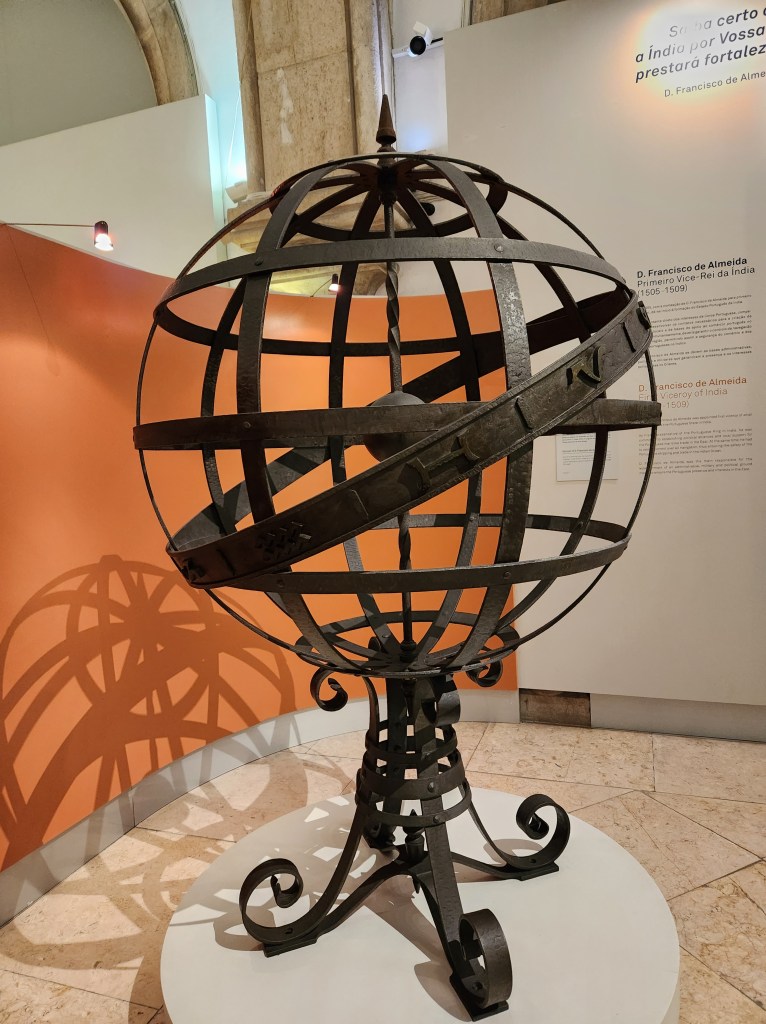
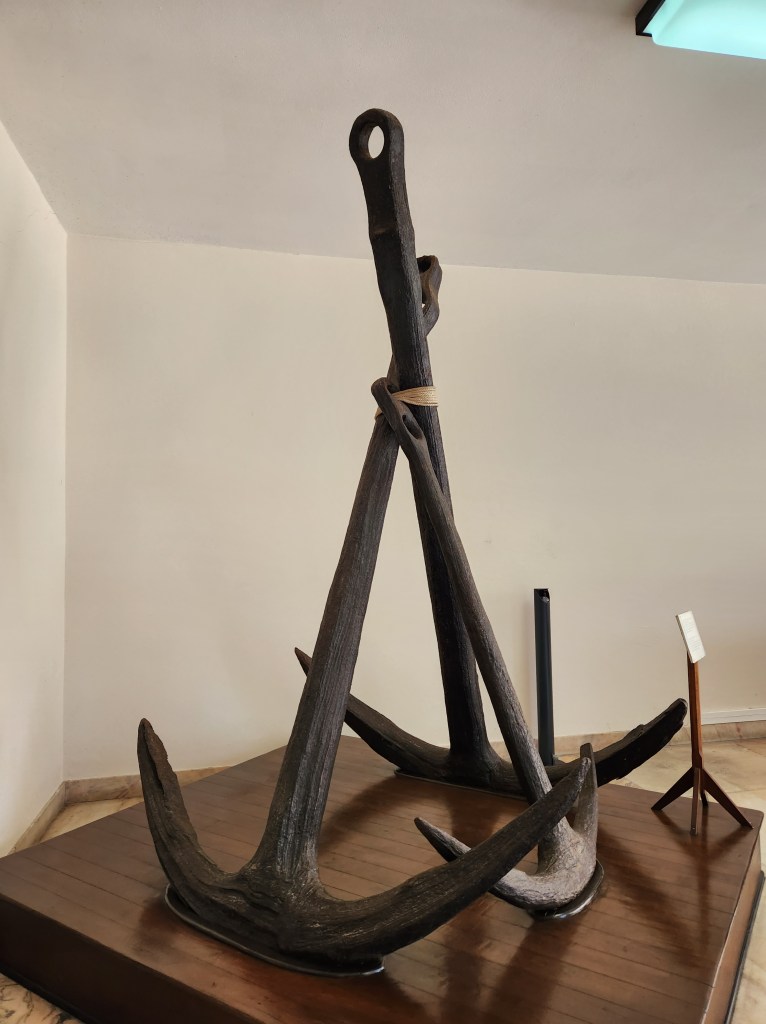
This fancy tilework is on the wall of a building where the LX Market, a craft and art market with some amazing booths, art galeries, and restaurants.Another big map that caused me some map envy. This map is in the entry to the Maritime Museum. The museum was very informative and fun.This is a navigation sphere, and representations of these appear all over Portugal.The cannons are both deadly and whimsically decorated.The museum houses many models of sailing vessels, showing the breadth of Portugese naval accomplishment.And a fair number of actual ship parts, not just the cannons.There is an entire wing to house various Royal Barges used in the river. Not quite as extensive as the Coaches Museum, but included is the barge used by the last King of Portugal. This barge was brought out to carry Queen Elizabeth on the river during her first Royal Visit in the 1950s.An impressive succulent growing in the botanical garden.A whimsical mauseleum in the Cemiterio de Prazeres. This cemetery is actually at the end of one of Lisbon’s iconic street car lines. Of course, we didn’t find this out until we had walked, uphill, of course, quite a distance from the train stop. The trolley ride back was fun, and the views from the cemetary were well worth it!
Lisbon has a lot going on, and this long post is just a small sampling of what we were able to do!
We stayed in Lisbon for several weeks over the holidays and happened upon a British born tour guide near our accommodations. We took several tours with him – you’ll hear more about that when I post about Lisbon (but we have a lot of photos and stories, so that one will take some time) – and one of the tours was Sintra. We started out bright and early, catching the first train from Lisbon to Sintra. We met our tour guide, Peter, at Rossio Station early enough that he was able to tell us about the history of the station and point out the beautiful stone carvings and decor. He also explained about how the statue featured in the front of the building was a recent reproduction because a few years ago some tourists, who clearly had enjoyed way too much Portuguese wine, had decided to climb up for a photo and managed to cause the statue to fall and break into many pieces. The original statue, of King Sebastion who was killed fighting in North Africa, dated back to the 1500s, so it was quite a shame to have some foolishness destroy it. Alas, it was cloudy and still dark when we met at the station, so I have no photos for this post, guess I’ll make a note to get a few on a future visit for a future post.
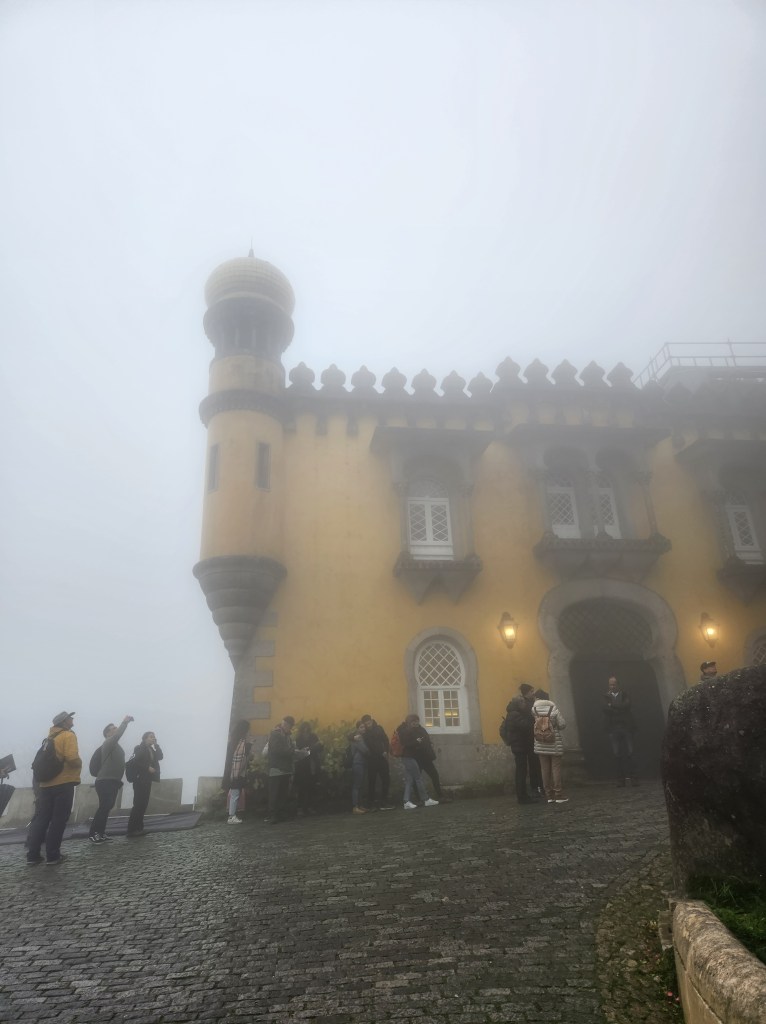
Our tour group consisted or our guide Peter and a lovely couple from Northern California. We spent the hour on the train learning about Sintra. We began with information about the Moors when they controlled this part of Portugal and the fortifications and outpost that was on the hillside. When the Portuguese and Crusaders from elsewhere in Europe approached the outpost one day in the 1100s, the soldiers garrisoned there realized how outnumbered they were and immediately surrendered the area. From here, King Alfonso and the Crusaders would carry on to Lisbon and lay siege to the main Moorish settlement and, ultimately, take Portugal from the Moors. Sintra still boasts significant Moorish remains and influences and was always an important place for the monarchs who ruled the country. In the 1800s, Queen Maria’s German husband, Prince Ferdinand II, designed Pena Palace, using remains of the much older convent on the sight. It is quite the building, incorporating many styles from the existing buildings and the new construction. The park it sits on is also renowned for great views, but on the day we were there it was shrouded in clouds – I guess we’ll have to go back some day!
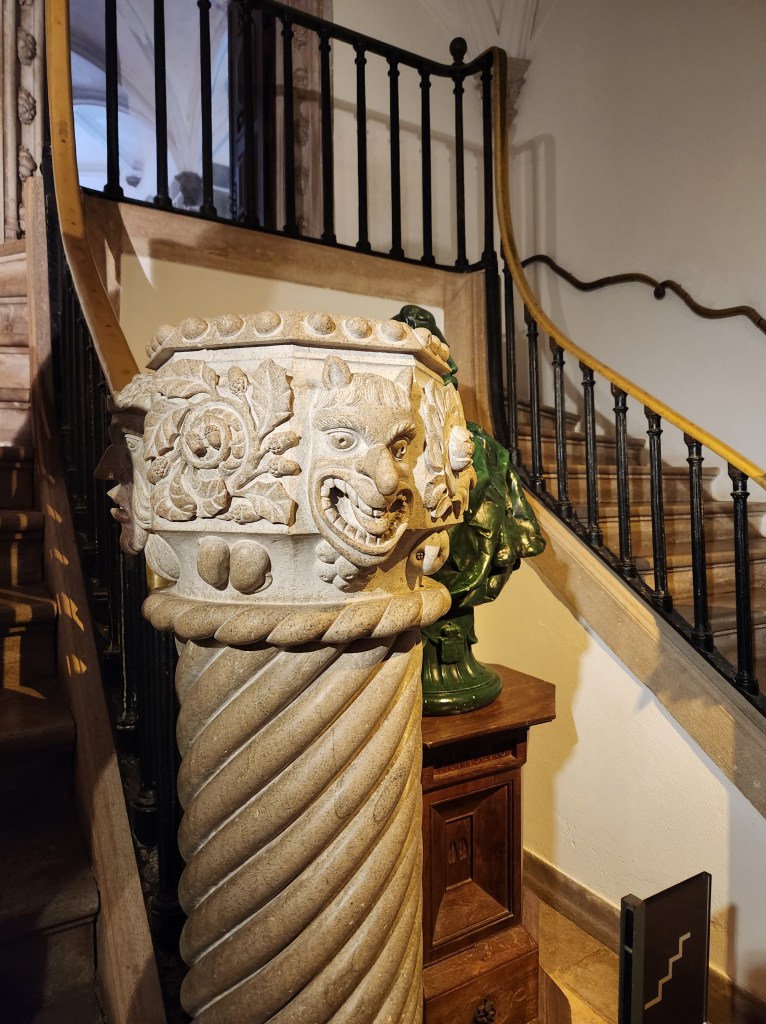
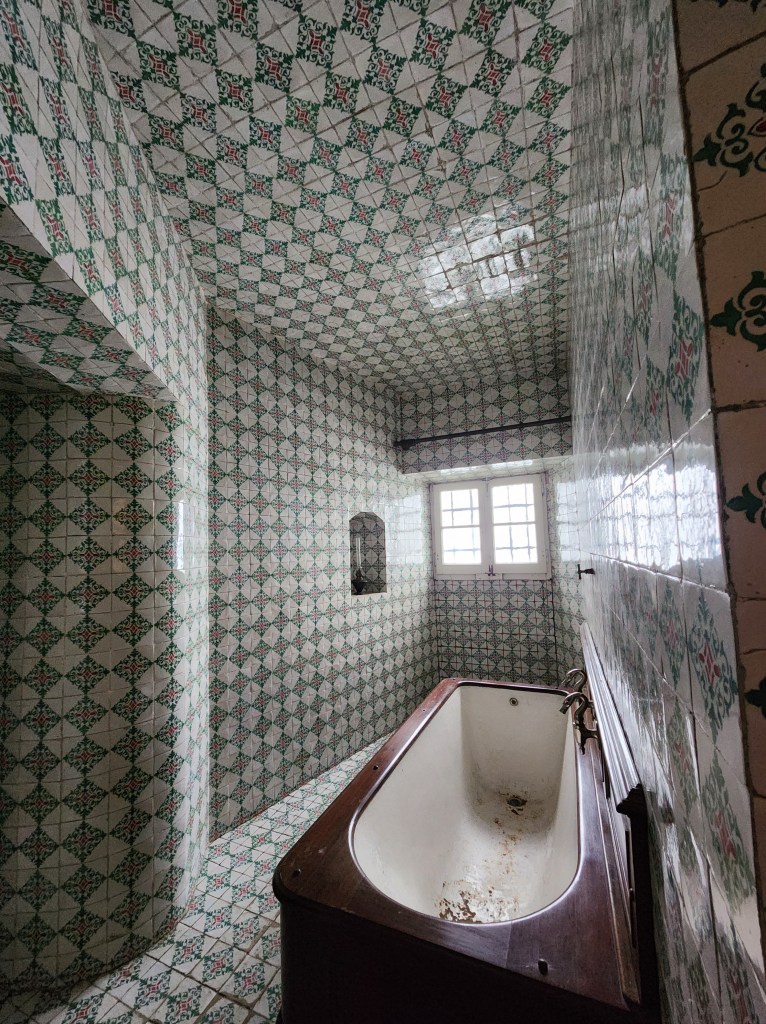
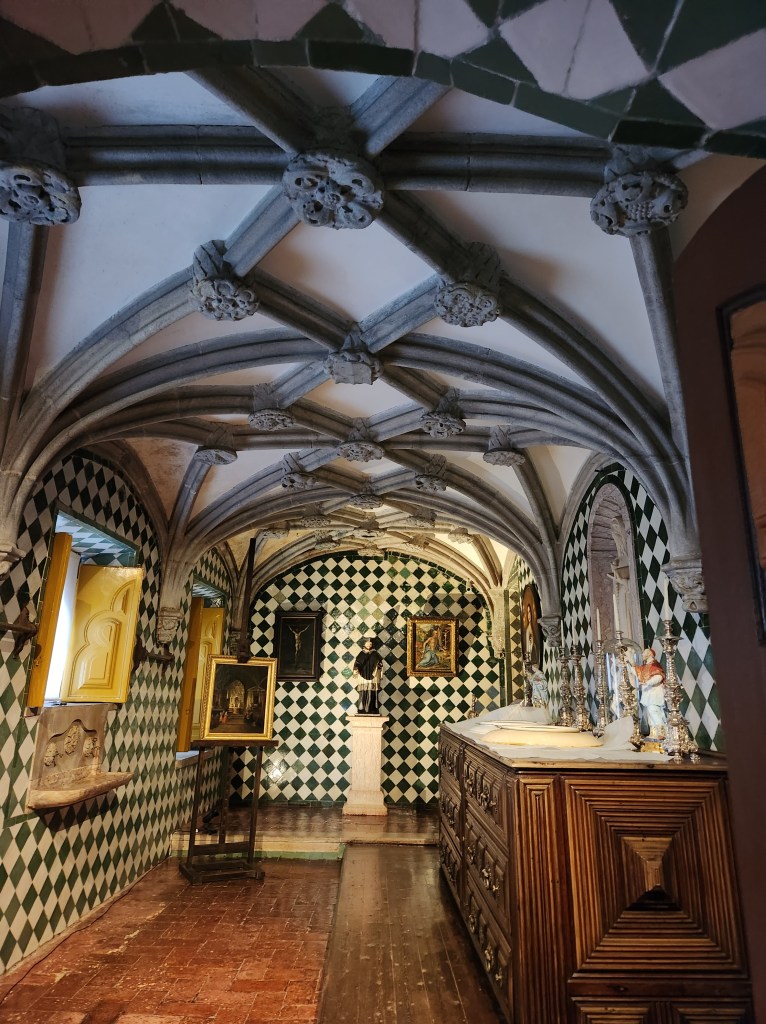
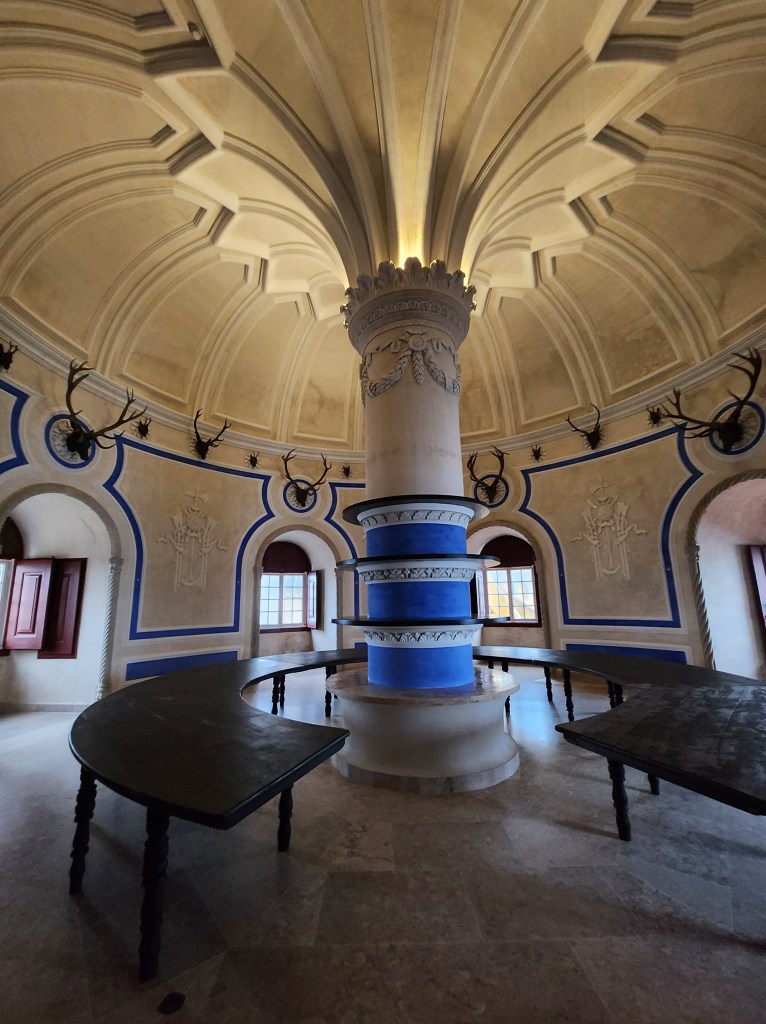
Approaching the Pena Palace. As you can see, it was a bit foggy and damp. We had timed tickets for the first entry of the day, and Peter said it was not crowded, but it was certainly a popular place. If you go, go as early as you can. Also, you need to enter the grounds a good 30 minutes before your ticket time, as there is a bit of a climb (or you can catch the paid shuttle) to the top from the ticket booth. It is also a bit of a climb from town. This is definitely one of those experiences that need to be planned in advance, there are some logistics that need to be taken into account. We appreciated having a tour guide, especially for such a small group.The entry gate, the Prince, part of the German Monarchy, had a very good sense of what it took to impress those in the exalted social and political circles they interacted with.The stone carvings scattered around the palace were impressive, and fun!I could probably do an entire post on the various ceilings, not just in the Palace, but all over Portugal.The bathing chamber for the Prince’s quarters. A sleeping chamber, this one is in part of the convent that was incorporated into the Palace. Again, notice the ceiling. The queen’s sleeping quarters and bed. The detail work on the furniture, walls, and ceiling really ups the luxury and wow factors for the space.Another elaborate room in what was the original convent, these areas of the palace are notable for the relatively small size of the rooms compared to what you might expect from such a luxurious Royal Residence of the period. A stained glass window.The “Stag Room” was used to host feasts. After our tour of the Palace we walked back down the hill toward town past the Moorish Castle and walls that remain. Because the cloud cover remained, we put touring this site on our “next time” list. The walk through the grounds is another highlight of a visit to Sintra, so when doing your planning remember your walking shoes!A fancy tower and roof as seen in town.
Sintra has been a favorite place for Portuguese Royalty since they defeated the Moors and took over the place. In addition to the Pena Palace, the city also boasts the National Palace, built on the foundation of a large Moorish building. Another grand building well worth a visit.
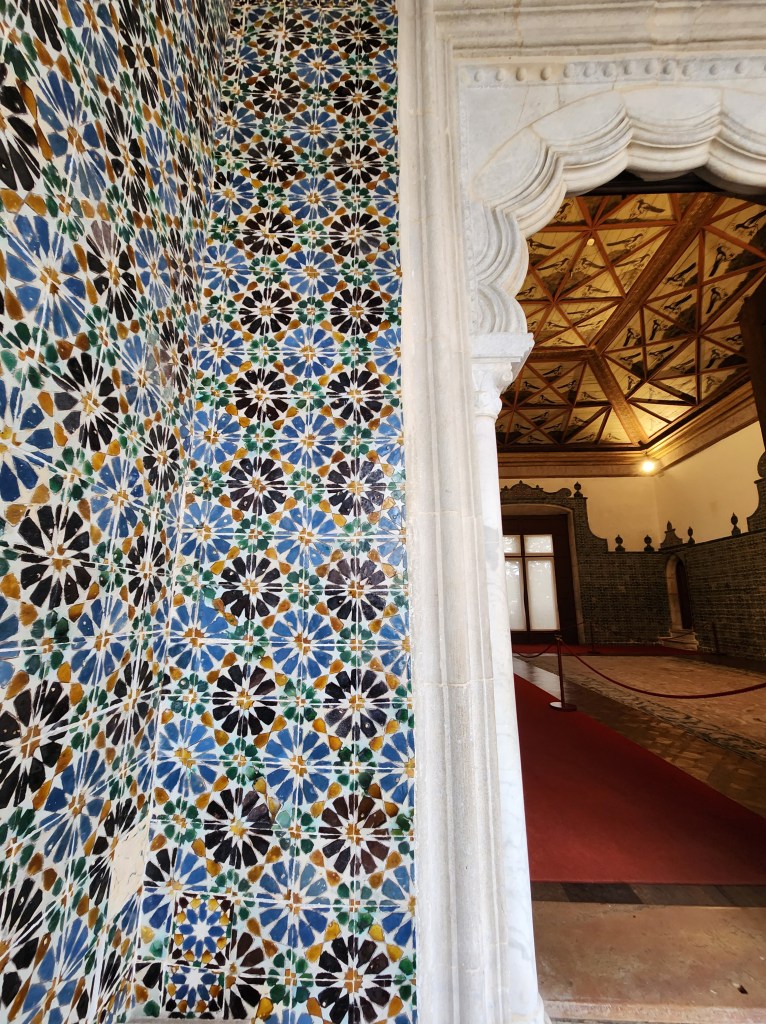
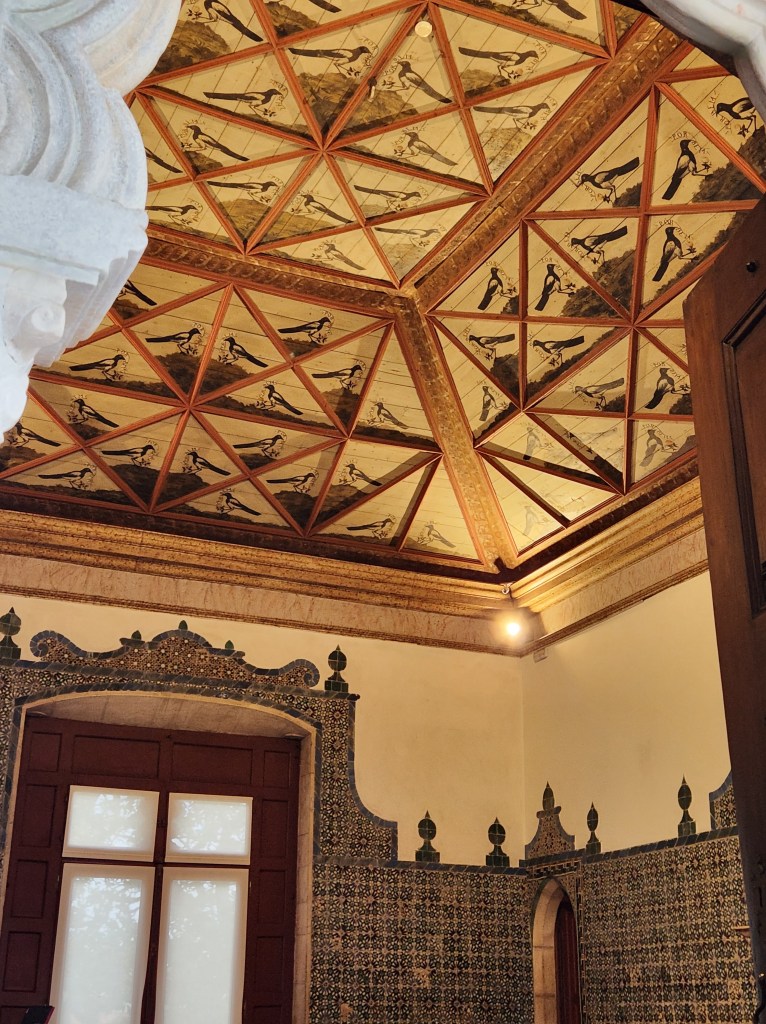
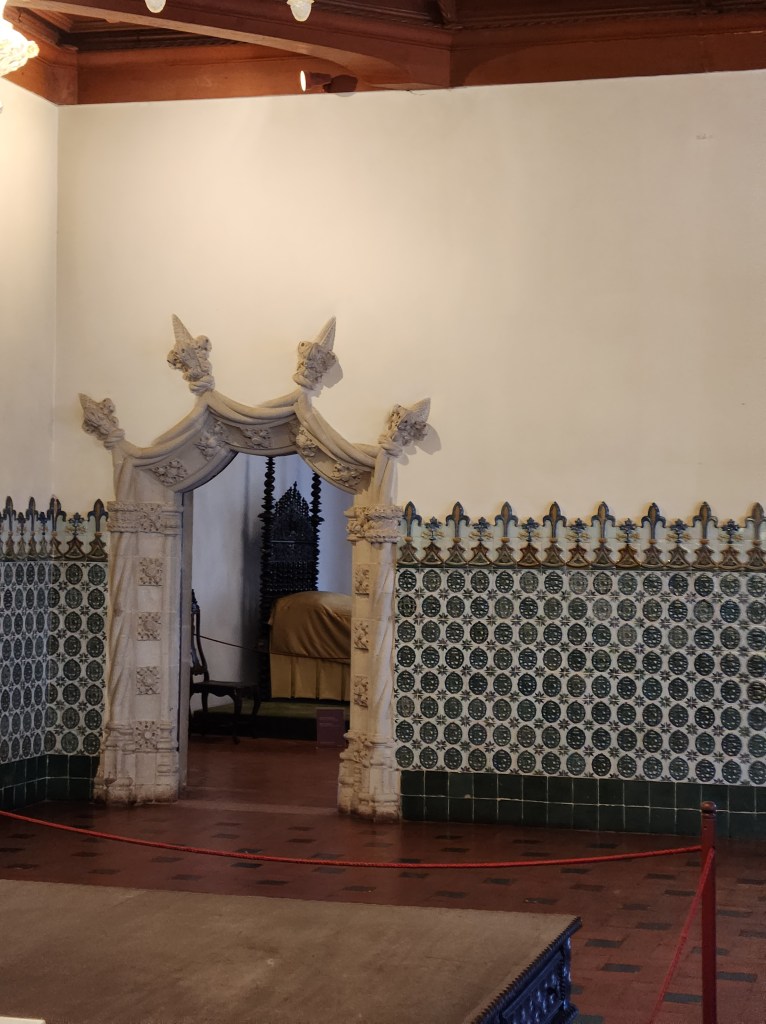
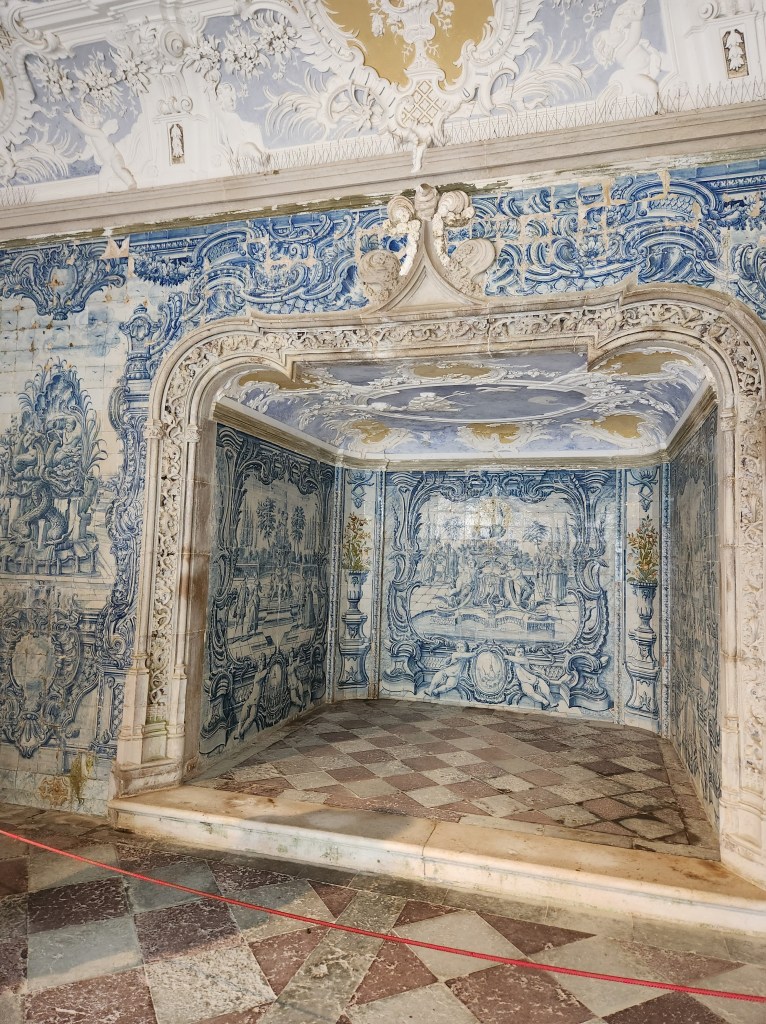
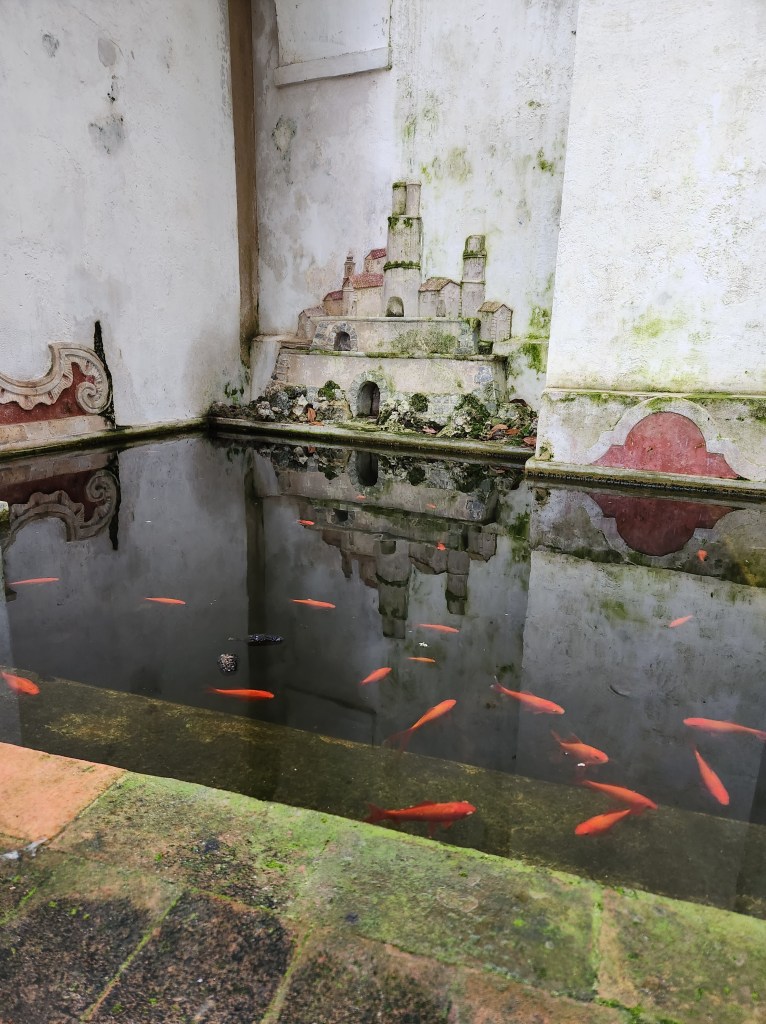
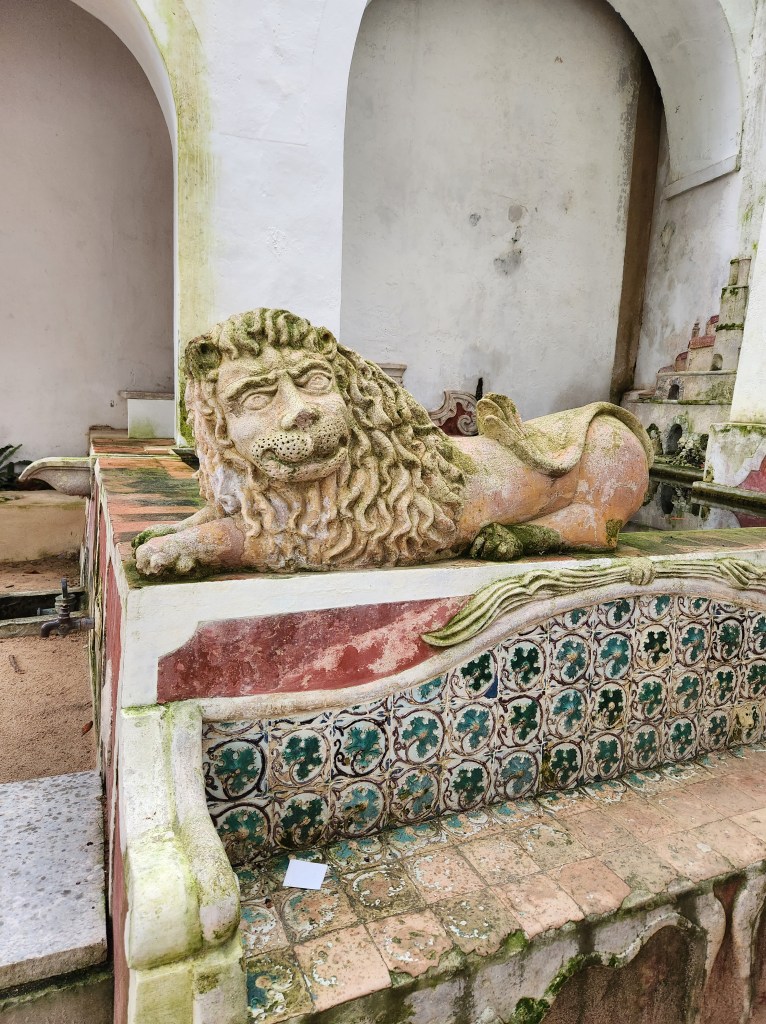
Sintra has both the Pena Palace and the National Palace. The National Palace is right in town and has history going back to the time the Moors were in charge. In fact, there are several Moorish influences still very visible in the Palace, like these tiles, which have vibrant colors and raised edges. You see this style of tile in lots of places and you see its influence lots of places.This large room had a Magpie motif on the ceiling and the story has it that King John I (1357-1433) had it painted as such after he was caught kissing a lady which caused the women of the court to chatter like magpies. This story does not appear on the “official” websites, but I am certain our tour guide was not sharing a story that had not been handed down based on some accurate recording of the King’s thoughts as the room was decorated. The room also had more lovely tile and an impressive fire place.Another room in the National Palace with more elaborate tiles and a very fancy door frame.This little alcove in the National Place has so many of the ornamental features that catch my eye: an elaborately carved frame, beautiful tiles and a decorated ceiling. A fountain on the palace grounds, with bright fish!I just like the look of this handsome fellow.
Because Sintra was where the Royals spent so much time the city has many large villas for the members of the court who moved around with the Kings and Queens. One of these is the Quinta da Regaleira, which has extensive grounds with many whimsical, and sometimes befuddling structures. The owner was a very wealthy Brazilian mining magnate who had a thing for secret societies, like the Freemasons, so not only is it very fancy, it also has grottos and caves on the grounds that could have been used for any number of rituals and activities.
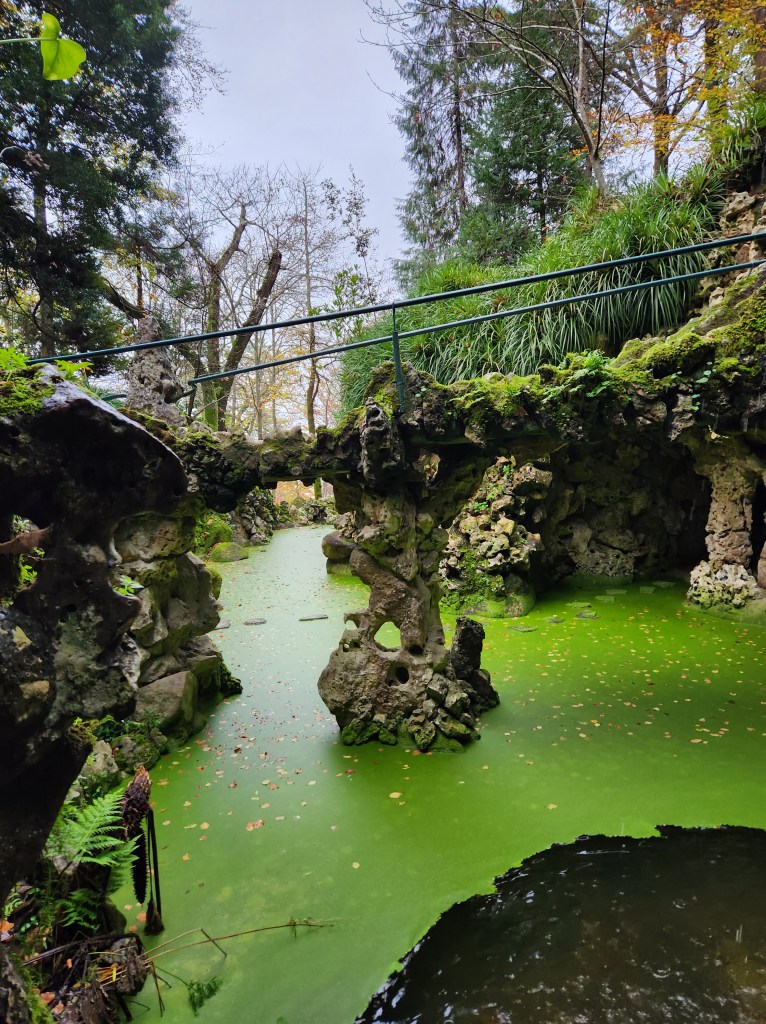
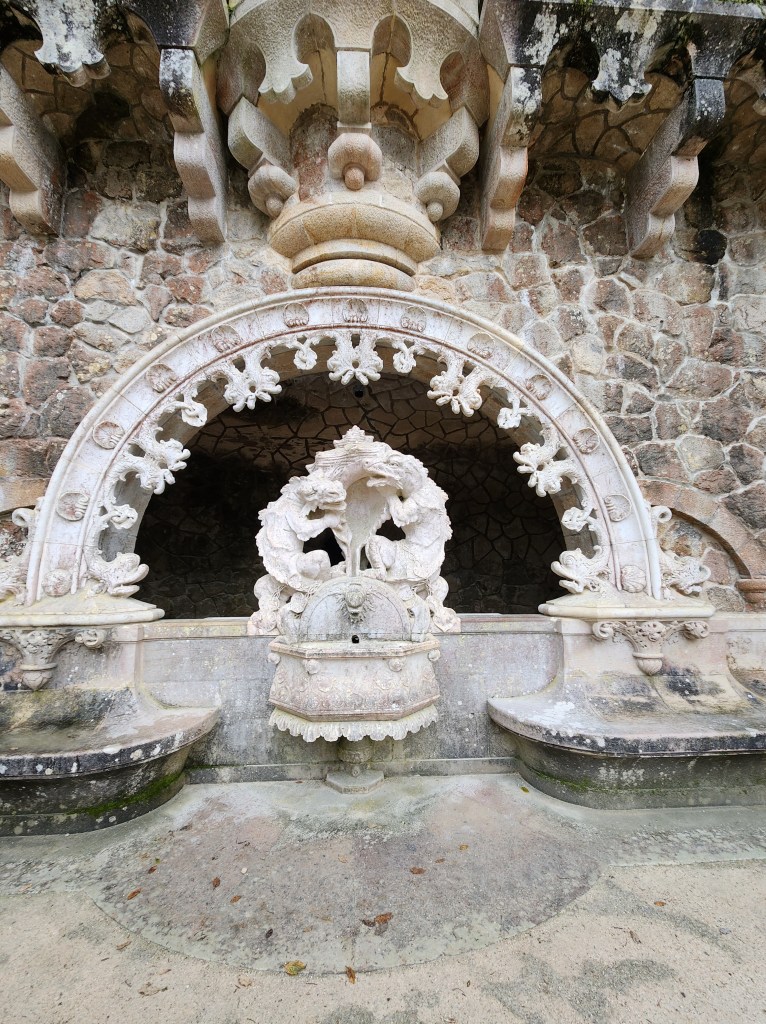
The main house, built in the early 1900s it has a lot of gothic style and incorporates the intricate carvings of the Manuelian style, which you see a lot in Portugal. There is an inverted tower on the grounds that lead down to some tunnels. It is not a well, and you can take the stone stairs down to the bottom.Looking up from the bottom of the tower.Inside the caves, these are not naturally occurring. There are several dead ends, but also a path out to a water feature.Looking out on the water feature from the cave.One of the more whimsical structures on the grounds.
We spent a good day in Sintra, and only scratched the surface. This is definitely one of those places that deserves the amount of tourism and attention it gets. We will likely make a few more trips here over the years to see more of sights and the area.
It is the big wave season and most of the top ten biggest waves surfed in the world have happened off the coast of Portugal in sight of the town of Nazare. There is a combination of topography, wind and ocean currents that create these big waves. It takes a big storm out at sea pushing the water toward a trench that funnels the water toward the beach where it pushes up and amplifies the “regular” wave action. Expert surfers from around the world come to surf these waves which require them to be towed out behind jet skis. There are not many days with the huge waves given the need for several factors to occur in just the right way to get the results. That said, none of those conditions were in place during the several days we were in Nazare. The water was calm, the winds mild and the town quiet. We enjoyed our stay and will try to be there for big waves on a future visit! One bartender did comment that lots of people come thinking the waves happen all of the time when in reality is a lot of waiting around for a few days with big waves.
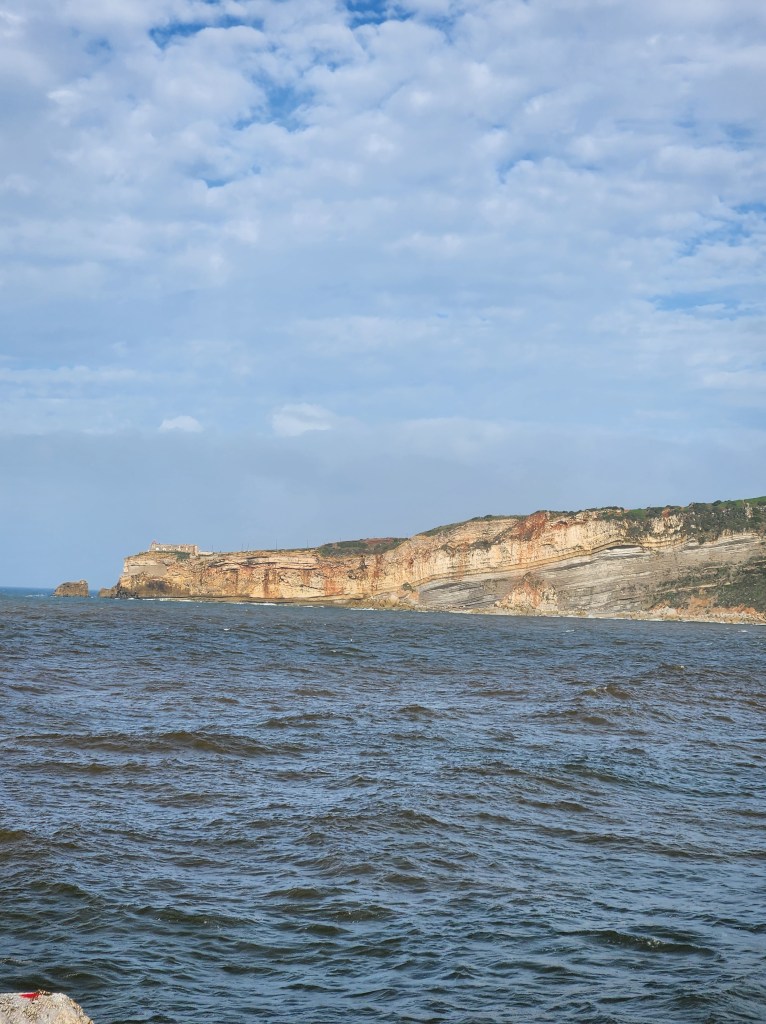
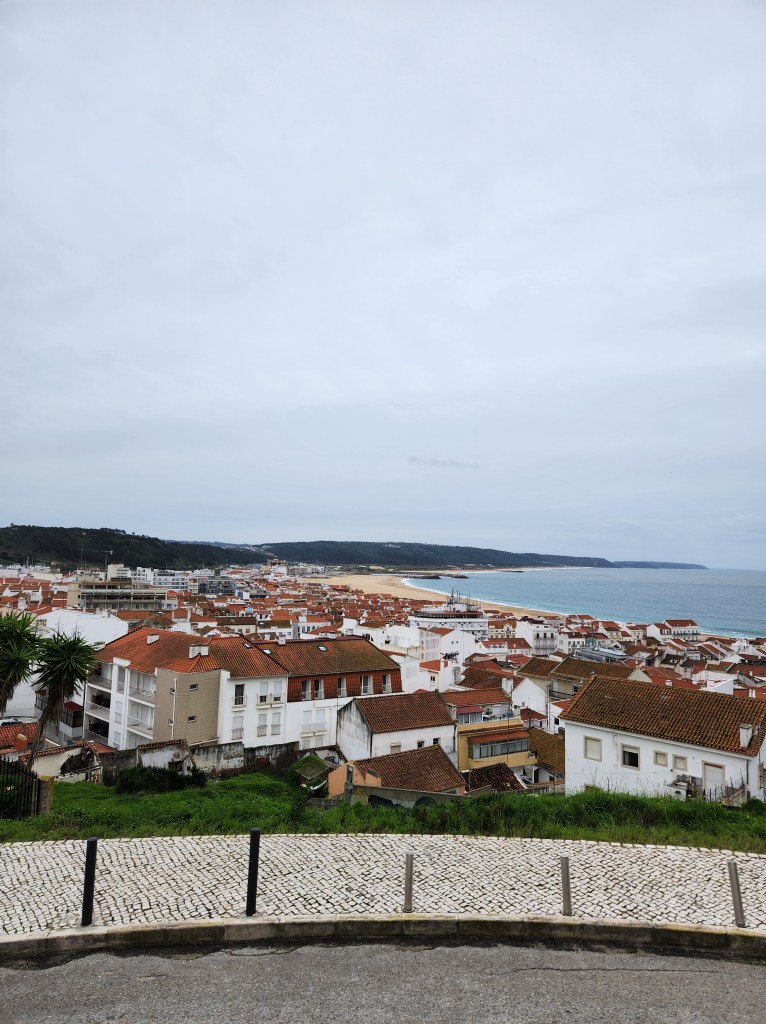
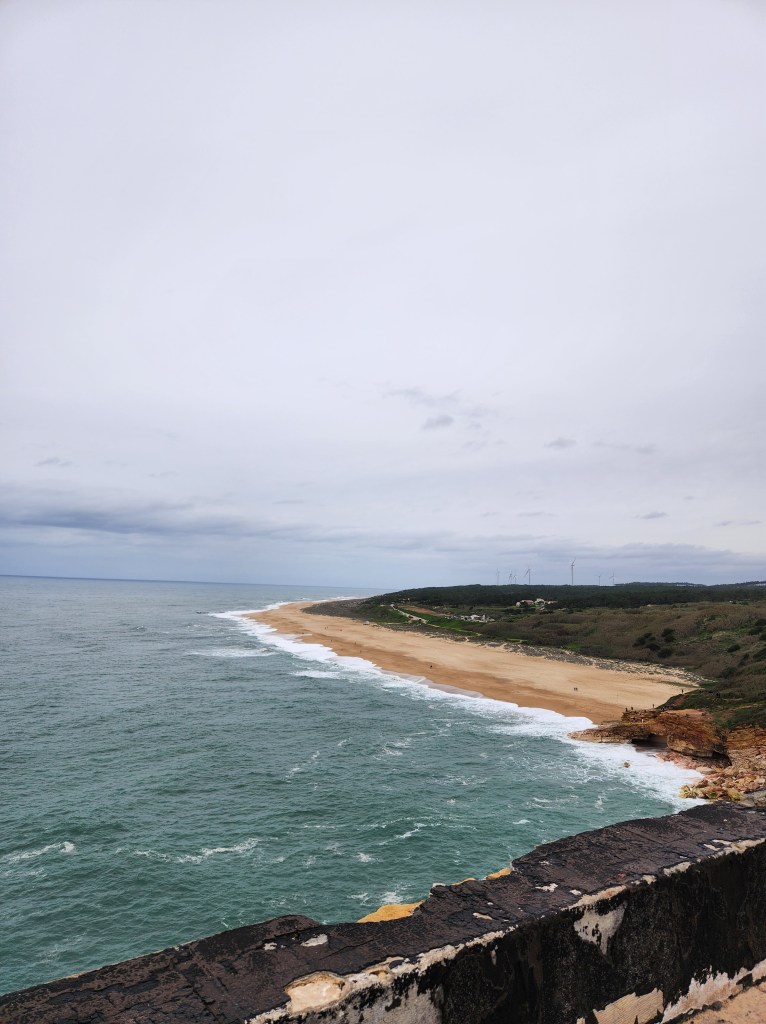
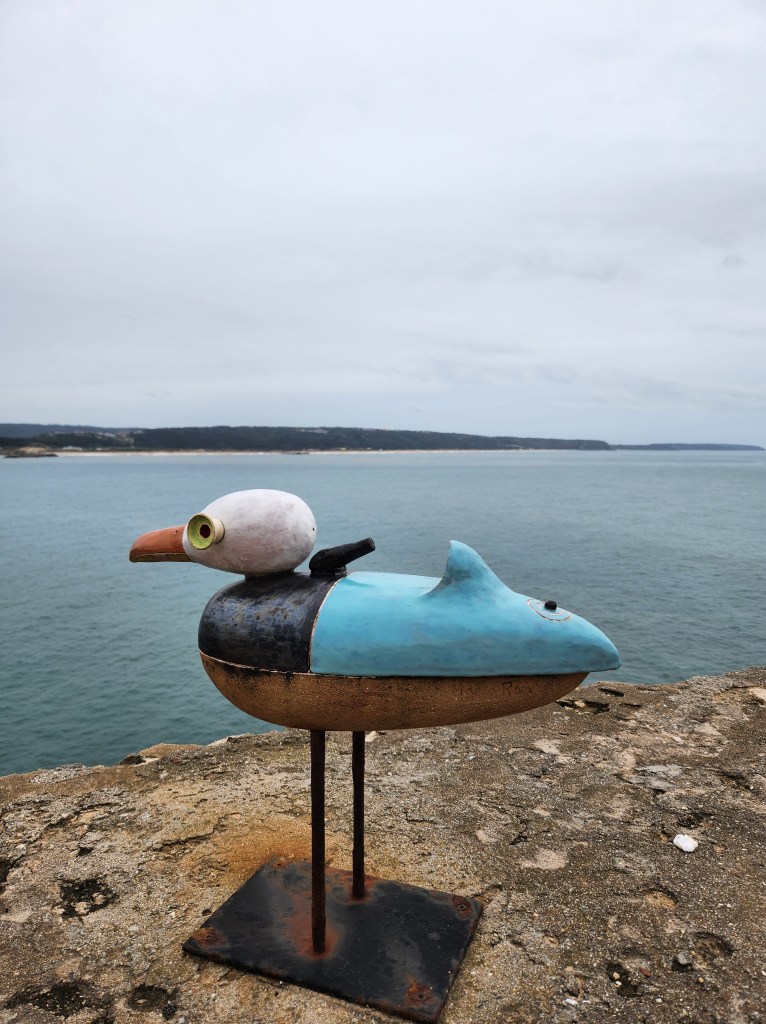
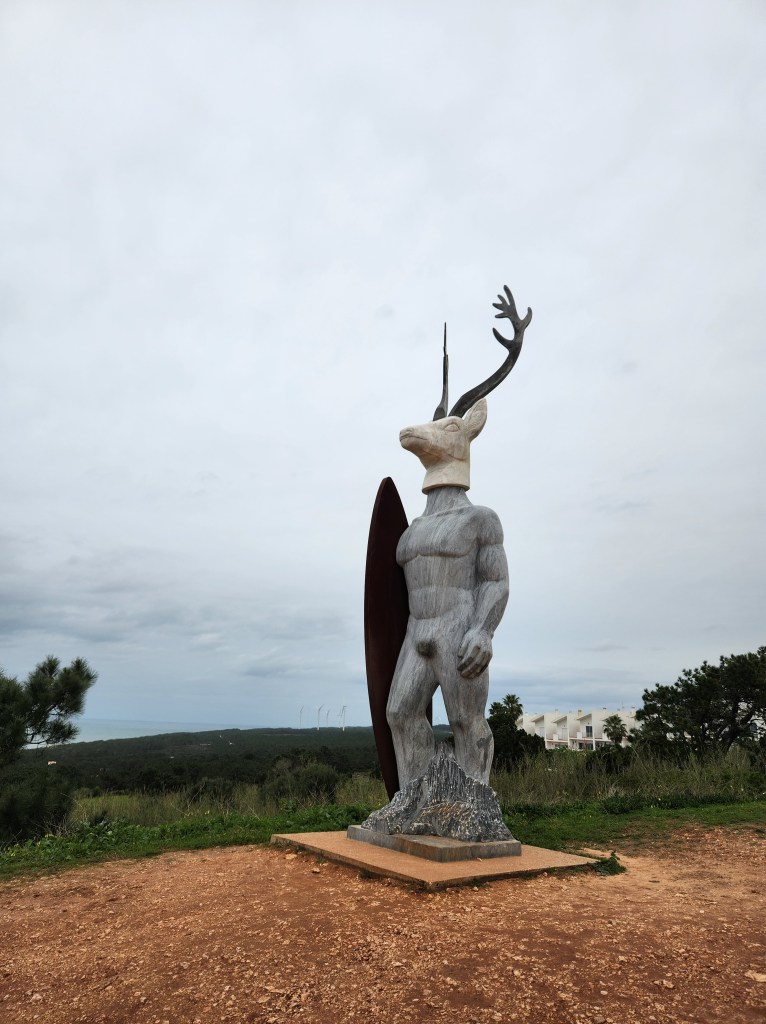
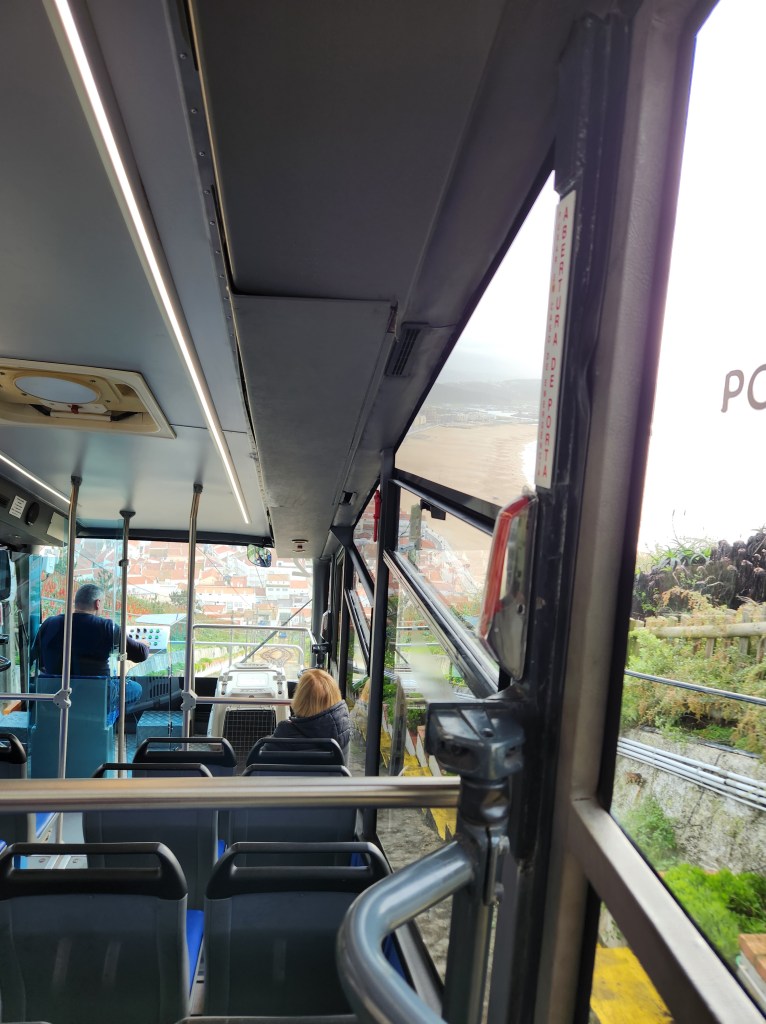
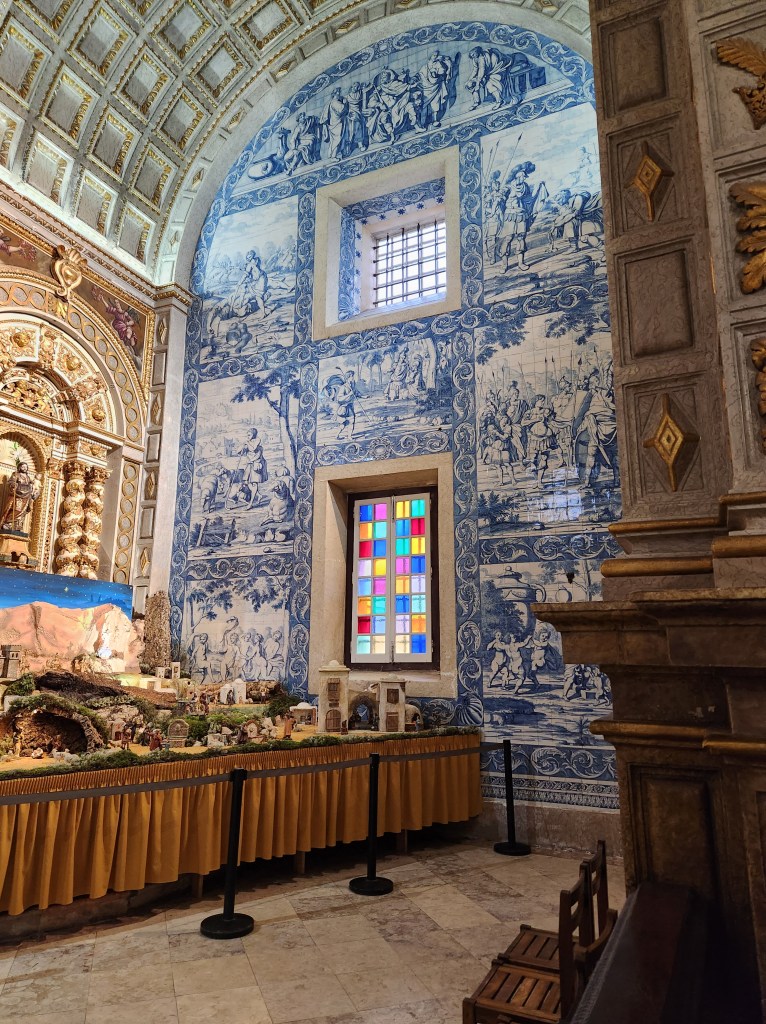
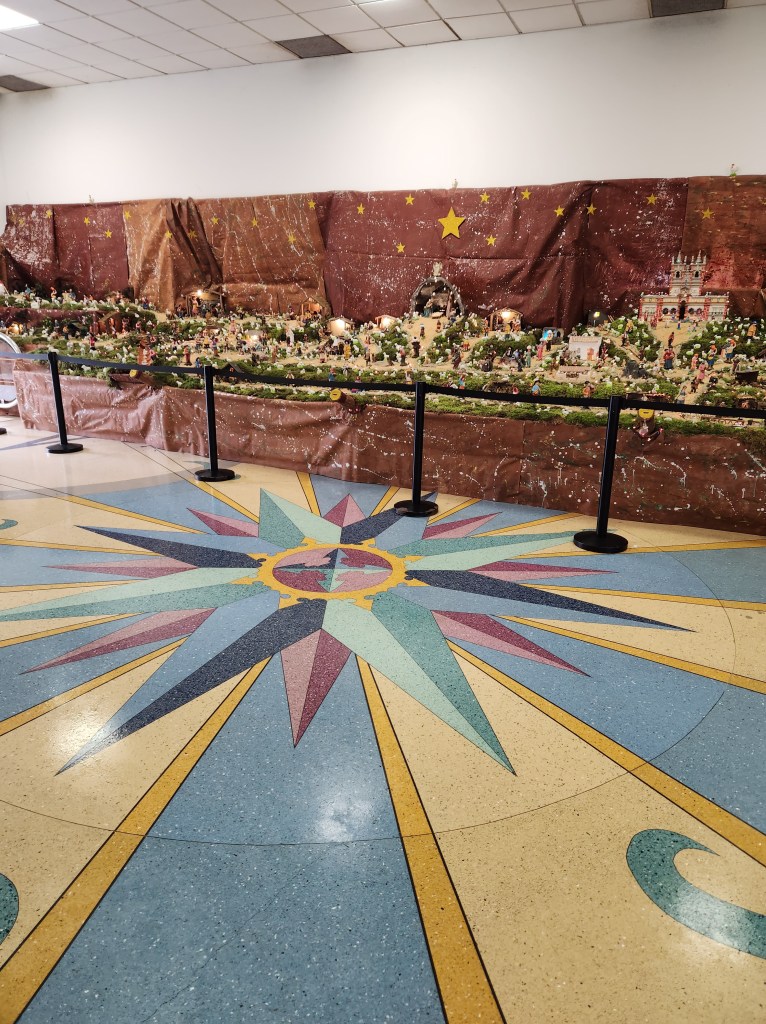
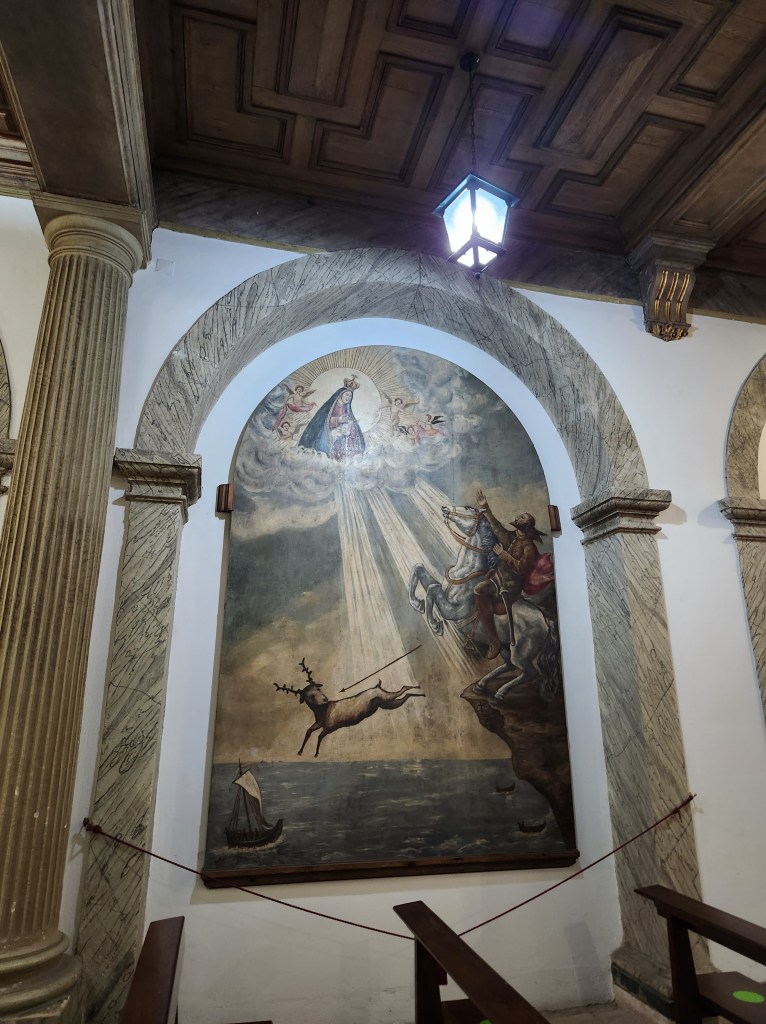
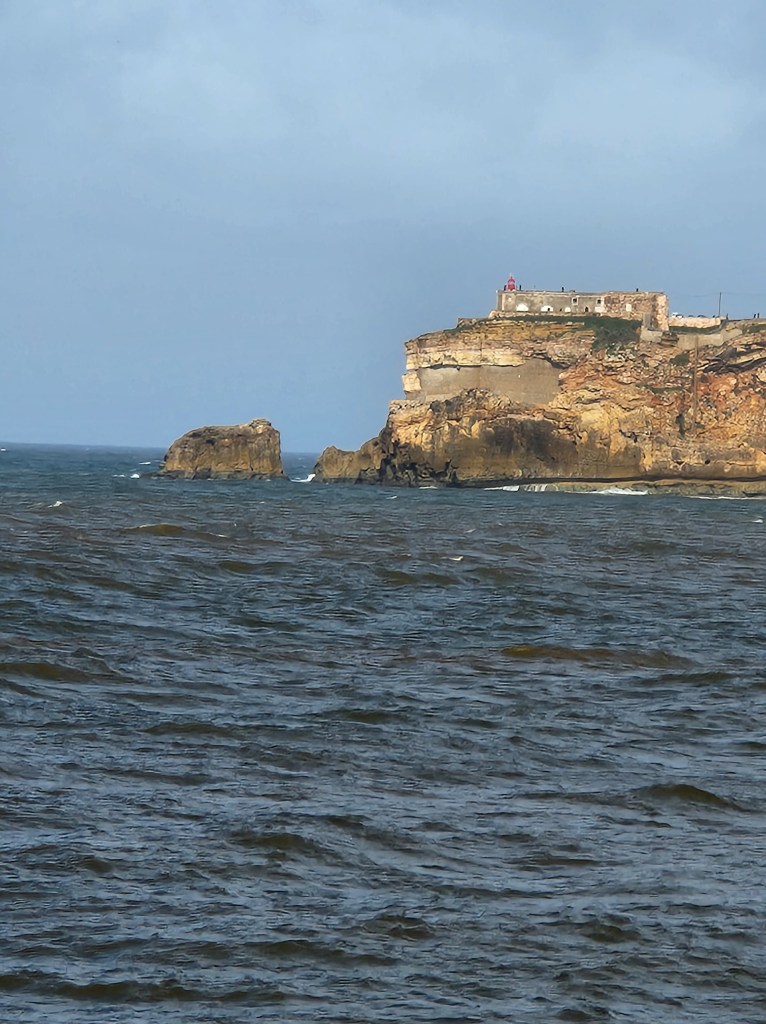
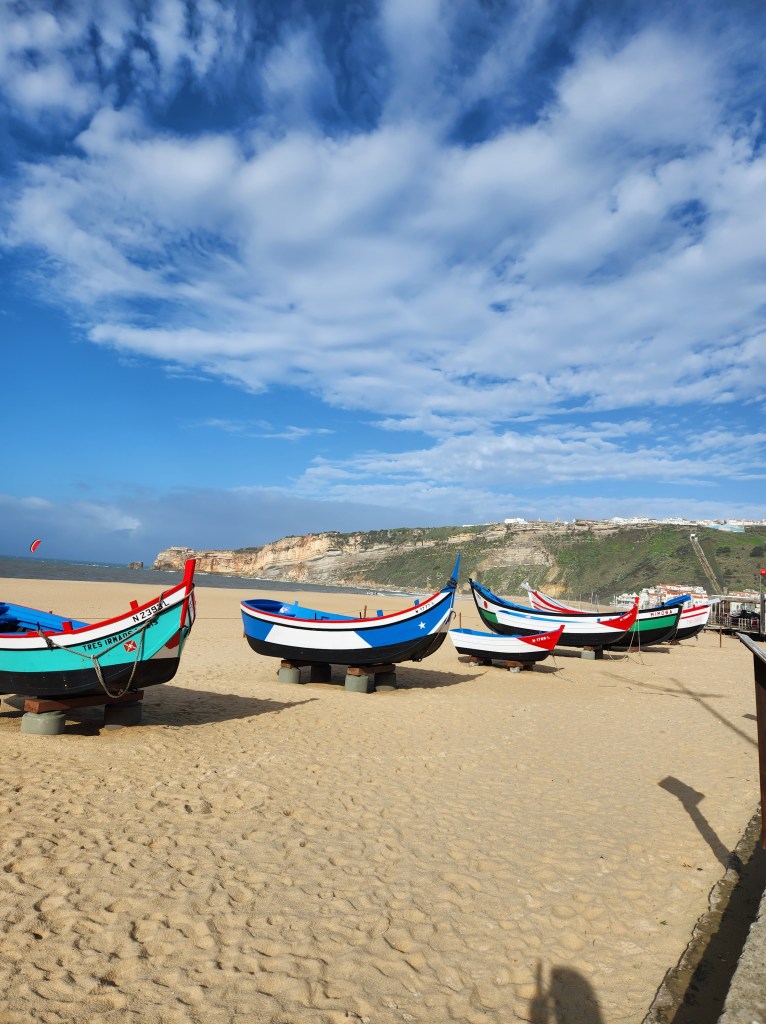
Nazare is a fishing village, and the town sits on a long, wide sandy beach that curves behind a cliff to the north. On the other side of the cliff is another beach where the big waves roll. The end of the cliff is the prime viewing spot for the waves.There is a nice path that allows you to climb to the top of the cliff, where the best views of the waves are. This is a view from about halfway up the trail.Looking down on the beach and town from the top of the trail. Yes, it was a pretty steep hike, but there were lots of great views, so it was a pleasant walk up.A view of the Praia do Norte – North Beach – from the fort, which is well situated for watching the action.The coastline between the beaches has some rocky areas that must help make the crashing waves all that much more impressive.The fort, in addition to being the prime viewing spot, also hosts exhibits, including a collection of these whimsical sculptures watching over the coastline.Legend has it that back in the Middle Ages a local noble was out hunting deer and got separated from the rest of the hunt in some fog. As he realized he was approaching the cliff at great speed, he called out a prayer and was able to avoid going over the cliff. It was attributed to the saint he called upon, who became the local patron saint. Not sure why the sure-footed horse he was riding was not given more credit. This story also has stags being a local symbol, and a sculpture combining the stag and the surfing culture sits atop the cliff with an excellent view.There is also a nice elevator – cable car – to get up and down the hill, so we took advantage of that for a repeat visit.The station for the elevator has some lovely tiles. We were here during the holidays and there was also a very impressive holiday display.In addition to the impressive holiday display, the floor of the elevator station is very nice. Portugal has so many things to love, the people, the food, the beautiful coastline, the tiles, the floors! I have so many photos of floors, ceilings and the paving tiles, they deserve their own post!At the top is another lovely neighborhood and it boasts a fancy church.An interior view of the church.The local huntsman and his trusty steed are memorialized in here as well.A close up of the fort and the cliff, which is rumored to be where the lost hunter avoided his plunge.Some colorful fishing boats on display. Nazare has a long history as a fishing village and proudly displays these traditional boats as part of their “living museum.” Shortly after we left the town I saw a news report that a small boat with five local fishermen aboard and run in to trouble and only one survivor had been found after the first day.


















































































 Oh Goody! An Adventure